
Spotted a bird? Identify it instantly with the Birdby app
Open the appAbout
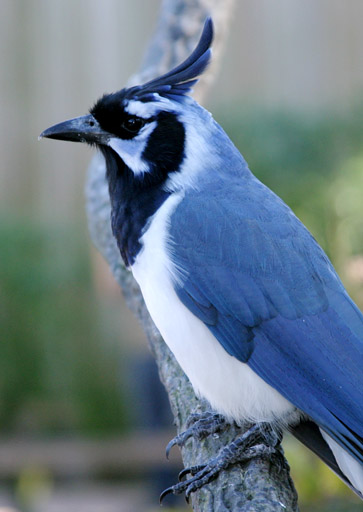
The Black-throated Magpie-Jay is a striking and highly vocal corvid known for its exceptionally long tail, prominent crest, and distinctive black and white plumage. It is a social bird, often found in small family groups or larger flocks foraging in the understory and mid-story of dry deciduous forests and thorn scrub.
Size & lifespan
- Length
- 58-76 cm (23-30 in), largely due to its tail
- Wingspan
- 30-36 cm (12-14 in)
- Weight
- 170-200 g (6.0-7.1 oz)
- Lifespan
- Typically 7-10 years in the wild, up to 15+ years in captivity.
- Diet
- Omnivorous, consisting mainly of insects (especially large beetles, grasshoppers, and caterpillars), other invertebrates, small vertebrates (lizards, snakes, eggs, and nestlings of other birds), fruits, berries, seeds, and nectar.
Physical characteristics
- Plumage
- Adults have a deep black head, throat, and breast, contrasting sharply with a bright white nape, collar, and underparts. The back and wings are a vibrant blue. The exceptionally long, graduated tail feathers are blue with broad white tips, becoming all black towards the base. A prominent, spiky crest on the forehead, also black, is a key feature.
- Beak shape
- Stout, conical, and sharp, typical of corvids, colored black.
- Eye color
- Dark brown.
- Leg color
- Dark gray to black.
- Distinguishing features
- Its most distinguishing features are the very long, graduated blue and white tail, the prominent black crest, and the stark black bib contrasting with the white nape and underparts. The body color is primarily blue on the back and wings.
- Juvenile appearance
- Juveniles are similar to adults but have a shorter crest, a duller blue coloration on the back, and a shorter tail. The black on the head and throat may appear more brownish or mottled, and the white areas can sometimes be tinged buffy.
- Seasonal changes
- No significant seasonal plumage changes. Plumage remains consistent year-round, though wear and tear can make feathers appear duller before molting.
- Sexual dimorphism
- Males and females are visually similar in plumage and size. Field identification of sex is generally not possible based solely on appearance.
How to identify
- 1
Long Tail
The exceptionally long, graduated blue and white tail is unmistakable, often longer than the body itself. This is the first and most obvious field mark.
- 2
Black Crest
A prominent, spiky black crest on the forehead is distinctive and rarely seen in other jays in its range.
- 3
Black Bib
The deep black coloration on the head, throat, and upper breast forming a 'bib' contrasts sharply with the white nape and underparts. This separates it clearly from the similar White-throated Magpie-Jay.
- 4
Blue Back and Wings
The vibrant blue plumage on its back and wings is a consistent characteristic. Observe this color in good light.
- 5
Vocalizations
Listen for its varied and often loud calls, including harsh squawks, chattering, and clear whistles. They are often heard before they are seen.
Habitat & range
- Biomes
- Dry tropical and subtropical forests, thorn scrub, forest edges, savannas, and sometimes agricultural areas with scattered trees.
- Geographic range
- Endemic to western Mexico, ranging from southern Sonora through Sinaloa, Nayarit, Jalisco, Colima, Michoacán, and Oaxaca.
- Elevation range
- Primarily found from sea level up to approximately 1500 meters (4900 feet).
- Preferred environments
- Prefers arid and semi-arid deciduous forests, mesquite woodlands, and thorn forest, often near human habitation or disturbed areas where food is readily available. They are less common in dense, undisturbed primary forest.
Behavior
- Activity time
- Diurnal, active during daylight hours.
- Feeding habits
- Forages mainly in the mid-story and understory, but will also descend to the ground or ascend to the canopy. They glean insects from foliage and bark, probe crevices, catch flying insects, and search for fruits and seeds. They are known to raid nests for eggs and nestlings.
- Social behavior
- Highly social birds, typically found in family groups of 3-10 individuals, sometimes congregating into larger flocks of up to 20 or more outside the breeding season. They are very vocal and communicate frequently with each other.
- Flight pattern
- Flight is strong and undulating, especially noticeable with their long tails, which often stream behind them. They can be quite agile through dense vegetation despite their size.
- Migration pattern
- Resident and non-migratory throughout its range.
- Territoriality
- Family groups maintain territories, especially during the breeding season, defending them against conspecifics and other potential threats. They can be quite aggressive in territorial disputes.
Song & calls
- Song
- Possesses a complex and varied repertoire, including clear whistles, harsh squawks, chattering calls, and mimicry of other bird species. Their vocalizations are often melodious but can also be quite raucous.
- Call
- Common calls include harsh, grating 'kraah-kraah', rattling 'churrr', and various clear, ringing whistles such as 'wheeoo'. They also produce a distinctive 'kwee-oooo' call.
- When they vocalize
- Highly vocal throughout the day, especially active and noisy during dawn and dusk, and when foraging in groups or defending territory.
Breeding & reproduction
- Breeding season
- Typically occurs between April and July, with the peak often in May and June, coinciding with the rainy season and increased insect abundance.
- Nesting habits
- Nests are large, bulky structures made of sticks, twigs, and thorny branches, lined with finer materials like rootlets, plant fibers, and sometimes mud. They are usually placed high in thorny trees or dense shrubs.
- Clutch size
- Usually 3-5 eggs, occasionally 2 or 6.
- Egg description
- Eggs are typically pale blue or greenish-blue, heavily spotted and blotched with various shades of brown, often concentrated at the larger end.
- Incubation period
- Approximately 18-20 days, primarily by the female, though the male may provide food.
- Fledging period
- Nestlings fledge in about 21-26 days after hatching. Young birds remain dependent on their parents and family group for an extended period after fledging.
- Parental care
- Both parents participate in nest building, incubation (female predominantly), and feeding of the young. Cooperative breeding has been observed, where subadults from previous broods assist in raising the current nestlings.
Where to find
Dry Deciduous Forests
Look in the mid-story and edges of dry deciduous forests, especially those with thorny trees and shrubs.
Thorn Scrub
Common in dense thorn scrub habitats, where they find both food and nesting sites.
Forest Edges and Riparian Zones
Often found along the edges of forests, near clearings, or in gallery forests along rivers and streams.
Cultivated Areas
Can be observed in agricultural fields with scattered trees, orchards, and rural gardens.
Field tips
- Listen for calls. Black-throated Magpie-Jays are very vocal. Learning their diverse calls will often lead you to their location before you spot them.
- Scan the mid-story. They frequently forage in the middle layers of vegetation but also visit the ground and canopy. Look for movement and flashes of blue, black, and white.
- Look for groups. These are social birds. If you find one, there are likely others nearby, often moving together noisily through the trees.
- Visit appropriate habitat. Focus on the dry, open woodlands and thorn scrub of western Mexico, avoiding dense, humid forests where they are generally absent.
Similar species
White-throated Magpie-Jay
Calocitta formosa
The White-throated Magpie-Jay (C. formosa) has an entirely white throat and breast, lacking the extensive black bib present in the Black-throated Magpie-Jay. Its crest is also typically less spiky and consists of shorter, more erectile feathers.
Purplish-backed Jay
Cyanocorax beecheii
While also a jay found in western Mexico, the Purplish-backed Jay lacks the extremely long tail and prominent crest of the Black-throated Magpie-Jay. It has entirely black underparts, a shorter tail, and a purplish-blue back. It also typically has a yellow eye.
Quick facts
- Distinctive Feature:
- Extremely long, blue and white tail and prominent black crest.
- Social Behavior:
- Highly social, found in family groups or larger flocks.
- Diet:
- Omnivorous, preying on insects, small vertebrates, fruits, and seeds.
- Vocalizations:
- Loud, varied, and includes whistles, squawks, chattering, and mimicry.
- Geographic Range:
- Endemic to western Mexico.
Fun facts
- The Black-throated Magpie-Jay's scientific name 'colliei' honors naturalist Alexander Collie.
- Its exceptionally long tail, which can be twice the length of its body, is among the longest relative to body size in any corvid species.
- These intelligent birds are known for their ability to mimic the calls of other bird species, adding to their complex vocal repertoire.
- They are often seen 'anting,' a behavior where they rub ants on their feathers, thought to help remove parasites or soothe skin irritations.
Scientific classification
- Kingdom
- Animalia
- Phylum
- Chordata
- Class
- Aves
- Order
- Passeriformes
- Family
- Corvidae
- Genus
- Calocitta
- Species
- C. colliei
Explore the Black-throated Magpie-Jay
Identify birds anywhere
Free on iOS, Android, and Web. Photo & sound identification, full species database, and your personal life list.