
Spotted a bird? Identify it instantly with the Birdby app
Open the appAbout
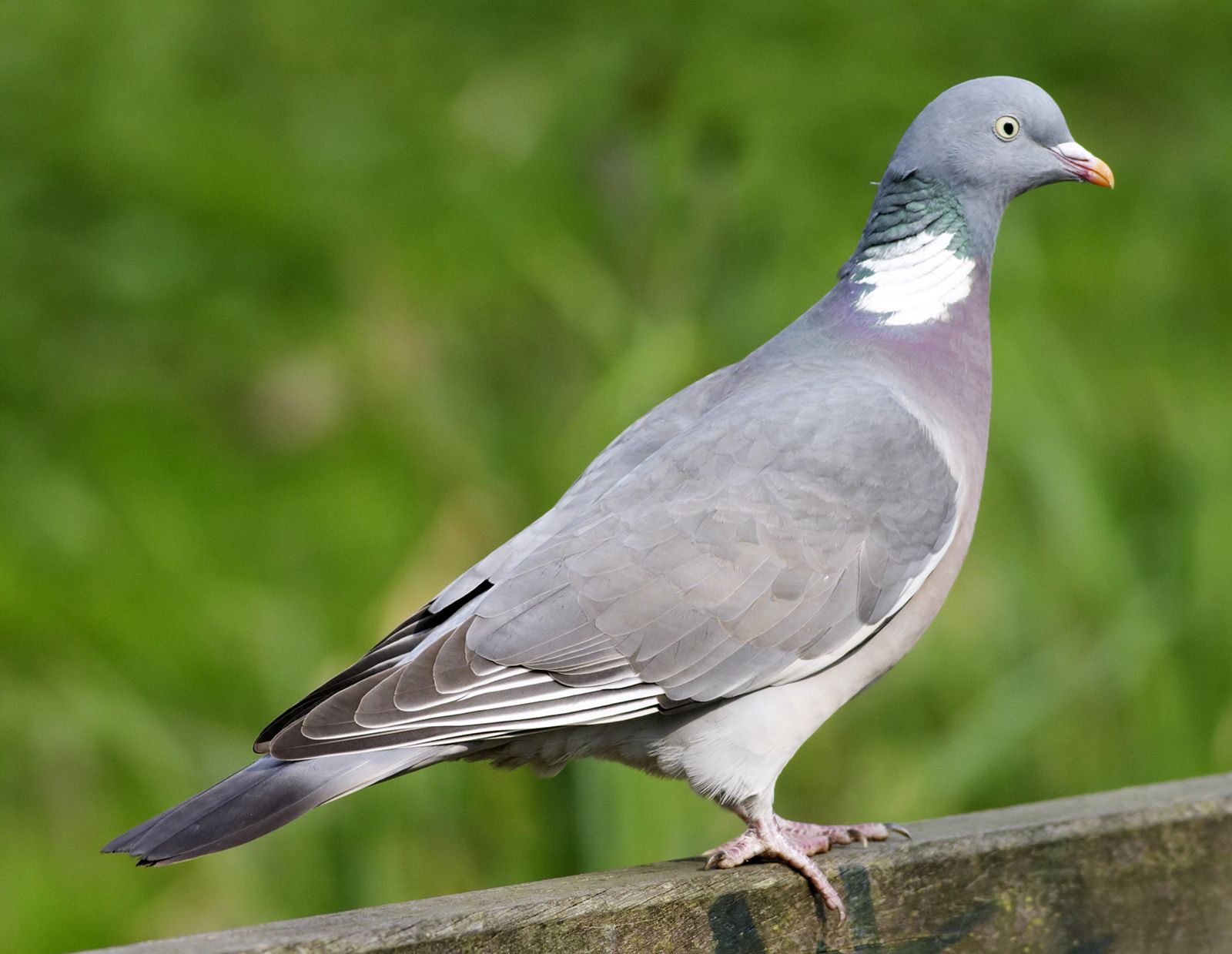
The Wood Pigeon is the largest and most common pigeon species in Europe, characterized by its robust build, grey plumage, and distinctive white neck patches and wing bars. It is a highly adaptable species, thriving in a variety of habitats from woodlands to urban parks and gardens.
Size & lifespan
- Length
- 38-43 cm
- Wingspan
- 68-80 cm
- Weight
- 300-615 g
- Lifespan
- Up to 17 years in the wild, typically 3-5 years
- Diet
- Herbivore (primarily granivorous and frugivorous)
Physical characteristics
- Plumage
- Adults have a predominantly grey body, with a pinkish-purple wash on the breast. The head is grey, often with a greenish-purple iridescent sheen on the nape. A prominent white patch on each side of the neck is a key identification feature. The wings are grey with a distinct white bar visible in flight and at rest. The tail is grey with a broad black terminal band. The undertail coverts are white.
- Beak shape
- Relatively small, slender bill, pinkish-red at the base fading to yellow at the tip.
- Eye color
- Pale yellow
- Leg color
- Reddish-pink
- Distinguishing features
- Large size, white neck patches (absent in juveniles), and prominent white wing bars are the most reliable field marks.
- Juvenile appearance
- Juveniles lack the white neck patches and the iridescent sheen on the neck. Their plumage is duller grey, and the breast has less pinkish wash. The bill is greyish, and the legs are duller pink. The white wing bar is present but may be less distinct.
- Seasonal changes
- No significant seasonal plumage changes. Plumage remains consistent year-round.
- Sexual dimorphism
- Males and females are generally monomorphic in plumage, though males may be slightly larger and have more intense iridescence on the neck.
How to identify
- 1
Size and Shape
Look for a large, plump pigeon with a relatively small head and long tail. It's noticeably larger than other common pigeons and doves.
- 2
Plumage - Neck Patches
Adults have prominent white patches on the sides of the neck. This is the most reliable field mark for adults. Juveniles lack these.
- 3
Plumage - Wing Bars
A distinct white bar across the middle of the wing is visible both at rest and especially in flight. This contrasts with the grey wing.
- 4
Breast Color
The breast often has a pinkish-purple wash, which can be quite striking in good light.
- 5
Flight
Listen for the loud clatter of wings on take-off. Their flight is strong and direct, often with glides.
- 6
Call
Learn its distinctive five-note cooing song ('hoo-hrooo-hoo-hoo-hoo'), which is a common sound in many habitats.
Habitat & range
- Biomes
- Temperate forests, woodlands, agricultural land, urban and suburban areas, parks, gardens.
- Geographic range
- Widespread across Europe, North Africa, and western Asia. Introduced to New Zealand.
- Elevation range
- Sea level up to 2,000 meters, occasionally higher in mountainous regions.
- Preferred environments
- Deciduous and mixed woodlands, parks, large gardens, farmland with scattered trees, and increasingly urban environments where food and nesting sites are abundant.
Behavior
- Activity time
- Diurnal
- Feeding habits
- Primarily ground feeders, foraging for seeds, grains, buds, shoots, berries, and fruits. They can also feed in trees. They are particularly fond of acorns, beech mast, and agricultural crops like oilseed rape and cereals. They will also consume invertebrates, especially during breeding season.
- Social behavior
- Highly gregarious, especially outside the breeding season, forming large flocks that can number in the thousands, particularly when feeding on agricultural land or roosting. During the breeding season, they are more territorial and often seen in pairs.
- Flight pattern
- Strong, direct flight with powerful wing beats. Often takes off with a characteristic loud clatter of wings. Glides on stiff wings, especially when descending.
- Migration pattern
- Resident in much of its range, particularly in Western and Southern Europe. Northern and Eastern European populations are partially migratory, moving south and west for the winter. Migratory movements are often observed in large flocks.
- Territoriality
- During the breeding season, males establish and defend a nesting territory, primarily through vocalizations and display flights. Outside of breeding, they are less territorial.
Song & calls
- Song
- The song is a characteristic five-note cooing phrase, often transcribed as 'hoo-hrooo-hoo-hoo-hoo'. The first note is often emphasized, and the last three are softer and run together. It is a deep, resonant sound.
- Call
- A loud, clattering wing noise on take-off. Alarm call is a sharp 'roo-hoo'. Display call is a deeper, more drawn-out version of the song.
- When they vocalize
- Most vocal during the breeding season (spring and summer), but can be heard year-round, especially on sunny days.
Breeding & reproduction
- Breeding season
- Typically March to September, but can extend into winter in mild climates or urban areas, allowing for multiple broods (2-4 per year).
- Nesting habits
- Nests are flimsy platforms of twigs, often built in the fork of a tree or dense shrub, usually 2-15 meters above the ground. They may also use old nests of other birds. Nests are often reused.
- Clutch size
- Typically 2 eggs
- Egg description
- Two pure white, elliptical eggs, smooth and non-glossy.
- Incubation period
- 16-17 days, incubated by both parents.
- Fledging period
- 28-35 days. Young are fed 'pigeon milk' (crop milk) by both parents initially, then regurgitated seeds and fruits.
- Parental care
- Both parents share incubation duties and care for the young. They feed the squabs 'crop milk' for the first few days, gradually transitioning to solid food.
Where to find
Woodlands and Forests
Especially deciduous and mixed woodlands, where they find food and nesting sites.
Agricultural Land
Often seen in large flocks feeding on crops like oilseed rape, cereals, and stubble fields.
Urban Parks and Gardens
Increasingly common in urban areas, utilizing trees for nesting and feeding on garden plants, bird feeders, and discarded food.
Suburban Areas
Similar to urban environments, they adapt well to human-modified landscapes.
Field tips
- Listen for their call. Their distinctive five-note coo is often the first indication of their presence, especially in wooded areas.
- Look for flocks. Outside the breeding season, they often gather in large flocks, particularly in fields or roosting in trees.
- Observe feeding behavior. They are often seen foraging on the ground, walking with a characteristic bobbing head motion.
- Check trees and power lines. They frequently perch on prominent branches, power lines, or rooftops, especially when surveying for food or resting.
Similar species
Stock Dove
Columba oenas
Smaller than Wood Pigeon, lacks white neck patches and white wing bars. Has dark eyes and a more uniform grey plumage. Flight is faster and more agile.
Feral Pigeon (Rock Dove)
Columba livia domestica
Highly variable in plumage, but generally smaller and stockier than Wood Pigeon. Lacks white neck patches and typically has two distinct black wing bars (though these can vary). Often found in closer association with human structures.
Collared Dove
Streptopelia decaocto
Significantly smaller and more slender than Wood Pigeon. Pale sandy-grey plumage with a distinctive black half-collar on the nape. Lacks white neck patches and wing bars. Its call is a distinctive three-note 'hoo-hooo-hoo'.
Quick facts
- Largest European Pigeon:
- Yes
- Distinctive Markings:
- White neck patches and white wing bars
- Diet:
- Mainly seeds, grains, buds, fruits
- Conservation Status:
- Least Concern (IUCN)
- Nesting:
- Flimsy twig platform in trees/shrubs
Fun facts
- Wood Pigeons are one of the few bird species that produce 'crop milk' to feed their young, a nutrient-rich secretion from the lining of their crop.
- Despite their seemingly clumsy nest construction, Wood Pigeons are highly successful breeders, often raising multiple broods in a single season.
- Their diet includes a wide variety of plant matter, making them significant dispersers of seeds, especially of berries and fruits.
- The Wood Pigeon's population has significantly increased in urban areas over recent decades, demonstrating its adaptability to human environments.
- The loud clatter of their wings upon take-off is a common and easily recognizable sound in their habitat.
Scientific classification
- Kingdom
- Animalia
- Phylum
- Chordata
- Class
- Aves
- Order
- Columbiformes
- Family
- Columbidae
- Genus
- Columba
- Species
- Columba palumbus
Explore the Wood Pigeon
Identify birds anywhere
Free on iOS, Android, and Web. Photo & sound identification, full species database, and your personal life list.