
Spotted a bird? Identify it instantly with the Birdby app
Open the appAbout
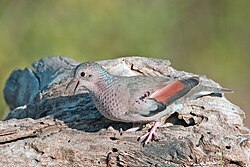
The Ground Dove (Columbina passerina) is a small, compact dove, one of the smallest in North America. It is characterized by its short tail, scaled appearance on the head and breast, and iridescent wing patches visible in flight. It is primarily a ground-dwelling species, often seen foraging in open, disturbed areas.
Size & lifespan
- Length
- 15-18 cm (5.9-7.1 in)
- Wingspan
- 27-30 cm (10.6-11.8 in)
- Weight
- 24-32 g (0.8-1.1 oz)
- Lifespan
- Typically 1-3 years in the wild, with records up to 7 years.
- Diet
- Granivore (primarily seeds), occasionally small insects.
Physical characteristics
- Plumage
- Adult males have a gray-blue crown, nape, and hindneck, fading to a pinkish-gray on the face, throat, and breast. The back and wings are brownish-gray, with dark spots on the wing coverts that appear iridescent purple-black in good light. The belly is whitish. Adult females are generally duller, with more brownish-gray overall and less pinkish wash. Both sexes have a scaled appearance on the head and breast due to dark feather edgings.
- Beak shape
- Short, slender, and slightly decurved. The bill is orange-yellow at the base, fading to black at the tip.
- Eye color
- Reddish-brown iris, surrounded by a narrow, pale orbital ring.
- Leg color
- Pinkish-red to reddish-orange.
- Distinguishing features
- Small size, short tail, scaled appearance on head and breast, iridescent dark spots on wings (visible when perched and in flight), and a distinctive reddish flash in the primaries during flight.
- Juvenile appearance
- Juveniles resemble adult females but are duller and browner, with less distinct scaling and a more mottled appearance. The iridescent wing spots may be less prominent.
- Seasonal changes
- No significant seasonal plumage changes. Plumage remains consistent year-round.
- Sexual dimorphism
- Males are generally brighter with more extensive pinkish-gray on the head and breast, and a more pronounced blue-gray crown. Females are duller and browner overall.
How to identify
- 1
Size and Shape
Look for a very small, compact dove with a short tail. It appears plump-bodied.
- 2
Plumage Pattern
Observe the scaled pattern on the head, neck, and breast, which gives it a 'scaly' or 'checkered' appearance. Note the dark, iridescent spots on the wing coverts.
- 3
Flight Flash
When the bird flies, look for a distinctive reddish-chestnut flash in the primary flight feathers, which is a key identification mark.
- 4
Bill Color
Note the bicolored bill: orange-yellow at the base, transitioning to black at the tip.
- 5
Vocalization
Listen for its soft, mournful, two-note 'woo-oop' or 'hoo-oop' call, repeated steadily.
- 6
Behavior
Often seen foraging on the ground, walking rather than hopping. When disturbed, it typically flies a short distance low to the ground before landing again.
Habitat & range
- Biomes
- Grasslands, shrublands, open woodlands, agricultural areas, urban and suburban environments.
- Geographic range
- Southeastern United States (from coastal South Carolina west to southern Texas, and south through Florida), Mexico, Central America, Caribbean islands, and northern South America.
- Elevation range
- Primarily lowlands, from sea level up to approximately 1,500 meters (4,900 feet).
- Preferred environments
- Open, dry areas with sparse vegetation, bare ground, and scattered shrubs or trees. They favor disturbed habitats such as pastures, cultivated fields, roadsides, suburban gardens, and coastal dunes.
Behavior
- Activity time
- Diurnal, most active during the morning and late afternoon.
- Feeding habits
- Forages almost exclusively on the ground, walking slowly and pecking at seeds. Its diet consists mainly of small seeds from grasses, weeds, and cultivated plants. Occasionally consumes small insects or grit.
- Social behavior
- Typically seen singly or in pairs, though small flocks may form outside the breeding season, especially around abundant food sources or water. Generally not highly social.
- Flight pattern
- Flight is fast and direct, with rapid wingbeats. When flushed, it flies low to the ground for a short distance before landing again. Displays a characteristic reddish flash in the primary feathers during flight.
- Migration pattern
- Mostly resident throughout its range. Northern populations in the United States may undertake short-distance, irregular movements south during harsh winters, but true long-distance migration is not observed.
- Territoriality
- Males defend a small breeding territory, primarily through vocalizations and display flights. They can be aggressive towards other doves entering their space.
Song & calls
- Song
- The song is a soft, monotonous, and mournful 'woo-oop' or 'hoo-oop', repeated steadily. It's often described as a two-note coo, with the second note slightly higher in pitch and emphasized.
- Call
- Alarm calls are a sharp 'whistle' or 'peep' when flushed. Contact calls are similar to the song but softer.
- When they vocalize
- Vocalizes throughout the day, especially during the breeding season, from a perch or the ground.
Breeding & reproduction
- Breeding season
- Varies geographically, but generally from March to October in the U.S., and year-round in tropical regions, often with multiple broods.
- Nesting habits
- Nests are typically flimsy, shallow platforms of twigs, grass, and rootlets, often placed low in a shrub, small tree, or vine, usually less than 2 meters (6 feet) above the ground. Occasionally nests on the ground or in hanging baskets.
- Clutch size
- Typically 2 eggs.
- Egg description
- Two pure white, elliptical eggs, glossy and unmarked.
- Incubation period
- 12-14 days.
- Fledging period
- 11-12 days after hatching, young leave the nest.
- Parental care
- Both parents share incubation duties and care for the young. They feed the nestlings 'crop milk' initially, transitioning to regurgitated seeds.
Where to find
Open Fields and Pastures
Look in areas with short grass, bare patches, and scattered weeds, especially where seeds are abundant.
Roadsides and Dirt Paths
Often seen foraging along the edges of roads and trails, picking up fallen seeds.
Suburban Gardens and Parks
Can be found in residential areas, particularly those with open lawns, feeders, and sparse shrubbery.
Coastal Dunes and Scrub
Common in sandy, open habitats along coastlines.
Field tips
- Look on the ground. Ground Doves spend most of their time foraging on the ground. Scan open areas carefully.
- Listen for their call. Their soft, mournful coo is often the first indication of their presence, especially when they are hidden in vegetation.
- Check bird feeders. They are attracted to ground feeders offering small seeds, especially millet.
- Observe flight. If a small bird flushes from the ground with a reddish flash in its wings, it's likely a Ground Dove.
Similar species
Common Ground-Dove
Columbina passerina
This is the same species. There are no other species named 'Common Ground-Dove' that are distinct from Columbina passerina.
Inca Dove
Columbina inca
The Inca Dove is slightly larger and has a more extensively scaled appearance over its entire body, including the back and wings, giving it a 'scaly' look. It also has a longer tail and a more prominent white outer tail feather pattern in flight. Its call is a distinctive 'coo-OO-coo' or 'no-hope'.
Ruddy Ground-Dove
Columbina talpacoti
The Ruddy Ground-Dove is more uniformly rufous (reddish-brown) overall, especially the male. It lacks the prominent scaled appearance on the breast and the iridescent wing spots of the Ground Dove. Its range is primarily more southerly, extending into the extreme southern U.S. (Texas) but not as widespread as the Ground Dove.
Blue-ground Dove
Claravis pretiosa
The Blue-ground Dove is a different genus and has a distinct blue-gray plumage, especially the male, with dark spots on the wings. It is typically found in more forested habitats and has a different vocalization.
Quick facts
- Smallest North American Dove:
- One of the smallest dove species in North America.
- Ground Forager:
- Almost exclusively feeds on seeds found on the ground.
- Red Wing Flash:
- Distinctive reddish-chestnut flash visible in the primaries during flight.
- Scaled Appearance:
- Feather edgings on the head and breast give a 'scaled' look.
- Monogamous:
- Typically forms monogamous pairs during the breeding season.
Fun facts
- Despite its small size, the Ground Dove is a surprisingly strong flyer, capable of rapid, direct flight.
- They are known to take dust baths, especially in dry, sandy areas, to maintain their plumage.
- Ground Doves can raise multiple broods in a single breeding season, sometimes as many as 3-4, due to their short incubation and fledging periods.
- The iridescent spots on their wings are structural colors, meaning they are produced by the physical structure of the feathers rather than pigments, causing them to shimmer differently depending on the light angle.
Scientific classification
- Kingdom
- Animalia
- Phylum
- Chordata
- Class
- Aves
- Order
- Columbiformes
- Family
- Columbidae
- Genus
- Columbina
- Species
- passerina
Explore the Ground Dove
Identify birds anywhere
Free on iOS, Android, and Web. Photo & sound identification, full species database, and your personal life list.