
Spotted a bird? Identify it instantly with the Birdby app
Open the appAbout
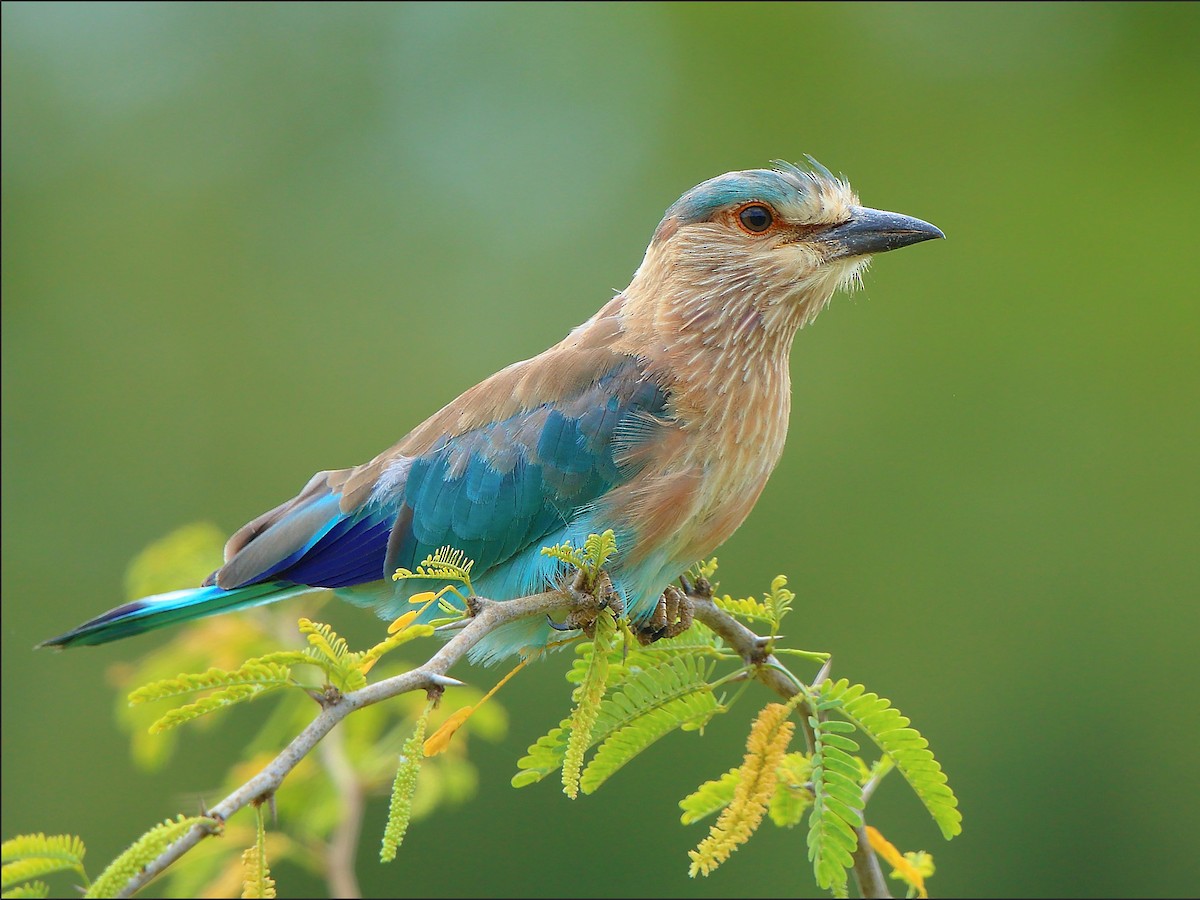
The Indian Roller is a medium-sized bird belonging to the roller family, known for its striking blue plumage and acrobatic flight displays. It is a common and widespread resident bird across the Indian subcontinent and parts of Southeast Asia, often seen perched conspicuously on wires, poles, or trees in open country.
Size & lifespan
- Length
- 30-34 cm (12-13 in)
- Wingspan
- 65-74 cm (26-29 in)
- Weight
- 100-170 g (3.5-6.0 oz)
- Lifespan
- Approximately 7-10 years in the wild
- Diet
- Carnivore (primarily insectivore)
Physical characteristics
- Plumage
- Adults have a bright turquoise-blue crown, lower belly, and undertail coverts. The back and mantle are dull olive-brown. The rump and upper tail coverts are bright purplish-blue. The wings are a spectacular mix of deep blue, purplish-blue, and black, especially visible in flight. The throat and upper breast are purplish-lilac with fine white streaking. The tail is dark blue with a pale blue terminal band.
- Beak shape
- Strong, stout, and slightly hooked black beak.
- Eye color
- Dark brown.
- Leg color
- Dull yellowish-brown to dark brown.
- Distinguishing features
- The most distinctive features are the brilliant blue and purplish hues, especially noticeable during its characteristic 'rolling' flight display. The olive-brown back contrasts with the blue plumage. A prominent white patch is visible at the base of the primary feathers during flight.
- Juvenile appearance
- Juveniles are duller overall, with less vibrant blue and purplish tones. Their plumage is more brownish, and the streaking on the breast is less defined. The beak may have a yellowish base.
- Seasonal changes
- No significant seasonal plumage changes. The plumage remains consistent throughout the year.
- Sexual dimorphism
- Males and females are monomorphic, meaning they look alike. There are no significant differences in plumage or size between the sexes.
How to identify
- 1
Plumage Coloration
Look for the striking combination of dull olive-brown on the back and mantle, contrasting with the bright turquoise-blue crown, rump, and underparts. The purplish-lilac throat with white streaks is also a key feature.
- 2
Flight Pattern
Observe its flight. The 'rolling' and acrobatic displays, especially during the breeding season, are highly characteristic. In normal flight, look for the flashes of deep blue and purplish-blue on the wings and tail, and the white primary patch.
- 3
Perching Behavior
Indian Rollers often perch conspicuously on elevated spots like power lines, bare branches, or fence posts in open areas, scanning the ground for prey. This behavior makes them relatively easy to spot.
- 4
Vocalizations
Listen for its harsh, grating 'chaak-chaak' or 'krak-krak' calls, particularly when it's agitated or performing aerial displays.
Habitat & range
- Biomes
- Open woodlands, cultivated areas, grasslands, scrubland, parks, and gardens.
- Geographic range
- Widespread across the Indian subcontinent, extending from Iraq and the Arabian Peninsula (subspecies Coracias benghalensis indicus) through India, Sri Lanka, Bangladesh, and parts of Southeast Asia (Myanmar, Thailand).
- Elevation range
- Primarily found in lowlands and plains, up to about 1,000 meters (3,300 feet) above sea level.
- Preferred environments
- Prefers open country with scattered trees, agricultural fields, roadside trees, and areas with suitable perching sites like power lines, fences, and dead snags for hunting.
Behavior
- Activity time
- Diurnal, most active during the day, particularly in the early morning and late afternoon.
- Feeding habits
- Primarily an insectivore, it hunts by perching conspicuously and swooping down to catch prey on the ground. Its diet includes a wide variety of insects such as grasshoppers, crickets, beetles, moths, and butterflies. It also preys on small vertebrates like lizards, frogs, and occasionally rodents or small snakes. Larger prey is often beaten against a perch before consumption.
- Social behavior
- Generally solitary or found in pairs. They are territorial, especially during the breeding season. Outside of breeding, they may gather in small groups at communal roosts.
- Flight pattern
- Strong, direct flight with powerful wingbeats. Known for its spectacular aerial displays during the breeding season, involving dives, rolls, and twists, which give the bird its common name 'roller'.
- Migration pattern
- Mostly resident throughout its range, though some local movements may occur in response to food availability or adverse weather conditions. The subspecies Coracias benghalensis benghalensis is largely resident.
- Territoriality
- Highly territorial, especially around nesting sites and prime hunting grounds. They will aggressively defend their territory against other rollers and sometimes against other bird species.
Song & calls
- Song
- Not known for a complex song. Vocalizations are generally harsh and raucous.
- Call
- Common calls include a harsh, grating 'chaak-chaak-chaak' or 'krak-krak-krak'. Also produces a series of short, sharp, and often repeated 'chack' or 'rattle' calls, particularly during display flights or when agitated.
- When they vocalize
- Most vocal during the breeding season, especially during courtship displays and territorial defense. Also calls when disturbed or in flight.
Breeding & reproduction
- Breeding season
- Typically from March to July, varying slightly with geographical location and monsoon patterns.
- Nesting habits
- Nests in natural tree hollows, old woodpecker holes, or crevices in buildings and walls. No nest material is typically added, though sometimes a few twigs or grass blades may line the cavity. Both parents participate in selecting the nest site.
- Clutch size
- 3-5 eggs, occasionally up to 6.
- Egg description
- Eggs are pure white, glossy, and oval-shaped. They are relatively small for the bird's size.
- Incubation period
- Approximately 17-19 days, primarily by the female, though the male may assist.
- Fledging period
- Chicks fledge (leave the nest) after about 28-30 days.
- Parental care
- Both parents share incubation duties (though female does more) and actively participate in feeding the nestlings. They continue to feed the fledglings for some time after they leave the nest.
Where to find
Agricultural Fields
Often seen in cultivated lands, especially those with scattered trees or irrigation channels, where insect prey is abundant.
Roadsides and Open Country
Commonly found along roadsides, in open grasslands, and scrublands, perching on utility wires, poles, or prominent branches.
Parks and Gardens
Can be found in urban and suburban parks and large gardens, particularly those with mature trees and open lawns.
Lightly Wooded Areas
Prefers areas with scattered trees rather than dense forests, providing both perching sites and open hunting grounds.
Field tips
- Look for prominent perches. Scan power lines, telephone wires, dead trees, and fence posts in open areas. Indian Rollers prefer elevated perches for hunting.
- Observe during early morning and late afternoon. These are typically the most active hunting times for the Indian Roller, making them more visible.
- Watch for aerial displays. During the breeding season (March-July), keep an eye out for their spectacular 'rolling' flight displays, which are unmistakable.
- Listen for calls. Their harsh, grating calls can often draw attention to their presence, even if they are initially hidden.
Similar species
European Roller
Coracias garrulus
The European Roller has a more uniform blue head and body, lacking the olive-brown back of the Indian Roller. Its breast is also a more uniform blue, without the streaking seen in the Indian Roller. The European Roller is a migratory species that breeds in Europe and winters in Africa, with some overlap in wintering grounds with the Indian Roller's range.
Dollarbird
Eurystomus orientalis
The Dollarbird (also known as Oriental Dollarbird) is generally darker blue-green overall, with a distinctive bright red beak and legs. It has a prominent white 'dollar-shaped' patch on its underwing, which is visible in flight. Its head is larger and more rounded, and it lacks the olive-brown back of the Indian Roller.
Quick facts
- National Bird:
- State bird of Karnataka, Odisha, Telangana, and Andhra Pradesh in India.
- Dietary Niche:
- Important predator of agricultural pests, consuming large quantities of insects.
- Flight Display:
- Named 'roller' due to its acrobatic, tumbling flight during courtship.
- Perching Style:
- Often sits upright and conspicuously on exposed perches.
Fun facts
- The Indian Roller is considered sacred in some Hindu traditions and is associated with Lord Vishnu. Seeing an Indian Roller on Dussehra (Vijayadashami) is considered auspicious.
- Despite its vibrant plumage, the Indian Roller is a master of camouflage when perched, with its duller back blending into tree bark, only revealing its brilliant colors in flight.
- They are quite fearless and will often chase away much larger birds, including raptors, from their nesting territories.
- Their diet can include venomous insects like scorpions, which they expertly disarm by beating them against a hard surface before consumption.
Scientific classification
- Kingdom
- Animalia
- Phylum
- Chordata
- Class
- Aves
- Order
- Coraciiformes
- Family
- Coraciidae
- Genus
- Coracias
- Species
- Coracias benghalensis
Explore the Indian Roller
Identify birds anywhere
Free on iOS, Android, and Web. Photo & sound identification, full species database, and your personal life list.