
Spotted a bird? Identify it instantly with the Birdby app
Open the appAbout
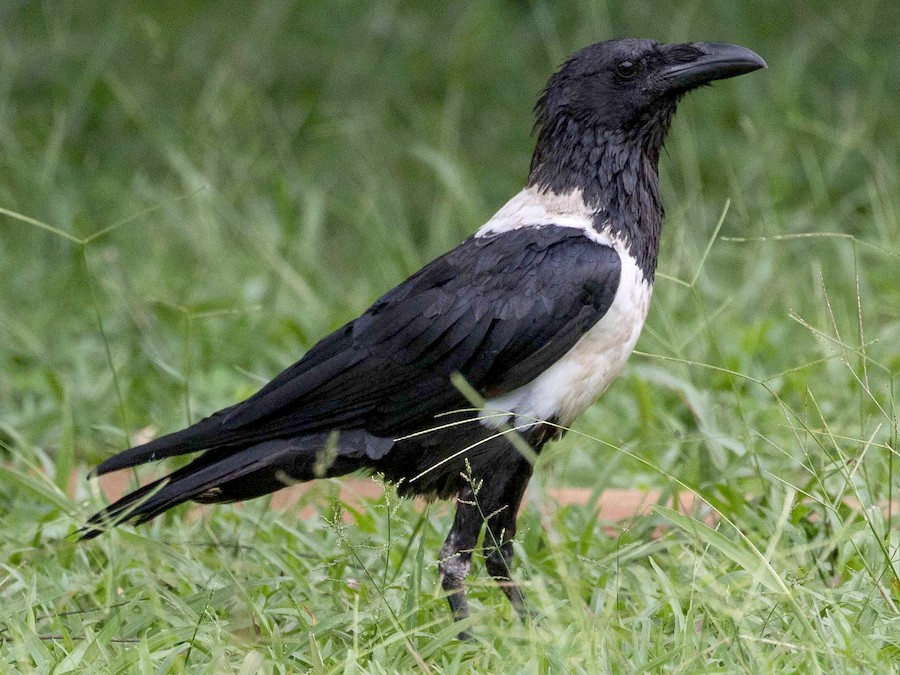
The Pied Crow is a medium-sized, distinctive crow species characterized by its striking black and white plumage. It is highly adaptable and commonly found across much of sub-Saharan Africa, often in close association with human settlements. Known for its intelligence and opportunistic feeding habits, it plays a significant ecological role as a scavenger.
Size & lifespan
- Length
- 46-52 cm (18-20.5 in)
- Wingspan
- 90-100 cm (35-39 in)
- Weight
- 450-700 g (16-25 oz)
- Lifespan
- Up to 15 years in the wild, potentially longer in captivity.
- Diet
- Omnivore
Physical characteristics
- Plumage
- Adults have glossy black head, throat, back, wings, and tail. A prominent white collar extends around the neck and onto the breast, contrasting sharply with the black. The belly and flanks are also white. The black plumage often shows a purplish-blue sheen in good light.
- Beak shape
- Robust, slightly decurved, and entirely black.
- Eye color
- Dark brown
- Leg color
- Black
- Distinguishing features
- The most distinctive feature is the bicolored plumage: black head, back, wings, and tail, with a broad white collar and white underparts. This pattern is unique among African corvids.
- Juvenile appearance
- Juveniles resemble adults but have duller, less glossy black plumage, and the white areas may appear slightly off-white or tinged with grey. Their eyes are typically grey-blue, gradually changing to dark brown with age.
- Seasonal changes
- No significant seasonal plumage changes.
- Sexual dimorphism
- None significant; males and females are visually identical in plumage and size.
How to identify
- 1
Plumage Pattern
Look for the unmistakable black and white pattern: glossy black head, back, wings, and tail, contrasted by a broad white collar around the neck and white underparts. This is the primary identification feature.
- 2
Size and Shape
Medium-large crow size, robust build, and a strong, slightly decurved black bill. Its proportions are typical of a crow.
- 3
Vocalizations
Listen for its characteristic harsh, ringing 'kraaah' or 'kwaark' calls, which are distinct from other corvids in its range.
- 4
Behavior and Habitat
Often seen in open areas, especially near human settlements, scavenging or perched conspicuously on trees, poles, or buildings. Its confident and intelligent demeanor is also a clue.
Habitat & range
- Biomes
- Savanna, grasslands, open woodlands, agricultural lands, urban and suburban areas, coastal regions.
- Geographic range
- Widespread across sub-Saharan Africa, from Mauritania and Senegal in the west, east to Ethiopia and Somalia, and south to South Africa. Also found on some offshore islands like Bioko, São Tomé, and Príncipe.
- Elevation range
- Sea level up to 2,500 meters (8,200 feet), occasionally higher.
- Preferred environments
- Highly adaptable, preferring open country with scattered trees, often near human habitation, towns, villages, and cultivated areas where food sources are abundant. Avoids dense forests and arid deserts.
Behavior
- Activity time
- Diurnal
- Feeding habits
- Highly opportunistic omnivores. Diet includes carrion, insects, small vertebrates (lizards, small birds, rodents), eggs, nestlings, fruits, seeds, and human refuse. They are adept scavengers, frequently seen foraging in rubbish dumps, markets, and along roadsides. They also cache food.
- Social behavior
- Typically seen in pairs or small family groups, but can gather in larger flocks at abundant food sources (e.g., rubbish dumps, carcasses) or communal roosts. They are intelligent and known to cooperate in foraging.
- Flight pattern
- Strong, direct flight with steady wingbeats. Capable of soaring on thermals. Often seen gliding or performing aerial displays.
- Migration pattern
- Generally resident throughout its range, though some local movements may occur in response to food availability or seasonal changes.
- Territoriality
- Breeding pairs are territorial, defending their nesting sites. Non-breeding birds may form communal roosts.
Song & calls
- Song
- Pied Crows do not have a complex song. Their vocalizations are primarily calls.
- Call
- A variety of harsh, guttural calls. Common calls include a loud, ringing 'kraaah' or 'kwaark', often repeated. They also produce softer 'caw' notes, chattering, and gurgling sounds. Their calls can vary depending on context, such as alarm, contact, or territorial display.
- When they vocalize
- Most vocal during the day, especially at dawn and dusk, and when interacting with other crows or during territorial disputes.
Breeding & reproduction
- Breeding season
- Varies geographically, typically during the dry season or early wet season. For example, in southern Africa, August-November; in West Africa, October-March.
- Nesting habits
- Nests are large, bulky structures made of sticks, twigs, and sometimes wire, lined with softer materials like grass, hair, rags, or plastic. They are usually placed high in tall trees, utility poles, or sometimes on cliffs or buildings.
- Clutch size
- 3-6 eggs
- Egg description
- Typically 3-6 eggs, pale blue-green to olive-green, heavily marked with dark brown, olive, or grey spots and blotches, particularly at the broader end.
- Incubation period
- 18-19 days
- Fledging period
- 35-45 days after hatching
- Parental care
- Both parents participate in nest building, incubation (primarily female), and feeding of the young. Juveniles remain dependent on parents for several weeks after fledging.
Where to find
Urban and Suburban Areas
Commonly found in towns, cities, and villages, especially near markets, rubbish dumps, and parks.
Agricultural Lands
Frequently seen in cultivated fields, pastures, and farmlands, foraging for insects, seeds, or carrion.
Open Woodlands and Savanna
Inhabits open country with scattered trees, often near water sources.
Coastal Regions
Can be found along coastlines, scavenging for marine life or human discards.
Field tips
- Look for contrasting plumage. The black and white pattern is highly conspicuous, even from a distance. Look for birds perched on prominent structures or flying overhead.
- Listen for calls. Their loud, distinctive calls are often heard before the bird is seen. Familiarize yourself with their vocalizations.
- Observe scavenging behavior. Pied Crows are often found near potential food sources, such as roadkill, picnic areas, or waste bins. Their opportunistic feeding habits make them relatively easy to spot.
- Check communal roosts. At dusk, large numbers of Pied Crows may gather at communal roosting sites, often in tall trees or communication towers.
Similar species
White-necked Raven
Corvultur albicollis
The White-necked Raven is larger and more robust than the Pied Crow. While it also has a white patch on its neck, this patch is on the nape (back of the neck) and is less extensive than the Pied Crow's white collar and underparts. The White-necked Raven has a much heavier, more arched bill with a white tip, and its overall plumage is entirely black except for the nape patch.
Cape Crow
Corvus capensis
The Cape Crow is entirely glossy black, lacking any white plumage. It also has a relatively long, slender bill compared to the Pied Crow's more robust bill.
Fan-tailed Raven
Corvus rhipidurus
The Fan-tailed Raven is entirely black and has a distinctive short, broad, fan-shaped tail, which is very noticeable in flight. Its bill is also relatively short and stout.
Quick facts
- Distinctive Feature:
- Black and white plumage
- Diet:
- Omnivorous scavenger
- Habitat:
- Open country, human settlements
- Sociality:
- Pairs, family groups, larger flocks at food sources
- Conservation Status:
- Least Concern (widespread and common)
Fun facts
- Pied Crows are known for their intelligence and problem-solving abilities, often observed using tools or devising clever ways to access food.
- They are highly adaptable and have successfully colonized urban environments, thriving alongside human populations.
- In some cultures, Pied Crows are associated with folklore and superstitions, sometimes seen as messengers or symbols of good or bad omens.
- They can mimic a variety of sounds, though this is less commonly reported than in some other corvid species.
Scientific classification
- Kingdom
- Animalia
- Phylum
- Chordata
- Class
- Aves
- Order
- Passeriformes
- Family
- Corvidae
- Genus
- Corvus
- Species
- Corvus albus
Explore the Pied Crow
Identify birds anywhere
Free on iOS, Android, and Web. Photo & sound identification, full species database, and your personal life list.