
Spotted a bird? Identify it instantly with the Birdby app
Open the appAbout
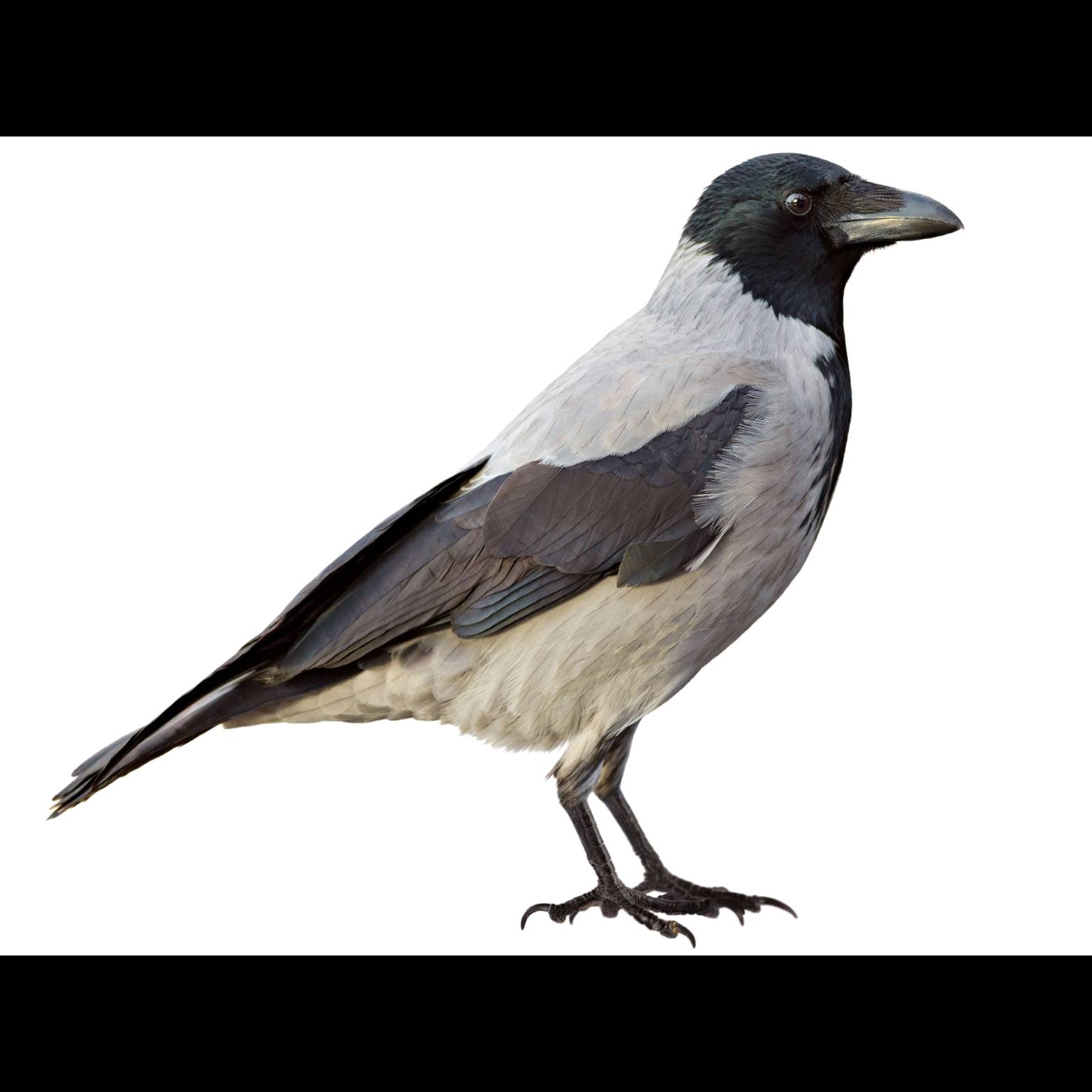
The Hooded Crow is a medium-sized passerine bird, a member of the crow family. It is easily recognizable by its distinctive bicoloured plumage of ash-grey and glossy black. Known for its intelligence and adaptability, it thrives in a variety of habitats, often in close proximity to human settlements. It is an opportunistic omnivore, playing a significant ecological role as a scavenger and predator.
Size & lifespan
- Length
- 48-54 cm
- Wingspan
- 98-104 cm
- Weight
- 370-650 g
- Lifespan
- Up to 20 years in the wild, typically 4-7 years
- Diet
- Omnivore
Physical characteristics
- Plumage
- Adults have a distinctive bicoloured plumage: the head, throat, wings, and tail are glossy black, while the body (mantle, scapulars, underparts) is ash-grey. The black areas often show a purplish-blue sheen in good light.
- Beak shape
- Strong, heavy, and slightly decurved black beak.
- Eye color
- Dark brown
- Leg color
- Black
- Distinguishing features
- The striking contrast between the black head/wings/tail and the grey body is the primary distinguishing feature. Its robust build and typical crow-like silhouette are also characteristic.
- Juvenile appearance
- Juveniles resemble adults but have duller, less glossy black plumage and a less distinct grey body. Their eyes may appear slightly paler, and their gape can be yellowish for a short period after fledging.
- Seasonal changes
- No significant seasonal plumage changes. The plumage remains consistent throughout the year, though wear and tear can make it appear duller before the annual molt.
- Sexual dimorphism
- Males and females are monomorphic, meaning they are visually identical in plumage and size. Males may be slightly larger on average, but this is not discernible in the field.
How to identify
- 1
Plumage Pattern
Look for the unmistakable bicoloured pattern: glossy black head, throat, wings, and tail contrasting sharply with an ash-grey body. This is the most reliable field mark.
- 2
Size and Shape
Medium-large crow, robust build, with a strong, slightly decurved bill. Typical crow silhouette in flight and perched.
- 3
Vocalizations
Listen for the characteristic harsh, guttural 'kraa-kraa-kraa' calls. While similar to other crows, the specific timbre can be learned with practice.
- 4
Behavior
Observe its opportunistic feeding habits, often scavenging or foraging in open areas. Its intelligent and wary demeanor is also typical of corvids.
Habitat & range
- Biomes
- Forest edges, open woodlands, agricultural land, coastal areas, urban and suburban environments, parks, gardens.
- Geographic range
- Widespread across Northern, Eastern, and Southeastern Europe, as well as parts of the Middle East and Central Asia. Its range extends from Scandinavia and the British Isles (excluding most of England and Wales) eastward through Russia, and south to the Mediterranean, including parts of North Africa.
- Elevation range
- Sea level up to 2000 meters, occasionally higher in mountainous regions.
- Preferred environments
- Highly adaptable, preferring open or semi-open landscapes with scattered trees for nesting and roosting. It thrives in areas with human activity, utilizing refuse and cultivated land for foraging.
Behavior
- Activity time
- Diurnal, active from dawn to dusk.
- Feeding habits
- Highly opportunistic omnivore. Diet includes carrion, insects, worms, molluscs, small mammals, birds and their eggs/young, fruits, seeds, grains, and human refuse. They are adept at scavenging and often cache food. They use tools and problem-solving to access food.
- Social behavior
- Often seen in pairs or small family groups during the breeding season. Outside of breeding, they can form large communal roosts, sometimes numbering in the thousands, especially in winter. Highly intelligent and social birds.
- Flight pattern
- Strong, direct flight with steady wingbeats. Can also soar and glide. Often seen performing aerial displays, especially during breeding season. Walks with a confident, deliberate gait on the ground.
- Migration pattern
- Generally resident throughout much of its range. Northern populations (e.g., Scandinavia, Russia) may undertake short-distance migrations southwards in winter, while southern populations are largely sedentary. Some dispersal of juveniles occurs.
- Territoriality
- Breeding pairs are territorial, defending their nesting area from other crows and potential predators. Outside of breeding, territoriality is less pronounced, especially at communal roosts or abundant food sources.
Song & calls
- Song
- Hooded Crows do not have a complex song. Their vocalizations are primarily calls.
- Call
- The most common call is a harsh, guttural 'kraa-kraa-kraa' or 'karr-karr-karr', often repeated. They have a wide repertoire of other calls, including softer 'caw' notes, alarm calls, and various croaks and rattles used for communication within their social groups. They are also known for their ability to mimic other birds and sounds.
- When they vocalize
- Vocalize throughout the day, particularly active in the morning and evening, and during territorial disputes or when mobbing predators.
Breeding & reproduction
- Breeding season
- Typically March to July, with peak egg-laying in April-May.
- Nesting habits
- Nests are large, bulky structures made of sticks, twigs, and often lined with mud, wool, hair, grass, and sometimes even wire or plastic. They are usually built high in trees, but can also be found on cliffs, pylons, or even buildings in urban areas. Both sexes participate in nest building.
- Clutch size
- 3-6 eggs
- Egg description
- 3-6 eggs, typically 4-5. Eggs are pale blue-green or olive-green, heavily spotted and blotched with dark brown, olive, or grey, particularly at the broader end. Size: approximately 4.0 x 2.9 cm.
- Incubation period
- 18-20 days, primarily by the female.
- Fledging period
- 32-36 days. Young leave the nest but remain dependent on parents for several weeks.
- Parental care
- Both parents feed and care for the young. The male often feeds the female during incubation. After fledging, the family group stays together for some time, with parents continuing to provide food and protection.
Where to find
Agricultural Land
Often found foraging in fields, pastures, and cultivated areas, especially after harvesting.
Coastal Areas
Common along coastlines, scavenging for food on beaches and mudflats.
Urban and Suburban Environments
Highly adaptable, frequently seen in parks, gardens, city centers, and around refuse bins.
Open Woodlands and Forest Edges
Utilizes these areas for nesting and roosting, often foraging in adjacent open spaces.
Field tips
- Look for contrast. The grey body against black wings and head is very distinctive, even at a distance. Binoculars will confirm the pattern.
- Listen for calls. Their loud, harsh calls are often the first indication of their presence, especially when they are mobbing a predator or communicating within a flock.
- Observe behavior. Watch for their intelligent foraging techniques, such as dropping hard-shelled food items onto hard surfaces to break them open, or their interactions with other birds.
- Check common areas. Focus your search in areas where food is readily available, such as agricultural fields, rubbish tips, or coastal zones.
Similar species
Carrion Crow
Corvus corone
The Carrion Crow is entirely black, lacking the grey body plumage of the Hooded Crow. In areas where their ranges overlap (e.g., parts of Central Europe), they hybridize, producing offspring with intermediate plumage patterns. The Hooded Crow was formerly considered a subspecies of the Carrion Crow (Corvus corone cornix), but is now widely recognized as a distinct species due to genetic and behavioral differences, despite hybridization.
Rook
Corvus frugilegus
Rooks are entirely black with a distinctive pale, bare patch of skin at the base of the bill in adults (juveniles have feathers here). They also have a more peaked head shape and often a shaggier 'trousers' appearance on their legs. Rooks are typically more gregarious, often feeding and nesting in large colonies (rookeries).
Raven
Corvus corax
Ravens are significantly larger than Hooded Crows, with a much heavier bill, a shaggy throat 'beard', and a wedge-shaped tail (Hooded Crows have a fan-shaped tail). Their flight is often characterized by soaring and gliding, and their call is a deeper, more resonant 'cronk' compared to the crow's 'kraa'.
Quick facts
- Distinctive Feature:
- Bicoloured grey and black plumage
- Diet Type:
- Highly omnivorous
- Social Structure:
- Pairs in breeding season, large communal roosts in winter
- Intelligence:
- Known for problem-solving and tool use
- Conservation Status:
- Least Concern (stable population)
Fun facts
- The Hooded Crow was formerly considered a subspecies of the Carrion Crow (Corvus corone), but genetic studies have led to its reclassification as a distinct species, Corvus cornix. However, they still hybridize in areas where their ranges meet.
- Hooded Crows are known for their intelligence and problem-solving abilities, including using tools to extract food and dropping nuts or shells from a height to break them open.
- In some cultures, the Hooded Crow is associated with folklore and mythology, often seen as a symbol of wisdom, cunning, or even a harbinger of misfortune.
- They are highly adaptable birds, thriving in a wide range of habitats from remote wilderness to bustling urban centers, demonstrating their ability to exploit diverse food sources.
Scientific classification
- Kingdom
- Animalia
- Phylum
- Chordata
- Class
- Aves
- Order
- Passeriformes
- Family
- Corvidae
- Genus
- Corvus
- Species
- Corvus cornix
Explore the Hooded Crow
Identify birds anywhere
Free on iOS, Android, and Web. Photo & sound identification, full species database, and your personal life list.