
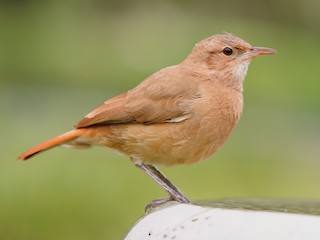
How to identify the Rufous Hornero
Furnarius rufus
Spotted a bird? Identify it instantly with the Birdby app
Open the appTo correctly identify the Rufous Hornero (Furnarius rufus), check each of these features. Birds can be tricky: habit, habitat, and call often confirm a sighting that a single photo cannot.
Size at a glance
- Length
- 19-23 cm
- Wingspan
- 30-35 cm
- Weight
- 31-65 g
Physical features to check
- 1
Plumage
Overall feather coloration and pattern.
Overall rufous-brown plumage. The back, wings, and tail are a rich rufous-chestnut. The crown is duller brown, often with a faint rufous wash. A pale supercilium (eyebrow stripe) is present, contrasting with a darker loral stripe. The throat is whitish, transitioning to a buffy-white or pale rufous breast and belly. The rump is also rufous. The primary flight feathers are dusky.
- 2
Beak shape
Shape and color of the bill: a key field mark.
Moderately long, straight, and stout bill, horn-colored to dusky, often paler at the base of the lower mandible.
- 3
Eye color
Iris color and any distinctive eye markings.
Dark brown.
- 4
Leg color
Leg and foot color.
Dusky gray to blackish.
- 5
Distinguishing features
Standout features that separate this species.
The most distinctive feature is its overall rufous coloration combined with its terrestrial foraging habits and, most notably, its large, oven-shaped mud nest. The pale supercilium and darker loral stripe are also good field marks.
- 6
Juvenile appearance
How young birds differ from adults.
Juveniles resemble adults but may have slightly duller plumage, sometimes with a faintly mottled or streaked breast, and a less distinct supercilium. Their bill may also be slightly shorter and paler.
- 7
Seasonal changes
Plumage variation between breeding and non-breeding seasons.
No significant seasonal plumage changes. Plumage may appear slightly worn or faded outside of the breeding season.
- 8
Sexual dimorphism
How males and females differ.
Males and females are monomorphic in plumage and size, making them indistinguishable in the field without behavioral cues (e.g., nest building).
Key field marks
- Plumage Coloration. Look for the overall rich rufous-brown color on the back, wings, and tail, contrasting with a paler, buffy-white underside. The duller brown crown and pale supercilium are also key.
- Behavior and Posture. Observe its terrestrial foraging behavior: walking or running on the ground with an upright stance, probing the soil. Its strong, direct flight is also characteristic.
- Nest. The presence of its distinctive, large, oven-shaped mud nest is an unmistakable sign of a Rufous Hornero's presence, even if the bird itself is not immediately visible.
- Vocalizations. Listen for its loud, rapid, chattering song, often given as a duet by a pair. This distinctive vocalization is a strong identifier.
- Habitat. While adaptable, its preference for open areas, grasslands, parks, and agricultural fields within its South American range helps narrow down identification.
Explore the Rufous Hornero
Identify birds anywhere
Free on iOS, Android, and Web. Photo & sound identification, full species database, and your personal life list.