
Spotted a bird? Identify it instantly with the Birdby app
Open the appAbout
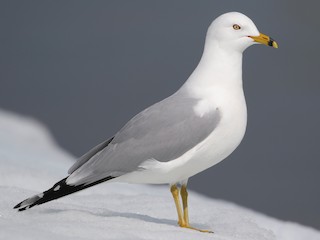
The Ring-billed Gull is a medium-sized gull common across North America. It is easily recognized by the black ring near the tip of its bill in adult plumage. Highly adaptable, it thrives in a variety of habitats, from coastal areas to inland lakes, rivers, and even urban environments. It is an opportunistic feeder, often seen scavenging in parking lots, landfills, and agricultural fields.
Size & lifespan
- Length
- 40-49 cm (15.7-19.3 in)
- Wingspan
- 105-117 cm (41.3-46.1 in)
- Weight
- 300-700 g (10.6-24.7 oz)
- Lifespan
- Typically 10-15 years in the wild, with records up to 20 years.
- Diet
- Omnivore, opportunistic feeder. Diet includes fish, insects, earthworms, small rodents, eggs and young of other birds, carrion, berries, grains, and human refuse.
Physical characteristics
- Plumage
- Adults have a white head, body, and tail, with a pale gray back and upperwings. The primary wingtips are black with white spots (mirrors).
- Beak shape
- Medium-sized, relatively slender, yellow bill with a prominent black ring near the tip in adults. Juveniles have a pinkish bill with a dark tip, which gradually develops the black ring.
- Eye color
- Pale yellow with a red orbital ring in adults. Dark in juveniles.
- Leg color
- Yellow in adults, pinkish-yellow in immatures.
- Distinguishing features
- The most distinctive feature is the black ring on the yellow bill of adults. Also note the pale gray mantle, yellow legs, and pale yellow eyes.
- Juvenile appearance
- Juveniles are mottled brown and white overall, with a dark brown bill and dark eyes. They undergo several molts, gradually acquiring adult plumage over 2-3 years. First-winter birds are largely brown-backed with a dark tail band and a pinkish bill with a dark tip. Second-winter birds are paler, with more gray on the back and a more defined black bill ring.
- Seasonal changes
- Adults show very little seasonal variation. In breeding plumage, the head is pure white. In non-breeding plumage (winter), adults may develop faint dusky streaking on the head and nape, but the overall appearance remains largely the same.
- Sexual dimorphism
- Males and females are outwardly similar in plumage and size, though males tend to be slightly larger on average.
How to identify
- 1
Bill Markings
Look for the distinct black ring near the tip of the yellow bill in adult birds. This is the most reliable field mark.
- 2
Leg Color
Adults have bright yellow legs. This distinguishes them from larger gulls with pink legs (e.g., Herring Gull) and some other medium-sized gulls.
- 3
Size and Build
Medium-sized gull, smaller than a Herring Gull but larger than a Bonaparte's Gull. It has a relatively slender build compared to larger gulls.
- 4
Plumage (Adult)
White head, body, and tail, with a pale gray back and upperwings. Black primary wingtips with white 'mirrors'.
- 5
Juvenile Plumage
Young birds are mottled brown and white, with a dark bill and dark eyes. They gradually acquire adult plumage over 2-3 years, so look for intermediate stages with varying amounts of brown and gray.
- 6
Behavior
Often seen in large flocks, especially in urban areas, parking lots, and landfills, scavenging for food. Their opportunistic feeding behavior is a good clue.
Habitat & range
- Biomes
- Coastal areas, freshwater lakes, rivers, agricultural fields, urban and suburban environments, landfills, parking lots.
- Geographic range
- Breeds across Canada and the northern United States. Winters along the coasts of the United States, Mexico, and the Caribbean, and inland across much of the southern U.S.
- Elevation range
- Sea level to several hundred meters, primarily in lowlands.
- Preferred environments
- Open water bodies, agricultural lands, urban centers, and areas with human activity where food sources are abundant.
Behavior
- Activity time
- Diurnal, primarily active during daylight hours.
- Feeding habits
- Highly opportunistic. Forages by walking, wading, swimming, and sometimes by dipping or shallow plunging. Often follows plows in fields, scavenges at landfills, and congregates in parking lots for discarded food. Also catches insects in flight and preys on small aquatic animals.
- Social behavior
- Highly social, especially outside the breeding season. Forms large flocks for foraging, roosting, and migration. Breeds in colonies, often mixed with other gull species.
- Flight pattern
- Strong, direct flight with steady wingbeats. Often soars on thermals. Graceful and agile in the air, especially when foraging for insects.
- Migration pattern
- Migratory. Northern populations move south for the winter, while southern populations may be resident or undertake shorter movements. Migrates in large flocks, often following coastlines or major river systems.
- Territoriality
- Territorial during the breeding season, defending a small area around the nest. Less territorial outside of breeding.
Song & calls
- Song
- Ring-billed Gulls do not have a complex song. Their vocalizations are primarily calls.
- Call
- A variety of calls, including a distinctive, high-pitched, somewhat nasal 'kyow' or 'kree-ah'. Also gives a rapid, laughing 'ha-ha-ha' call, especially during disputes or when excited. Alarm calls are sharper and more insistent.
- When they vocalize
- Vocalizes year-round, but most frequently and intensely during the breeding season and when interacting in flocks.
Breeding & reproduction
- Breeding season
- Typically April to July, varying by latitude.
- Nesting habits
- Nests in dense colonies on islands, peninsulas, or dikes, often near freshwater or saltwater. The nest is a shallow depression on the ground, lined with grass, twigs, and other vegetation. Both parents participate in nest building.
- Clutch size
- 2-4 eggs, most commonly 3.
- Egg description
- 2-4 eggs, typically 3. Eggs are olive to buff-brown, heavily spotted and blotched with dark brown or black. Average size is about 6.5 x 4.5 cm.
- Incubation period
- 23-28 days, incubated by both parents.
- Fledging period
- Chicks leave the nest within a few days of hatching but remain in the colony. They achieve flight at about 35-40 days old.
- Parental care
- Both parents share incubation duties and care for the young, feeding them regurgitated food until they fledge and for a period thereafter.
Where to find
Urban and Suburban Areas
Parking lots, shopping centers, parks, landfills, and fast-food restaurant areas are prime locations due to abundant food scraps.
Coastal Areas
Beaches, harbors, piers, and estuaries, especially during migration and winter.
Inland Water Bodies
Large lakes, rivers, reservoirs, and ponds, particularly during breeding season and migration.
Agricultural Fields
Often follow tractors during plowing or harvesting to feed on exposed invertebrates and small rodents.
Field tips
- Look for Flocks. Ring-billed Gulls are highly social and are rarely seen alone. Look for groups, especially where food is readily available.
- Observe Feeding Behavior. Their opportunistic feeding habits mean they can be found in diverse settings. Watch for them scavenging or foraging in open areas.
- Listen for Calls. Their distinctive 'kyow' or 'kree-ah' calls can help locate them, especially in noisy environments.
- Check Bill and Leg Color. These are key identification features for adults. Binoculars will be helpful for confirming the black bill ring and yellow legs.
Similar species
Herring Gull
Larus argentatus
Herring Gulls are significantly larger than Ring-billed Gulls. Adults have pink legs (vs. yellow), a larger, heavier bill with a red spot on the lower mandible (vs. black ring), and a more robust build. Juveniles are much darker and more uniformly brown than juvenile Ring-billed Gulls.
California Gull
Larus californicus
California Gulls are slightly larger and darker-backed than Ring-billed Gulls. Adults have a red and black spot on the bill (vs. just a black ring), and their legs are typically greenish-yellow (vs. bright yellow). Their eyes are usually darker than the pale yellow eyes of Ring-billed Gulls.
Mew Gull (Common Gull)
Larus canus
Mew Gulls are slightly smaller and more delicate than Ring-billed Gulls. Adults have a plain yellow bill without a black ring (though some may show a faint dusky smudge), and their wingtips have more white. Their head is rounder, and their overall appearance is gentler.
Quick facts
- Status:
- Common and widespread
- Key ID Mark:
- Black ring on yellow bill (adults)
- Habitat Diversity:
- Highly adaptable to various environments
- Sociality:
- Colonial breeder, forms large flocks
- Diet:
- Opportunistic omnivore
Fun facts
- The Ring-billed Gull is sometimes referred to as the 'parking lot gull' due to its common presence in urban and suburban areas, particularly around shopping centers and fast-food restaurants.
- Despite their commonness, Ring-billed Gulls are quite intelligent and adaptable, quickly learning to exploit new food sources, including those provided by humans.
- Their population experienced a significant decline in the late 19th and early 20th centuries due to hunting for feathers, but they have since made a remarkable recovery and are now one of the most abundant gull species in North America.
- Ring-billed Gulls are known to engage in kleptoparasitism, stealing food from other birds and even from humans.
Scientific classification
- Kingdom
- Animalia
- Phylum
- Chordata
- Class
- Aves
- Order
- Charadriiformes
- Family
- Laridae
- Genus
- Larus
- Species
- Larus delawarensis
Explore the Ring-billed Gull
Identify birds anywhere
Free on iOS, Android, and Web. Photo & sound identification, full species database, and your personal life list.