
Spotted a bird? Identify it instantly with the Birdby app
Open the appAbout
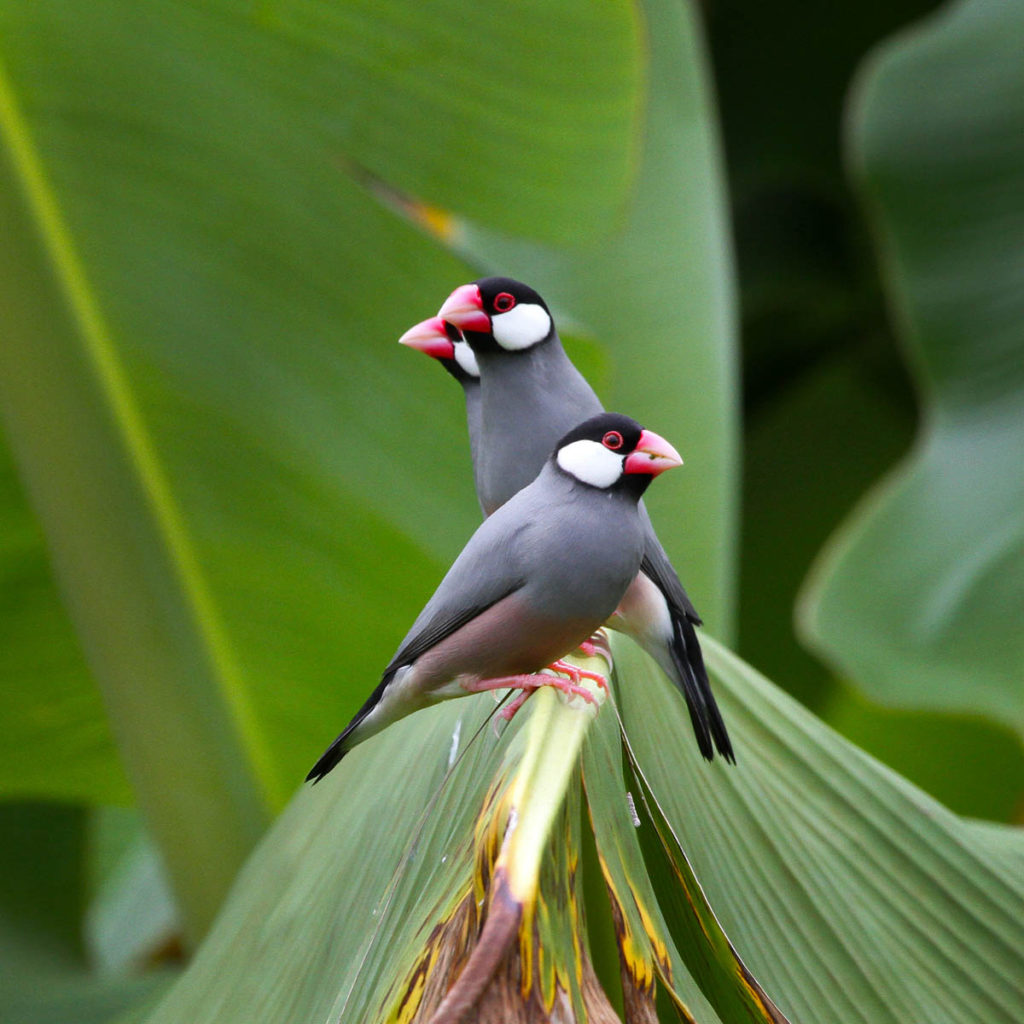
The Java Sparrow is a striking estrildid finch native to Java, Bali, and Bawean in Indonesia. It is well-known for its distinctive grey, white, and black plumage, robust pink bill, and red eye-ring. Highly social, it is often found in flocks, particularly in agricultural areas, feeding primarily on rice and other grains. Due to its attractive appearance and relatively docile nature, it has been widely introduced as a cage bird across the globe, leading to feral populations in many tropical and subtropical regions.
Size & lifespan
- Length
- 13-17 cm
- Wingspan
- 20-22 cm
- Weight
- 25-35 g
- Lifespan
- 5-10 years (in the wild), up to 15 years (in captivity)
- Diet
- Granivore
Physical characteristics
- Plumage
- Adults have a slate-grey back and underparts, a black head with prominent white cheek patches, and a black tail. The belly is a paler grey, transitioning to white on the undertail coverts. The rump is white. The wings are dark grey to blackish.
- Beak shape
- Conical and very stout, bright pink to reddish-pink.
- Eye color
- Dark brown, surrounded by a prominent red orbital ring.
- Leg color
- Pinkish-red.
- Distinguishing features
- The combination of a black head with large white cheek patches, a robust pink bill, and a grey body is unique among finches in its native range. The red eye-ring is also a key feature.
- Juvenile appearance
- Juveniles are duller and browner overall, lacking the distinct black head and white cheek patches. Their plumage is a uniform dull grey-brown, with a paler belly. The bill is dark grey or blackish, gradually turning pink as they mature. The eye-ring is also duller or absent.
- Seasonal changes
- No significant seasonal plumage changes. Plumage remains consistent year-round.
- Sexual dimorphism
- Males and females are generally monomorphic in plumage. Males may have a slightly larger, more bulbous bill and a more intense red eye-ring, but these differences are subtle and not reliable for field identification. Behavioral cues, such as singing, are more indicative of sex.
How to identify
- 1
Head Pattern
Look for the striking black head with large, contrasting white cheek patches. This is the most distinctive field mark.
- 2
Bill Color and Shape
Note the very stout, conical, bright pink to reddish-pink bill. This is unique among similar-sized finches in its range.
- 3
Body Plumage
Observe the slate-grey back and underparts, contrasting with the black head and white rump. Juveniles are duller brown with a dark bill.
- 4
Eye-ring
A prominent red orbital ring around the dark eye is characteristic of adults.
- 5
Behavior
Often seen in flocks, foraging on the ground or in rice fields. Their direct, undulating flight is also a good clue.
Habitat & range
- Biomes
- Tropical and subtropical grasslands, savannas, agricultural areas (especially rice paddies), urban and suburban gardens, parks.
- Geographic range
- Native to Java, Bali, and Bawean (Indonesia). Introduced and established feral populations exist in many parts of Asia (e.g., Singapore, Malaysia, Thailand, Philippines, Japan, China, India, Sri Lanka), Africa (e.g., Zanzibar, St. Helena), North America (e.g., Florida, Hawaii), and other tropical/subtropical islands.
- Elevation range
- Primarily lowlands, typically below 1,000 meters (3,300 feet) above sea level.
- Preferred environments
- Open country with scattered trees, cultivated fields (especially rice fields), human settlements, and areas with abundant seed sources. They often frequent areas near water.
Behavior
- Activity time
- Diurnal. Most active during the morning and late afternoon, foraging and socializing.
- Feeding habits
- Primarily granivorous, feeding on a wide variety of seeds, especially rice (Oryza sativa), which forms a significant part of their diet. They also consume other grass seeds, millet, and occasionally insects, particularly during the breeding season to feed chicks. They forage on the ground or directly from seed heads.
- Social behavior
- Highly gregarious, typically found in flocks of varying sizes, from a few individuals to hundreds, especially outside the breeding season. They roost communally and forage together. During breeding, pairs become more territorial around the nest site but still maintain some social contact with other pairs.
- Flight pattern
- Strong, direct, and undulating flight, often in tight flocks. They can be quite agile when maneuvering through vegetation.
- Migration pattern
- Resident throughout its native and introduced ranges. No significant migratory movements are observed, though local movements may occur in response to food availability.
- Territoriality
- During the breeding season, pairs will defend a small territory around their nest site, but they are generally tolerant of other pairs nesting in close proximity, forming loose colonies.
Song & calls
- Song
- The song is a soft, complex warbling series of notes, often described as a 'chattering' or 'twittering' melody, interspersed with whistles and trills. It is typically delivered by the male from a perch.
- Call
- Common calls include a sharp, metallic 'chip' or 'tchip', often given in flight or as an alarm call. They also produce a softer 'cheep' or 'churp' contact call within flocks.
- When they vocalize
- Vocalize throughout the day, especially during foraging and social interactions. Males sing more frequently during the breeding season to attract mates and defend territory.
Breeding & reproduction
- Breeding season
- Varies geographically, often coinciding with the rainy season or periods of abundant food. In its native range, typically from February to August. In introduced populations, it can breed almost year-round if conditions are favorable.
- Nesting habits
- Nests are typically built in tree cavities, crevices in buildings, under eaves, or in dense foliage of trees and shrubs. They are bulky, dome-shaped structures made of grass stems, leaves, and other plant fibers, lined with softer materials like feathers or fine grasses. Both sexes participate in nest building.
- Clutch size
- 3-8 eggs, typically 4-6.
- Egg description
- Eggs are pure white, oval-shaped, and smooth. Approximately 18-20 mm in length and 13-15 mm in width.
- Incubation period
- 13-14 days, shared by both parents.
- Fledging period
- 21-24 days after hatching. Young are fed by both parents.
- Parental care
- Both male and female participate in incubation, brooding, and feeding the nestlings. After fledging, the young remain dependent on their parents for a short period before becoming independent.
Where to find
Agricultural Areas
Especially rice paddies and fields growing other grains, where they feed on fallen seeds.
Urban and Suburban Parks/Gardens
In introduced ranges, they readily adapt to human-modified landscapes, feeding on spilled seeds or bird feeders.
Open Woodlands and Savannas
Areas with scattered trees and open grassy patches provide both food and nesting sites.
Coastal Areas
In some introduced ranges, they can be found in coastal scrub and cultivated areas near the sea.
Field tips
- Look for flocks. Java Sparrows are highly social; spotting one often means many more are nearby. Look for groups foraging on the ground or perched in trees.
- Listen for calls. Their sharp 'chip' calls and soft chattering songs can help locate them, especially when they are hidden in foliage.
- Check rice fields. If in their native or introduced agricultural areas, rice fields are prime locations for observing them feeding.
- Visit bird feeders. In areas where they are introduced, they may frequent bird feeders offering millet or other small seeds.
- Observe at dawn/dusk. They are often active and vocal during these times, especially when moving to and from communal roosts.
Similar species
Scaly-breasted Munia
Lonchura punctulata
The Scaly-breasted Munia (also known as Nutmeg Mannikin) is smaller and lacks the distinct black head and white cheek patches of the Java Sparrow. It has a brown back, white underparts with dark scaling, and a conical grey bill. Its overall coloration is much browner.
White-rumped Munia
Lonchura striata
The White-rumped Munia is smaller, has a dark brown head and back, a white rump (similar to Java Sparrow but less prominent), and white underparts. It lacks the black head and white cheek patches, and its bill is dark grey, not pink.
Black-headed Munia
Lonchura malacca
The Black-headed Munia has a black head, but it lacks the white cheek patches. Its body is chestnut brown, and it has a greyish bill. The Java Sparrow's grey body and prominent white cheek patches are key distinguishing features.
Quick facts
- Native Range:
- Java, Bali, Bawean (Indonesia)
- Diet:
- Mainly seeds, especially rice
- Sociality:
- Highly gregarious, forms large flocks
- Conservation Status:
- Endangered (due to trapping for pet trade and habitat loss in native range)
- Bill Color:
- Bright pink/reddish-pink
Fun facts
- The Java Sparrow is one of the most popular cage birds worldwide, leading to its widespread introduction and establishment of feral populations in many countries.
- Despite its popularity as a pet, its wild population has declined dramatically, leading to its classification as 'Endangered' by the IUCN.
- Its scientific name 'oryzivora' literally means 'rice eater', reflecting its primary food source and its historical association with rice cultivation.
- In some parts of its introduced range, it is considered an agricultural pest due to its consumption of rice crops.
- There are several color mutations developed in captivity, including white, fawn, and pied varieties, which are not found in the wild.
Scientific classification
- Kingdom
- Animalia
- Phylum
- Chordata
- Class
- Aves
- Order
- Passeriformes
- Family
- Estrildidae
- Genus
- Lonchura
- Species
- Lonchura oryzivora
Explore the Java Sparrow
Identify birds anywhere
Free on iOS, Android, and Web. Photo & sound identification, full species database, and your personal life list.