
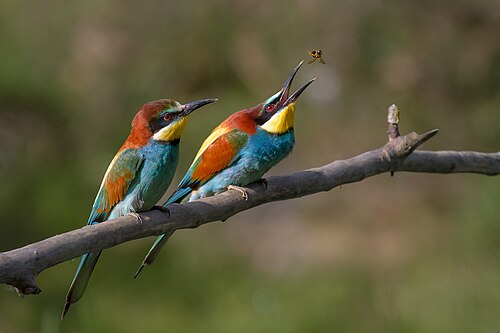
How to identify the European Bee-eater
Merops apiaster
Spotted a bird? Identify it instantly with the Birdby app
Open the appTo correctly identify the European Bee-eater (Merops apiaster), check each of these features. Birds can be tricky: habit, habitat, and call often confirm a sighting that a single photo cannot.
Size at a glance
- Length
- 27-29 cm (including 2-3 cm central tail streamers)
- Wingspan
- 36-40 cm
- Weight
- 44-78 g
Physical features to check
- 1
Plumage
Overall feather coloration and pattern.
Adults have a rich chestnut crown and mantle, fading to yellow on the upper back. The rump is golden-yellow, and the tail is greenish-blue with elongated central tail streamers. The wings are a mix of chestnut, green, and blue. The throat is bright yellow, bordered by a narrow black band, and the breast and belly are turquoise-blue. A prominent black eye-stripe extends from the beak to behind the eye.
- 2
Beak shape
Shape and color of the bill: a key field mark.
Long, slender, decurved (downcurved) black beak, adapted for catching insects in flight.
- 3
Eye color
Iris color and any distinctive eye markings.
Bright red iris.
- 4
Leg color
Leg and foot color.
Dull reddish-brown to greyish-brown.
- 5
Distinguishing features
Standout features that separate this species.
Vibrant multi-colored plumage (chestnut, yellow, blue, green), long decurved black bill, black eye-stripe, yellow throat, and elongated central tail feathers (in adults).
- 6
Juvenile appearance
How young birds differ from adults.
Juveniles are duller overall, lacking the rich chestnut and yellow tones of adults. Their crown and mantle are greenish, and the yellow throat is less vibrant, often lacking the distinct black border. The central tail streamers are absent or very short. The eye-stripe is less defined.
- 7
Seasonal changes
Plumage variation between breeding and non-breeding seasons.
No significant seasonal plumage changes. Breeding and non-breeding plumages are essentially the same, though plumage may appear slightly worn by the end of the breeding season.
- 8
Sexual dimorphism
How males and females differ.
Males and females are largely similar in plumage. Males typically have slightly longer central tail streamers and often more intense chestnut coloration on the crown and mantle, but these differences are subtle and not reliable for field identification.
Key field marks
- Plumage Coloration. Look for the unique combination of rich chestnut on the crown and mantle, golden-yellow rump, bright yellow throat bordered by black, and turquoise-blue underparts. The black eye-stripe is also a key feature.
- Flight and Silhouette. Observe its graceful, undulating flight pattern with stiff wings and its long, slender, slightly decurved bill. In flight, the elongated central tail streamers are often visible.
- Vocalization. Listen for its distinctive, liquid, rolling 'prruup' call, often given repeatedly in flight or from a perch. This call is highly characteristic and often heard before the bird is seen.
- Habitat and Behavior. Look for them in open areas with sandy banks, often perching conspicuously on wires or branches, sallying out to catch insects. Their colonial nesting behavior is also a strong indicator.
Explore the European Bee-eater
Identify birds anywhere
Free on iOS, Android, and Web. Photo & sound identification, full species database, and your personal life list.