
Spotted a bird? Identify it instantly with the Birdby app
Open the appAbout
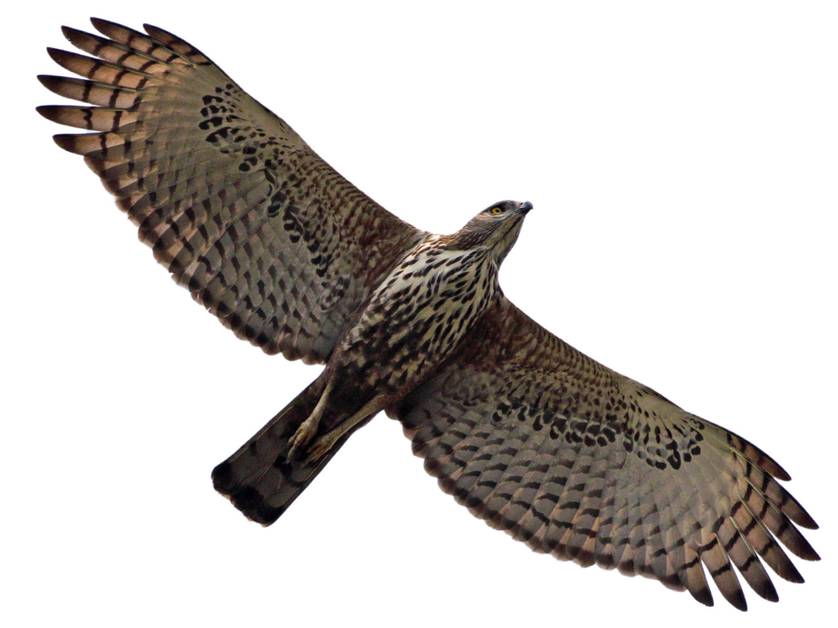
The Changeable Hawk-Eagle is a medium-large raptor found across a wide range of habitats in tropical Asia. Known for its polymorphic plumage, it exhibits significant variation in coloration, from pale to dark morphs, and can be crested or uncrested. It is a powerful predator, primarily feeding on birds and small mammals, often hunting from a perch or soaring high above its territory.
Size & lifespan
- Length
- 55-75 cm
- Wingspan
- 100-160 cm
- Weight
- 1.0-1.9 kg (males), 1.3-2.3 kg (females)
- Lifespan
- Up to 15-20 years in the wild
- Diet
- Carnivore (primarily birds, small mammals, reptiles, and amphibians)
Physical characteristics
- Plumage
- Highly polymorphic, ranging from very pale (whitish underparts, pale brown upperparts) to very dark (dark brown to blackish overall). Intermediate morphs show varying degrees of streaking and barring. Underparts can be plain white, streaked, or heavily barred. Upperparts are typically dark brown. The 'changeable' aspect refers to these significant individual variations, not seasonal changes.
- Beak shape
- Strong, hooked beak, typical of raptors; dark grey to black with a yellow cere.
- Eye color
- Bright yellow to orange-yellow in adults; paler in juveniles.
- Leg color
- Yellow legs and feet with powerful talons.
- Distinguishing features
- Key features include its robust build, relatively long tail, and broad, rounded wings. The presence or absence of a crest (a short, shaggy crest of feathers on the nape) is variable even within the same morph. The underwing pattern often shows dark flight feathers and a paler underwing coverts, though this also varies with morph. In flight, it often holds its wings in a shallow dihedral.
- Juvenile appearance
- Juveniles are typically paler than adults, often with whiter underparts and less distinct markings. The head and underparts may be buffy or rufous, and the eyes are paler yellow. The crest, if present, may be less developed. They gradually acquire adult plumage over 2-3 years.
- Seasonal changes
- No significant seasonal plumage changes. The 'changeable' refers to individual polymorphism, not seasonal variation.
- Sexual dimorphism
- Females are generally larger and heavier than males, but plumage coloration is similar between sexes.
How to identify
- 1
Overall Size and Build
Look for a medium-large, robust raptor with broad wings and a relatively long tail. It appears powerful in flight and perched.
- 2
Plumage Polymorphism
Be aware of the wide range of plumage variations. It can be very pale (whitish underparts, pale brown upperparts) to very dark (dark brown/blackish overall). Intermediate morphs are common, showing streaking or barring on the underparts. Do not expect a single 'typical' plumage.
- 3
Crest (Variable)
Check for a short, shaggy crest on the nape, though its presence and prominence are variable even within the same morph and age. Some individuals are uncrested.
- 4
Underwing Pattern
In flight, observe the underwing. It often shows dark flight feathers contrasting with paler underwing coverts, though this can vary with morph. Look for a dark trailing edge to the wing.
- 5
Flight Profile
Note its powerful flight with strong wing beats and glides. When soaring, wings are held in a shallow dihedral. It can appear quite agile for its size.
- 6
Vocalizations
Listen for its distinctive, loud, high-pitched, and far-carrying 'ki-ki-ki-ki-ki-ki-ki-ki-keee' or 'klee-klee-klee-klee-klee' calls, often accelerating and rising in pitch.
- 7
Habitat
Consider the habitat – it prefers a mix of tall trees and open areas, often in lowlands and foothills across tropical Asia.
Habitat & range
- Biomes
- Tropical and subtropical forests, woodlands, plantations, open country with scattered trees, cultivated areas, and even suburban parks.
- Geographic range
- Widely distributed across tropical Asia, from India and Sri Lanka eastward through Southeast Asia, including the Philippines, Indonesia (Sumatra, Java, Borneo, Sulawesi), and parts of southern China.
- Elevation range
- Primarily found in lowlands and foothills, typically up to 1,500 meters (5,000 feet), but occasionally recorded higher.
- Preferred environments
- Prefers areas with a mix of tall trees for nesting and perching, and open areas for hunting. Often found near water bodies.
Behavior
- Activity time
- Diurnal, active during daylight hours.
- Feeding habits
- A powerful and opportunistic predator. Hunts from a high perch, swooping down on unsuspecting prey, or by soaring high and stooping. Prey includes a wide variety of birds (especially junglefowl, pheasants, pigeons, and smaller raptors), small mammals (squirrels, rats, bats), reptiles (lizards, snakes), and amphibians. It is known to hunt in pairs, with one bird flushing prey towards the other.
- Social behavior
- Generally solitary or found in pairs, especially during the breeding season. Not typically seen in large flocks.
- Flight pattern
- Powerful and agile flight, characterized by strong wing beats interspersed with glides. Soars effortlessly on thermals, often at great heights. When hunting, it can be very swift and direct. Wings are held in a shallow dihedral when soaring.
- Migration pattern
- Mostly resident throughout its range, with no significant migratory movements. Local dispersal of juveniles may occur.
- Territoriality
- Territorial, especially around nesting sites. Pairs will defend their breeding territory from other raptors.
Song & calls
- Song
- Not known for a complex song. Vocalizations are typically calls.
- Call
- A distinctive, loud, high-pitched, and far-carrying 'ki-ki-ki-ki-ki-ki-ki-ki-keee' or 'klee-klee-klee-klee-klee' series, often accelerating and rising in pitch towards the end. Also produces a sharp 'kek-kek-kek' or 'whi-whee' call. Calls are often given in flight or from a prominent perch.
- When they vocalize
- Most vocal during the breeding season, especially around the nest, and when soaring or displaying.
Breeding & reproduction
- Breeding season
- Varies geographically, generally between December and May in India, and later in Southeast Asia, often coinciding with the dry season or early wet season.
- Nesting habits
- Builds a large, bulky stick nest high in a tall tree, often near the canopy. Nests are typically reused year after year and can become quite substantial. Both parents contribute to nest building.
- Clutch size
- 1-2 eggs
- Egg description
- Typically 1-2 eggs, rarely 3. Eggs are dull white or pale buff, sometimes with faint reddish-brown spots or streaks.
- Incubation period
- Approximately 35-40 days, primarily by the female.
- Fledging period
- Chicks fledge around 60-70 days after hatching, but remain dependent on parents for several weeks to months.
- Parental care
- Both parents are involved in raising the young. The female primarily incubates and broods, while the male provides most of the food. After hatching, both parents hunt and feed the chicks.
Where to find
Forest Edges
Often seen perched on tall trees at the edges of forests, woodlands, and plantations, overlooking open areas.
Cultivated Areas
Can be found in agricultural landscapes with scattered large trees, where it hunts for rodents and birds.
Suburban Parks and Gardens
In some parts of its range, it has adapted to human-modified landscapes and can be seen in large parks or gardens with mature trees.
Near Water Bodies
Frequently found near rivers, lakes, or reservoirs, as these areas often attract prey.
Field tips
- Scan Tall Perches. Look for it perched conspicuously on the highest branches of tall trees, dead snags, or electricity pylons, from where it surveys its hunting grounds.
- Watch the Skies. Spend time scanning the sky, especially during mid-morning to early afternoon, as they often soar on thermals, sometimes at considerable heights.
- Listen for Calls. Its loud and distinctive calls are often the first indication of its presence, especially during the breeding season. Learn to recognize its 'ki-ki-ki-keee' call.
- Observe Prey Activity. Areas with high concentrations of potential prey (e.g., junglefowl, pigeons, squirrels) are good places to look.
Similar species
Crested Serpent Eagle
Spilornis cheela
The Crested Serpent Eagle has a much broader, rounded crest, often appearing shaggy. Its underparts are typically heavily spotted or barred, not streaked. It has a distinctive bare yellow face and often shows a broad white band on the tail and underwing. It primarily preys on snakes and lizards, whereas the Changeable Hawk-Eagle focuses more on birds and mammals.
Black Eagle
Ictinaetus malaiensis
The Black Eagle is uniformly glossy black, with distinctive long, splayed primary feathers ('fingers') at the wingtips and a long, narrow tail. It has yellow feet and cere, but lacks the polymorphic plumage of the Changeable Hawk-Eagle. Its flight is often described as buoyant and languid, and it specializes in preying on bird nests and small arboreal mammals.
Mountain Hawk-Eagle
Nisaetus nipalensis
The Mountain Hawk-Eagle is generally larger and more robust. It typically has a more prominent crest (though variable) and more heavily barred underparts, especially on the belly and thighs. Its range is generally at higher elevations and more montane forests. Identification can be challenging where ranges overlap, requiring careful attention to size, crest development, and specific plumage patterns.
Quick facts
- Common Name:
- Changeable Hawk-Eagle
- Scientific Name:
- Nisaetus cirrhatus
- Family:
- Accipitridae
- Diet:
- Carnivore (birds, small mammals, reptiles)
- Habitat:
- Tropical forests, woodlands, cultivated areas
- Conservation Status:
- Least Concern
- Distinguishing Feature:
- Highly polymorphic plumage, variable crest
- Vocalization:
- Loud, high-pitched 'ki-ki-ki-keee' calls
Fun facts
- The 'Changeable' in its name refers to its highly polymorphic plumage, meaning individuals can vary greatly in color from very pale to very dark, rather than changing plumage seasonally.
- It is known to hunt in pairs, with one bird flushing prey towards its partner, demonstrating cooperative hunting behavior.
- Despite its large size, it is an agile hunter, capable of pursuing prey through dense forest canopy.
- Its diet includes a wide variety of prey, showcasing its adaptability as a predator in diverse Asian ecosystems.
Scientific classification
- Kingdom
- Animalia
- Phylum
- Chordata
- Class
- Aves
- Order
- Accipitriformes
- Family
- Accipitridae
- Genus
- Nisaetus
- Species
- Nisaetus cirrhatus
Explore the Changeable Hawk-Eagle
Identify birds anywhere
Free on iOS, Android, and Web. Photo & sound identification, full species database, and your personal life list.