
Spotted a bird? Identify it instantly with the Birdby app
Open the appAbout
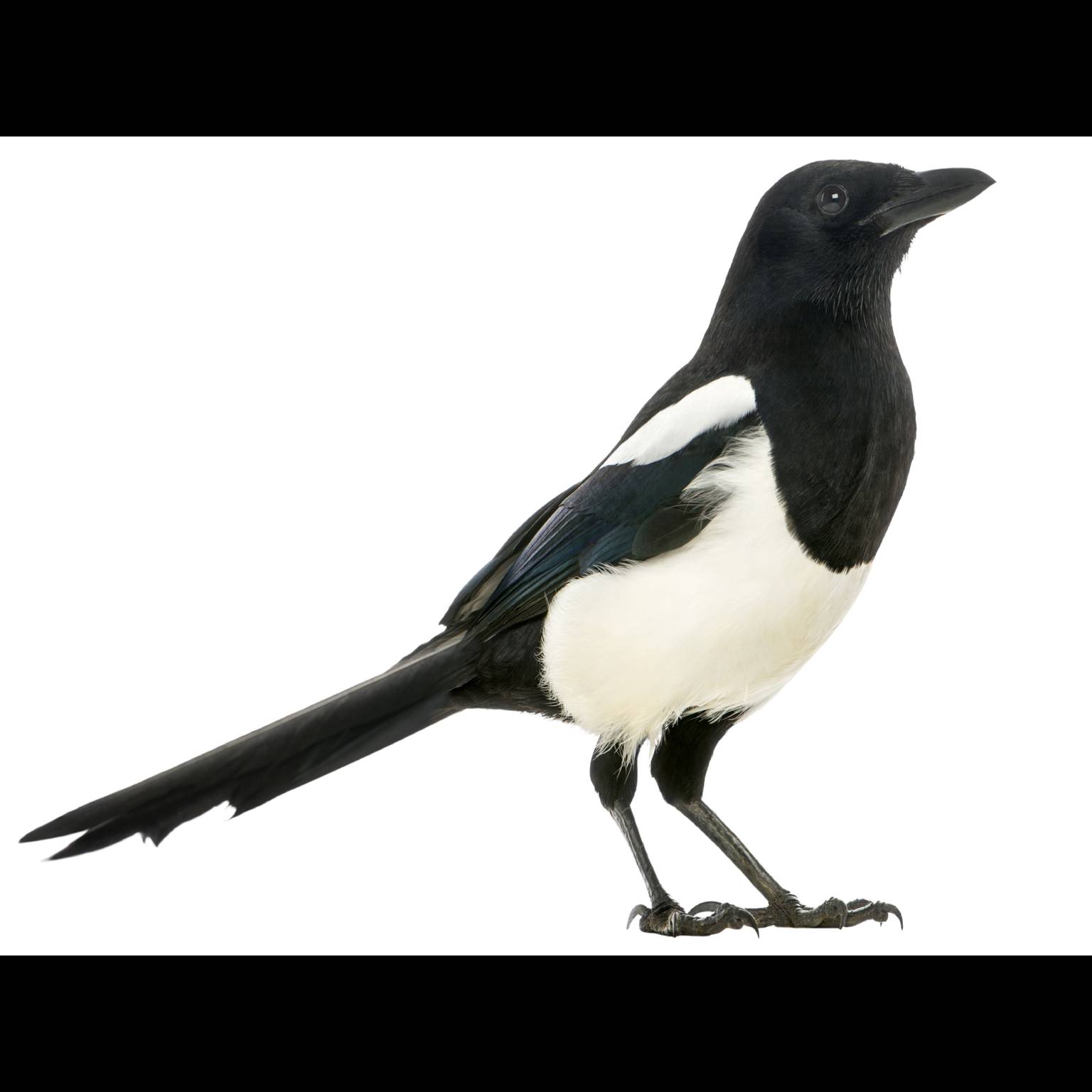
The Eurasian Magpie is a striking, intelligent, and highly recognizable passerine bird belonging to the crow family. Known for its distinctive black and white plumage with iridescent sheens, and its long, graduated tail, it is a common sight across much of Eurasia. It is an omnivorous and opportunistic feeder, often found in close proximity to human settlements.
Size & lifespan
- Length
- 44-50 cm (including tail, which can be 20-30 cm)
- Wingspan
- 52-62 cm
- Weight
- 180-270 g
- Lifespan
- 3-5 years in the wild, up to 15 years in captivity
- Diet
- Omnivore
Physical characteristics
- Plumage
- Adults have glossy black plumage on the head, neck, back, and breast, with a strong iridescent sheen of blue, green, and purple, particularly visible on the wings and tail in good light. The belly and flanks are pure white. The primary flight feathers are white with black tips, forming a prominent white patch on the wing when in flight or at rest. The long, graduated tail is black with a metallic green and bronze sheen.
- Beak shape
- Strong, conical, and pointed black beak.
- Eye color
- Dark brown
- Leg color
- Black
- Distinguishing features
- The combination of glossy black and pure white plumage, the long, graduated tail, and the iridescent sheens on the wings and tail are highly distinctive. The white primary patch is a key field mark.
- Juvenile appearance
- Juveniles resemble adults but have duller, less iridescent black plumage, often with a brownish tinge. Their white areas may be slightly off-white, and their tails are shorter and less glossy, often appearing more pointed at the tip.
- Seasonal changes
- No significant seasonal plumage changes. Plumage remains consistent year-round, though wear and tear can make the iridescence appear less vibrant towards the end of the breeding season.
- Sexual dimorphism
- Males and females are generally monomorphic in plumage, though males tend to be slightly larger and have longer tails than females.
How to identify
- 1
Plumage Pattern
Look for the stark contrast of glossy black and pure white. The black areas (head, back, breast, tail) have a strong iridescent sheen (blue, green, purple) in good light. The belly and flanks are white.
- 2
White Wing Patches
Observe the prominent white patches on the primary flight feathers, visible both at rest and especially in flight. This is a key identifier.
- 3
Tail Length and Shape
Note the exceptionally long, graduated tail, which makes up a significant portion of its total length. The tail is black with metallic green and bronze iridescence.
- 4
Vocalizations
Listen for its characteristic harsh, chattering calls ('chac-chac-chac' or 'shack-shack-shack'). They are often quite noisy.
- 5
Flight Style
Observe its undulating flight pattern, with rapid wing beats followed by short glides. The long tail is very noticeable during flight.
Habitat & range
- Biomes
- Temperate forests, woodlands, scrublands, grasslands, agricultural areas, urban and suburban environments.
- Geographic range
- Widespread across Europe, much of Asia (excluding extreme north and south), and parts of North Africa. Its range extends from the British Isles and Scandinavia eastward through Russia, China, and Korea.
- Elevation range
- Sea level up to 2,500 meters, occasionally higher in some parts of its range.
- Preferred environments
- Highly adaptable, preferring open country with scattered trees, hedgerows, parks, gardens, and urban areas. They thrive in mosaic landscapes that offer both foraging grounds and suitable nesting sites.
Behavior
- Activity time
- Diurnal
- Feeding habits
- Highly opportunistic and omnivorous. Diet includes insects, worms, snails, slugs, small mammals (rodents), young birds and eggs, carrion, seeds, fruits, berries, and human scraps. They often forage on the ground, probing with their beaks, and are known to cache food.
- Social behavior
- Often seen in pairs or small family groups. Outside the breeding season, they can form larger communal roosts, sometimes numbering hundreds of individuals. They are known for their intelligence and complex social structures.
- Flight pattern
- Characterized by a rather heavy, undulating flight with rapid wing beats, interspersed with glides. They often fly low over the ground, especially when moving between foraging areas or to their nests. Their long tail is prominent in flight.
- Migration pattern
- Mostly resident throughout their range. Northern populations may undertake short-distance movements or irruptions in harsh winters, but true long-distance migration is rare.
- Territoriality
- Breeding pairs are territorial, defending their nest site and immediate foraging area. Non-breeding birds may form loose flocks.
Song & calls
- Song
- Magpies do not have a melodious song. Their vocalizations are primarily a series of harsh, chattering calls.
- Call
- The most characteristic call is a rapid, harsh, and often repetitive 'chac-chac-chac' or 'shack-shack-shack'. They also produce a variety of other calls, including softer 'mag' or 'yak' notes, alarm calls, and mimicry of other birds or sounds.
- When they vocalize
- Vocalize throughout the day, particularly active and noisy during the breeding season and when disturbed or communicating within their social groups.
Breeding & reproduction
- Breeding season
- Typically March to June, with peak egg-laying in April.
- Nesting habits
- Build large, domed nests, usually high in trees or tall bushes, often thorny ones for protection. Nests are constructed from sticks, mud, and roots, lined with finer materials, and often have a mud cup. A distinctive feature is the thorny stick dome covering the nest cup, providing protection from predators.
- Clutch size
- 5-8 eggs
- Egg description
- 3-10 (typically 5-8) eggs, pale blue-green to olive-green, heavily spotted and blotched with dark brown, olive, or grey, particularly at the broader end. Average size is about 33 x 23 mm.
- Incubation period
- 17-24 days, primarily by the female.
- Fledging period
- 22-30 days after hatching. Young remain dependent on parents for several weeks after fledging.
- Parental care
- Both parents feed the young, though the female does most of the incubation. After fledging, both parents continue to care for and feed the juveniles for an extended period.
Where to find
Urban and Suburban Parks/Gardens
Common in human-modified landscapes, often seen foraging on lawns, in trees, and around buildings.
Agricultural Land
Frequently found in fields, hedgerows, and farmsteads, where they forage for insects and seeds.
Open Woodlands and Scrub
Prefers areas with a mix of open ground and scattered trees or dense bushes for nesting and roosting.
Field tips
- Look for movement on the ground. Magpies spend a lot of time foraging on the ground, so scan open areas like lawns, fields, and verges.
- Listen for their calls. Their distinctive chattering calls often give away their presence before you see them.
- Observe their flight. Their undulating flight and long tail are good indicators, especially when flying between trees or across open spaces.
- Check high in trees for nests. During breeding season, look for their large, domed stick nests, often in the upper branches of tall trees.
Similar species
Black-billed Magpie
Pica hudsonia
Found in North America. While very similar in appearance, the Black-billed Magpie is generally considered a distinct species, though some taxonomists previously grouped it as a subspecies of P. pica. Field identification is primarily by geographic range.
Oriental Magpie
Pica serica
Found in East Asia. Formerly considered a subspecies of P. pica. It has a slightly longer tail and often more extensive white on the primaries than the Eurasian Magpie, but again, geographic range is the primary differentiator.
Azure-winged Magpie
Cyanopica cyanus
Smaller, with a distinctive blue-grey back, azure-blue wings and tail, and a black cap. Lacks the prominent white belly and large white wing patches of the Eurasian Magpie.
Quick facts
- Family:
- Corvidae (Crow family)
- Diet:
- Omnivorous
- Social Behavior:
- Pairs or small groups, communal roosts outside breeding season
- Conservation Status:
- Least Concern
- Distinguishing Feature:
- Black and white plumage with iridescent sheens and a very long tail
Fun facts
- Eurasian Magpies are one of the few non-mammalian species known to recognize themselves in a mirror, indicating a high level of self-awareness.
- They are renowned for their intelligence, problem-solving abilities, and ability to mimic sounds.
- Magpies are often associated with folklore and superstitions, sometimes seen as symbols of good luck, other times as harbingers of misfortune, depending on the culture.
- Their nests are elaborate structures, often featuring a thorny dome to deter predators, showcasing their engineering skills.
- Despite popular belief, studies have shown that magpies are not particularly attracted to shiny objects more than other birds, and the 'thieving magpie' reputation is largely anecdotal.
Scientific classification
- Kingdom
- Animalia
- Phylum
- Chordata
- Class
- Aves
- Order
- Passeriformes
- Family
- Corvidae
- Genus
- Pica
- Species
- Pica pica
Explore the Eurasian Magpie
Identify birds anywhere
Free on iOS, Android, and Web. Photo & sound identification, full species database, and your personal life list.