
Spotted a bird? Identify it instantly with the Birdby app
Open the appAbout
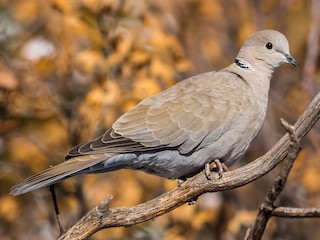
The Eurasian Collared Dove is a medium-sized dove, characterized by its pale grey-buff plumage, black half-collar on the nape, and distinctive cooing call. Originally native to Asia, it has undergone a remarkable and rapid range expansion across Europe and North America in the last century, becoming a common sight in urban and suburban environments.
Size & lifespan
- Length
- 30-33 cm
- Wingspan
- 47-55 cm
- Weight
- 125-240 g
- Lifespan
- 3-7 years (up to 17 years in captivity)
- Diet
- Granivore (primarily seeds, grains, and small fruits)
Physical characteristics
- Plumage
- Overall pale grey-buff, with a pinkish wash on the breast and belly. The back and wings are slightly darker, brownish-grey. The primary flight feathers are darker, almost blackish. The undertail coverts are white. The most distinctive feature is the narrow black half-collar bordered with white on the nape.
- Beak shape
- Slender, dark grey to blackish beak.
- Eye color
- Dark red iris, surrounded by a narrow white orbital ring.
- Leg color
- Reddish-purple legs and feet.
- Distinguishing features
- Black half-collar on the nape, pale grey-buff plumage, and white outer tail feathers visible in flight.
- Juvenile appearance
- Juveniles resemble adults but lack the distinct black half-collar, which develops gradually. Their plumage may appear duller and browner, and their legs and feet are paler.
- Seasonal changes
- No significant seasonal plumage changes. Plumage remains consistent year-round.
- Sexual dimorphism
- Males and females are virtually identical in plumage and size, making them difficult to distinguish visually in the field.
How to identify
- 1
Size and Shape
Medium-sized, plump dove with a relatively long tail. Appears larger and stockier than a Turtle Dove but smaller than a Wood Pigeon.
- 2
Plumage Color
Look for the overall pale grey-buff coloration, with a pinkish wash on the breast. The wings are slightly darker brownish-grey.
- 3
Nape Collar
The most definitive field mark is the narrow black half-collar on the nape (back of the neck), bordered with white.
- 4
Tail Pattern
In flight, observe the white outer tail feathers contrasting with the darker central tail feathers and rump.
- 5
Legs and Eyes
Note the reddish-purple legs and the dark red iris with a narrow white orbital ring.
- 6
Vocalization
Listen for its characteristic three-note 'hoo-hoo-hooo' cooing call, which is very distinctive and often heard repeatedly.
- 7
Behavior
Often seen foraging on the ground in open areas, or perched conspicuously on wires, rooftops, and tree branches in urban/suburban settings. They are generally quite tame.
Habitat & range
- Biomes
- Temperate forests, grasslands, urban and suburban areas, agricultural lands.
- Geographic range
- Native to Asia, it has expanded across Europe, North Africa, and North America. It is now widespread throughout most of these continents.
- Elevation range
- Typically found from sea level up to 2,000 meters, though less common at higher altitudes.
- Preferred environments
- Highly adaptable, preferring human-modified landscapes such as towns, villages, parks, gardens, farms, and areas with scattered trees and food sources. They avoid dense forests and open treeless plains.
Behavior
- Activity time
- Diurnal, most active during daylight hours, particularly in the morning and late afternoon.
- Feeding habits
- Primarily ground feeders, foraging for seeds, grains, and fallen fruits. They often feed in open areas, such as lawns, fields, and bird feeders. They can also consume small invertebrates, berries, and buds. They are opportunistic and will readily visit bird tables.
- Social behavior
- Often seen in pairs or small flocks, especially outside the breeding season when they can form larger communal roosts. They are generally quite tame and accustomed to human presence.
- Flight pattern
- Strong, direct, and purposeful flight with rapid wingbeats. They often glide on stiff wings, especially when descending. In display flight, males perform a 'clapping' flight, ascending steeply and then gliding down.
- Migration pattern
- Mostly resident throughout its range, though some northern populations may undertake short-distance dispersive movements, especially juveniles. The species is known for its rapid and continuous range expansion rather than traditional migration.
- Territoriality
- Males establish and defend small territories around the nest site during the breeding season, primarily through vocalizations and display flights. They can be aggressive towards other doves entering their immediate nesting area.
Song & calls
- Song
- The primary song is a distinctive, monotonous, three-note cooing call, often transcribed as 'hoo-hoo-hooo' or 'coo-COO-coo', with the middle note emphasized and slightly higher pitched. This call is repeated frequently.
- Call
- Besides the song, they emit a harsh, nasal 'krrraah' alarm call when startled or in distress. They also have a soft 'hoo-hoo' contact call.
- When they vocalize
- Vocalizes year-round, but most frequently during the breeding season, from early morning to late evening. They can also be heard cooing at night, especially during full moons or in well-lit urban areas.
Breeding & reproduction
- Breeding season
- Highly extended, often from February/March to October/November, and can breed almost year-round in warmer climates or with abundant food. They are multi-brooded, raising 3-6 broods per year.
- Nesting habits
- Nests are typically flimsy platforms of twigs, often placed in trees, shrubs, or on man-made structures like eaves, window ledges, or utility poles. Both parents participate in nest construction.
- Clutch size
- 2 eggs
- Egg description
- Typically two pure white, elliptical eggs, smooth and non-glossy.
- Incubation period
- 14-18 days, shared by both parents.
- Fledging period
- 15-19 days after hatching. Young leave the nest but are still fed by parents for a short period.
- Parental care
- Both parents share incubation duties and feed the altricial young with 'crop milk' initially, transitioning to regurgitated seeds as they grow.
Where to find
Urban and Suburban Areas
Parks, gardens, residential areas, city centers, and any place with scattered trees and human activity.
Agricultural Lands
Farmyards, grain storage areas, and fields where spilled seeds and grains are abundant.
Bird Feeders
They are frequent visitors to garden bird feeders, especially those offering seeds and grains.
Field tips
- Listen for their call. Their distinctive 'hoo-hoo-hooo' call is often the first indication of their presence, even before you see them.
- Check open ground. They frequently forage on lawns, pavements, and other open ground for seeds. Look for them walking with a characteristic bobbing head motion.
- Scan rooftops and wires. Collared Doves often perch conspicuously on television aerials, power lines, and rooftops, especially when calling or sunning themselves.
- Visit bird feeders. If you have a bird feeder, they are likely to visit, particularly if it offers seeds like sunflower or mixed grains.
Similar species
Turtle Dove
Streptopelia turtur
Smaller and more slender than the Collared Dove. Has a distinctive black and white striped patch on the side of the neck (not a full collar). Plumage is more mottled brown and rufous, with a pinkish breast. Its call is a purring 'turrr-turrr', very different from the Collared Dove's cooing. It is also a migratory species, unlike the largely resident Collared Dove.
African Collared Dove
Streptopelia roseogrisea
Very similar in appearance and often confused, especially where their ranges overlap or in captive populations. The African Collared Dove is generally slightly smaller and paler, with a less distinct black collar. Its call is also a 'hoo-hoo-hooo' but often described as softer and less emphatic. Hybridization can occur.
Mourning Dove
Zenaida macroura
Found in North America. The Mourning Dove is more slender with a longer, pointed tail. It lacks the black half-collar. Its plumage is more uniformly grey-brown, and it has small black spots on the wings. Its call is a mournful 'coo-OO-oo-oo', distinct from the Collared Dove.
Quick facts
- Common Name:
- Eurasian Collared Dove
- Scientific Name:
- Streptopelia decaocto
- Family:
- Columbidae
- Conservation Status:
- Least Concern
- Diet:
- Granivore
- Key ID Feature:
- Black half-collar on nape
- Call:
- Monotonous 'hoo-hoo-hooo'
- Habitat:
- Urban, suburban, agricultural areas
Fun facts
- The Eurasian Collared Dove is one of the most successful avian colonizers in recent history, having expanded its range from Asia across Europe and into North America in less than a century.
- Its rapid expansion is attributed to its adaptability to human-modified environments, its ability to breed multiple times a year, and its generalist diet.
- The species' scientific name 'decaocto' means 'eighteen' in Greek, referring to a legend where a servant girl transformed into a dove and cooed 'decaocto' (18) to complain about her low wages of 18 coins.
- They are known to be quite tame and will often allow close approach by humans, especially in urban settings.
Scientific classification
- Kingdom
- Animalia
- Phylum
- Chordata
- Class
- Aves
- Order
- Columbiformes
- Family
- Columbidae
- Genus
- Streptopelia
- Species
- Streptopelia decaocto
Explore the Eurasian Collared Dove
Identify birds anywhere
Free on iOS, Android, and Web. Photo & sound identification, full species database, and your personal life list.