
Spotted a bird? Identify it instantly with the Birdby app
Open the appAbout
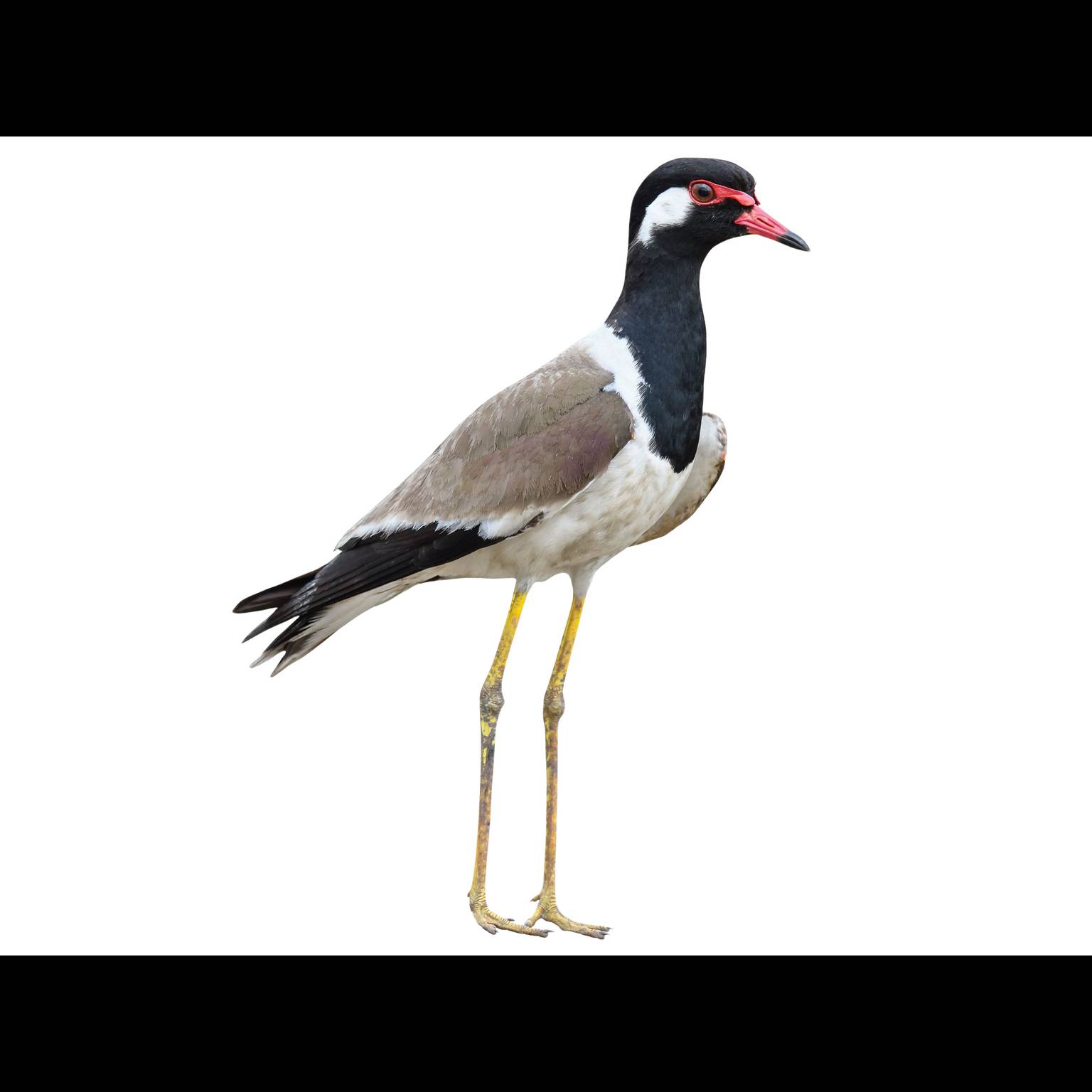
The Red-wattled Lapwing is a medium-sized wader, conspicuous and noisy, commonly found in open country and cultivated lands across South Asia. It is easily identified by its prominent red wattle in front of each eye and its distinctive loud calls.
Size & lifespan
- Length
- 32-35 cm
- Wingspan
- 60-70 cm
- Weight
- 100-250 g
- Lifespan
- Approximately 10-15 years in the wild
- Diet
- Insectivore
Physical characteristics
- Plumage
- Adults have a black head, neck, and upper breast, sharply demarcated from the white underparts. The back and wings are bronze-brown. A prominent white stripe runs from the eye down the side of the neck to the breast. The rump is white, and the tail is black-tipped. In flight, a broad white wing bar is visible.
- Beak shape
- Relatively short, stout, and black with a red base.
- Eye color
- Dark brown, surrounded by a prominent red fleshy wattle.
- Leg color
- Bright yellow, long and slender.
- Distinguishing features
- The most distinctive feature is the bright red fleshy wattle in front of each eye, extending to the base of the bill. The black cap and white belly with bronze-brown back are also key identifiers.
- Juvenile appearance
- Juveniles resemble adults but have duller plumage, a less prominent or absent red wattle, and often have a brownish wash on the black areas of the head and breast. The white stripe on the neck may be less distinct, and the legs are duller yellow.
- Seasonal changes
- No significant seasonal plumage changes. The intensity of the red wattle may be slightly more vibrant during the breeding season.
- Sexual dimorphism
- Males and females are generally similar in plumage, though males may be slightly larger and have a more prominent wattle during the breeding season. Differences are subtle and not reliable for field identification.
How to identify
- 1
Red Wattle
Look for the bright red fleshy wattle in front of each eye. This is the most definitive field mark.
- 2
Head and Neck Pattern
Observe the contrasting black head and neck, sharply defined from the white underparts, with a distinct white stripe running down the side of the neck.
- 3
Plumage Coloration
Note the bronze-brown back and wings, white rump, and black-tipped tail.
- 4
Leg Color
Identify the long, bright yellow legs.
- 5
Vocalization
Listen for its loud, piercing 'did-he-do-it' or 'pity-to-do-it' calls, which are highly characteristic and often heard before the bird is seen.
- 6
Behavior
Watch for its typical 'run-and-peck' foraging style in open fields and its aggressive territorial displays.
Habitat & range
- Biomes
- Grasslands, wetlands, agricultural lands, open country, scrublands, and urban parks.
- Geographic range
- Widely distributed across South Asia, including India, Pakistan, Nepal, Bangladesh, Sri Lanka, and parts of Southeast Asia (Myanmar, Thailand, Cambodia, Vietnam).
- Elevation range
- Typically found from sea level up to 1,800 meters, occasionally higher.
- Preferred environments
- Prefers open, flat or gently undulating areas with short grass or bare ground, often near water bodies such as ponds, lakes, rivers, and irrigation canals. Frequently seen in cultivated fields, pastures, and even urban fringes.
Behavior
- Activity time
- Diurnal, most active during early morning and late afternoon. Can be active on moonlit nights.
- Feeding habits
- Forages on the ground, primarily feeding on insects (beetles, ants, termites, grasshoppers, crickets) and their larvae, as well as other invertebrates like worms and mollusks. It uses a 'run-and-peck' method, often probing the soil with its bill. Occasionally consumes small seeds.
- Social behavior
- Usually seen in pairs or small family groups. Outside the breeding season, they may form larger flocks, especially at communal roosts or feeding sites. Highly territorial during the breeding season.
- Flight pattern
- Strong, direct flight with rapid wing beats. Often flies low over the ground. When disturbed, it takes off with loud calls and circles overhead.
- Migration pattern
- Mostly resident throughout its range, with some local movements in response to rainfall and food availability. Northern populations may undertake short-distance altitudinal or seasonal migrations.
- Territoriality
- Highly territorial, especially during the breeding season. Pairs will aggressively defend their nesting territory against intruders, including much larger birds and even humans, using loud calls and dive-bombing displays.
Song & calls
- Song
- Does not have a complex song. Its vocalizations are primarily calls.
- Call
- Known for its loud, piercing, and distinctive alarm calls, often described as 'did-he-do-it' or 'pity-to-do-it'. These calls are repeated rapidly and can be heard from a considerable distance, especially when disturbed. Also produces softer 'chip' or 'chick' contact calls.
- When they vocalize
- Vocalizes frequently throughout the day, particularly when disturbed or during territorial disputes. Calls are especially prominent during the breeding season and at dawn/dusk.
Breeding & reproduction
- Breeding season
- Primarily March to August, but can vary regionally, often coinciding with the monsoon season.
- Nesting habits
- Nests on the ground in a shallow scrape, often unlined or sparsely lined with pebbles, dung pellets, or small bits of vegetation. Nests are typically in open areas, sometimes near a small stone or clump of grass for camouflage. Both parents participate in nest site selection and preparation.
- Clutch size
- 3-4 eggs
- Egg description
- Typically 3-4 eggs, pyriform (pear-shaped), olive-brown to buff with dark brown or black blotches and streaks, providing excellent camouflage against the ground.
- Incubation period
- 28-30 days
- Fledging period
- Chicks are precocial, able to walk and feed themselves shortly after hatching. They fledge (become capable of sustained flight) in about 4-5 weeks.
- Parental care
- Both parents share incubation duties and care for the young. They are highly protective of their chicks, employing distraction displays (e.g., feigning injury) to lure predators away from the nest or young.
Where to find
Agricultural Fields
Commonly found in cultivated lands, especially freshly plowed or harvested fields.
Wetlands and Water Bodies
Look around the edges of ponds, lakes, rivers, and irrigation canals.
Open Grasslands and Pastures
Frequently seen in short-grass areas and grazing lands.
Urban and Suburban Areas
Can be found in large parks, open grounds, and even on flat rooftops in some urban environments.
Field tips
- Listen for Calls. Their loud calls are often the first indication of their presence. Follow the sound to locate the bird.
- Scan Open Areas. They prefer open ground, so scan fields, pastures, and wetland edges with binoculars.
- Look for Movement. Watch for their characteristic 'run-and-peck' foraging behavior.
- Observe in Pairs/Small Groups. They are often seen in pairs or small family groups, making them easier to spot.
- Be Patient. While conspicuous, their camouflage can make them blend into the background. Patience is key.
Similar species
Yellow-wattled Lapwing
Vanellus malabaricus
The Yellow-wattled Lapwing has a yellow wattle (not red), a brown cap (not black), and lacks the prominent white stripe on the side of the neck. Its legs are also yellow, but the overall plumage is duller brown.
Sociable Lapwing
Vanellus gregarius
The Sociable Lapwing has a black crown and eye-stripe, a white supercilium, and a chestnut belly patch in breeding plumage. It lacks the red wattle and the distinct black-and-white head pattern of the Red-wattled Lapwing. It is also a migratory species, primarily found in Central Asia and wintering in parts of India.
Quick facts
- Common Name:
- Red-wattled Lapwing
- Scientific Name:
- Vanellus indicus
- Family:
- Charadriidae
- Order:
- Charadriiformes
- Size:
- 32-35 cm (length)
- Diet:
- Insects and invertebrates
- Habitat:
- Open country, wetlands, cultivated fields
- Conservation Status:
- Least Concern
- Key Feature:
- Red fleshy wattle in front of eyes
- Vocalization:
- Loud 'did-he-do-it' call
Fun facts
- The Red-wattled Lapwing is often referred to as the 'alarm bird' due to its loud and persistent calls when disturbed, alerting other wildlife to potential danger.
- Its eggs are perfectly camouflaged to blend in with the ground, making them incredibly difficult to spot for predators and humans alike.
- Despite its relatively small size, it is known for its aggressive defense of its nest and young, often dive-bombing much larger animals, including humans.
- In some cultures, the Red-wattled Lapwing's calls are associated with the arrival of the monsoon season.
Scientific classification
- Kingdom
- Animalia
- Phylum
- Chordata
- Class
- Aves
- Order
- Charadriiformes
- Family
- Charadriidae
- Genus
- Vanellus
- Species
- Vanellus indicus
Explore the Red-wattled Lapwing
Identify birds anywhere
Free on iOS, Android, and Web. Photo & sound identification, full species database, and your personal life list.