
Melihat burung? Identifikasi seketika dengan aplikasi Birdby
Buka aplikasiTentang
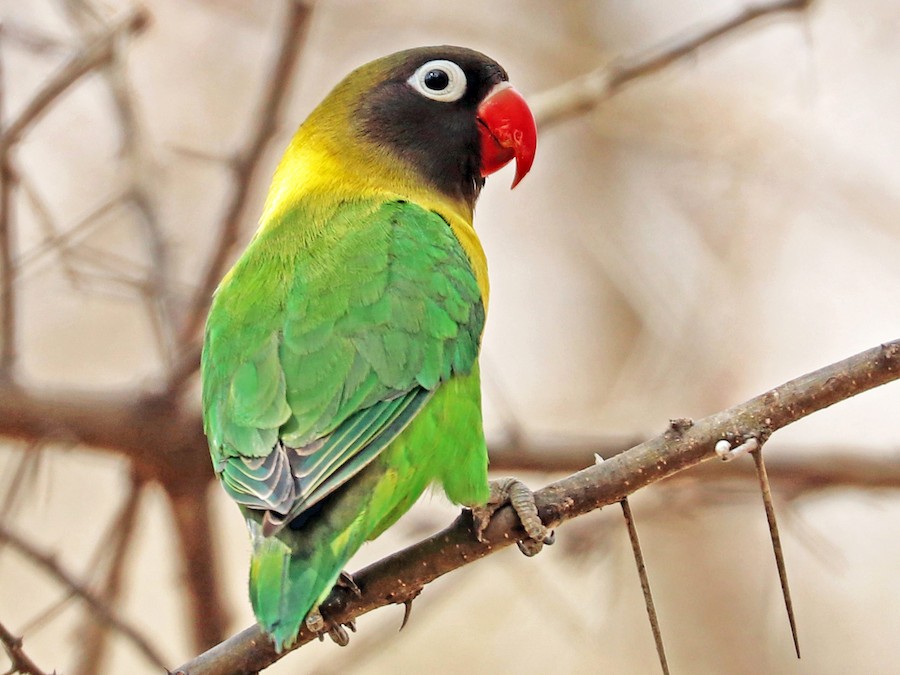
Lovebird Muka Salem, also known as the Yellow-collared Lovebird or Masked Lovebird, is a small, stocky parrot native to the arid and semi-arid regions of northeastern Tanzania. It is characterized by its distinctive black 'mask' on the face, a bright yellow collar, and predominantly green body plumage. These highly social birds are popular in aviculture worldwide due to their vibrant colors and affectionate nature.
Ukuran dan masa hidup
- Panjang
- 14-15 cm
- Bentang sayap
- 20-22 cm
- Berat
- 40-60 g
- Masa hidup
- 10-15 years (in the wild), up to 20 years (in captivity)
- Makanan
- Herbivore (primarily granivorous and frugivorous)
Ciri fisik
- Bulu
- Adults have a striking black head (mask) extending from the forehead to the throat, contrasting sharply with a bright yellow collar around the neck and upper breast. The rest of the body plumage is predominantly green, with a brighter green on the underparts and a darker green on the back and wings. The rump is blue, and the tail feathers are green with orange and black markings near the tips. The primary flight feathers are blackish.
- Bentuk paruh
- Strong, hooked, and conical beak, typically bright red.
- Warna mata
- Dark brown with a prominent white periophthalmic ring (bare skin around the eye).
- Warna kaki
- Greyish-pink to grey.
- Ciri pembeda
- The combination of the black mask, bright yellow collar, and white eye-ring is unique among lovebirds. The red beak is also a key identifier.
- Penampilan muda
- Juveniles resemble adults but have duller plumage, a less intense black mask, and a paler yellow collar. Their beaks may have black markings at the base, which fade with maturity.
- Perubahan musiman
- No significant seasonal plumage changes.
- Dimorfisme seksual
- Monorphic; males and females are visually identical. Sexing typically requires DNA testing or surgical sexing.
Cara identifikasi
- 1
Head and Face
Look for the prominent, solid black 'mask' covering the face from the forehead to the throat. This is the most distinctive feature.
- 2
Neck Collar
Observe the bright yellow band or 'collar' that encircles the neck, immediately behind the black mask.
- 3
Eye-ring
Note the conspicuous white bare skin ring around the dark eyes, which stands out against the black mask.
- 4
Beak Color
Identify the bright red, strong, hooked beak.
- 5
Body Plumage
The rest of the body is predominantly green, with a blue rump, which can be seen in flight or when the bird is perched.
- 6
Vocalizations
Listen for their characteristic high-pitched, chattering, and screeching calls, often given in flight or when in a flock.
Habitat dan persebaran
- Bioma
- Savanna, dry woodlands, acacia and baobab forests, cultivated areas, and suburban gardens.
- Persebaran geografis
- Native to northeastern Tanzania, particularly around the Serengeti National Park and the coastal regions. Feral populations exist in various parts of the world due to escapes from captivity.
- Rentang ketinggian
- Typically found at elevations between 1,100 and 1,700 meters (3,600 to 5,600 feet).
- Lingkungan yang disukai
- Prefers areas with scattered trees, especially acacia, and access to water sources. They adapt well to human-modified landscapes.
Perilaku
- Waktu aktivitas
- Diurnal, most active during early morning and late afternoon.
- Kebiasaan makan
- Feeds primarily on seeds of grasses and acacia, fruits (especially figs), berries, and occasionally insects. They forage in flocks, often on the ground or in trees and shrubs.
- Perilaku sosial
- Highly social birds, typically found in small flocks of 5-20 individuals, but can form larger aggregations of several hundred birds at communal roosts or feeding sites. They are monogamous and form strong pair bonds.
- Pola terbang
- Fast, direct, and undulating flight with rapid wing beats. They are agile flyers, especially when navigating through dense vegetation.
- Pola migrasi
- Resident; generally non-migratory, but may undertake local movements in search of food and water, especially during dry seasons.
- Teritorialitas
- Pairs defend their nest site during the breeding season, but feeding and roosting areas are often shared communally.
Kicauan dan suara
- Kicauan
- Lovebirds do not have complex songs. Their vocalizations are generally described as chattering, twittering, and high-pitched squeaks.
- Panggilan
- Common calls include a series of short, sharp, high-pitched 'screeches' or 'chirps' often repeated rapidly. They also emit softer 'chatter' calls when feeding or interacting within the flock. Alarm calls are louder and more insistent.
- Kapan bersuara
- Vocalize frequently throughout the day, especially when flying, feeding, or interacting with flock members. They are particularly noisy at dawn and dusk.
Reproduksi
- Musim kawin
- Typically occurs during the dry season in their native range, usually between March and May, and again from October to November, coinciding with food availability.
- Kebiasaan bersarang
- Nests are built in tree cavities, often old woodpecker holes, or in crevices in rocks or buildings. They are colonial nesters, with several pairs sometimes nesting in close proximity. The female constructs the nest using strips of bark, leaves, and other plant material, which she tucks into her rump feathers to carry to the nest site.
- Jumlah telur
- 3-8 eggs, typically 4-6.
- Deskripsi telur
- White, oval-shaped eggs.
- Masa inkubasi
- Approximately 22-24 days, primarily by the female.
- Masa terbang
- Chicks fledge (leave the nest) around 42-45 days after hatching.
- Perawatan orang tua
- Both parents feed the chicks, though the female does most of the brooding. Young birds remain dependent on their parents for a short period after fledging.
Di mana ditemukan
National Parks in Tanzania
Serengeti National Park, Tarangire National Park, and other protected areas in northeastern Tanzania are prime locations to observe them in their natural habitat.
Dry Woodlands and Savannas
Look in areas with scattered acacia trees, baobabs, and other dryland vegetation, especially near water sources.
Cultivated Areas and Gardens
They can often be found in agricultural lands and suburban gardens where food and nesting sites are available, particularly in areas where feral populations have established.
Tips lapangan
- Look for Flocks. Lovebirds are highly social; spotting one often means there are more nearby. Look for groups feeding or flying together.
- Listen for Calls. Their noisy, high-pitched calls are often the first indication of their presence, especially when they are in flight or foraging in dense foliage.
- Check Water Sources. Like many arid-dwelling birds, they frequent waterholes and rivers, especially during the hotter parts of the day.
- Observe Feeding Behavior. Watch for them feeding on the ground for seeds or in trees for fruits and berries.
- Early Morning/Late Afternoon. These are their most active periods for foraging and social interaction.
Spesies serupa
Fischer's Lovebird
Agapornis fischeri
Fischer's Lovebird has an orange-red face that fades to yellow on the back of the head and neck, and lacks the distinct black mask and bright yellow collar of the Masked Lovebird. It also has an olive-brown crown, whereas the Masked Lovebird's mask is uniformly black.
Nyasa Lovebird (Lilian's Lovebird)
Agapornis lilianae
Nyasa Lovebird has an orange-red face and throat, but the color is less extensive than Fischer's and it lacks the black mask and yellow collar. Its overall body plumage is also a lighter green.
Fakta singkat
- Native Range:
- Northeastern Tanzania
- Diet:
- Seeds, fruits, berries, some insects
- Sociality:
- Highly social, forms flocks
- Conservation Status:
- Least Concern
- Key ID Feature:
- Black mask, yellow collar, white eye-ring
Fakta menarik
- The name 'Lovebird' comes from their strong, monogamous pair bonds and affectionate behavior, often seen preening each other.
- Female Masked Lovebirds are known for their unique method of carrying nesting material, tucking strips of bark or leaves into their rump feathers.
- Despite being native to Africa, feral populations of Masked Lovebirds have established in various urban areas around the world, including parts of Florida in the USA.
- They are one of the 'eye-ring' lovebird species, distinguished by the bare white skin around their eyes.
Klasifikasi ilmiah
- Kerajaan
- Animalia
- Filum
- Chordata
- Kelas
- Aves
- Ordo
- Psittaciformes
- Famili
- Psittaculidae
- Genus
- Agapornis
- Spesies
- Agapornis personatus
Jelajahi Lovebird Muka Salem
Identifikasi burung di mana saja
Gratis di iOS, Android, dan Web. Identifikasi foto & suara, database spesies lengkap, dan daftar pribadi Anda.