
Melihat burung? Identifikasi seketika dengan aplikasi Birdby
Buka aplikasiTentang
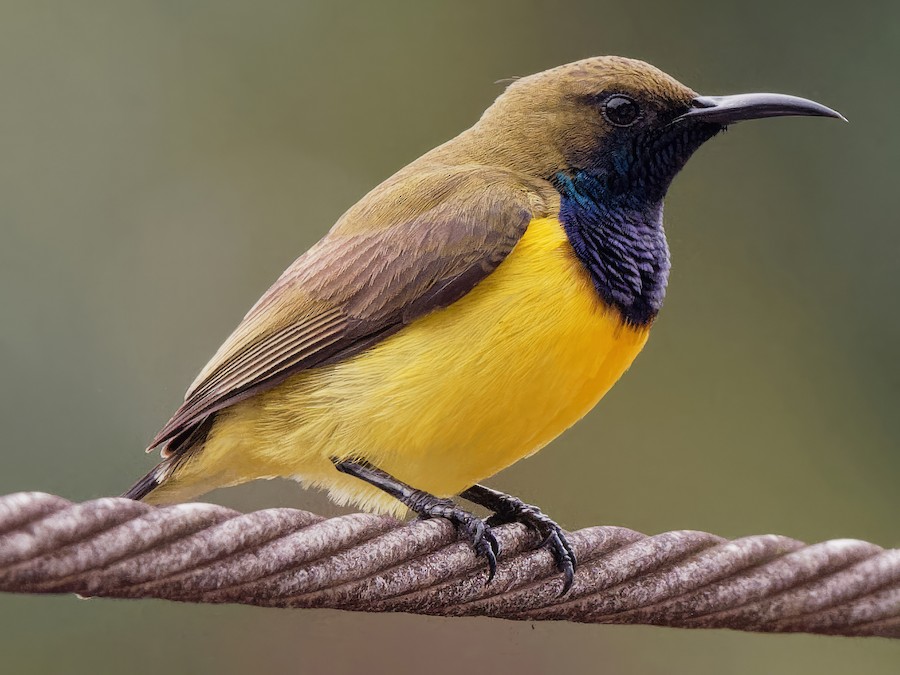
The Olive-backed Sunbird, locally known as Burung Sriganti, is a small passerine bird of the sunbird family. It is widely distributed across Southeast Asia and northeastern Australia, known for its vibrant iridescent plumage in males and its active, nectar-feeding behavior. It is a common and adaptable species, often found in human-modified landscapes.
Ukuran dan masa hidup
- Panjang
- 10-12 cm
- Bentang sayap
- 14-16 cm
- Berat
- 6-11 g
- Masa hidup
- 3-5 years in the wild
- Makanan
- Nectarivore (primarily nectar), Insectivore (spiders and small insects)
Ciri fisik
- Bulu
- Males have a glossy, iridescent metallic blue-black throat and upper breast, contrasting with a bright yellow belly and olive-green back. Females lack the iridescent throat, having a duller olive-green head and upperparts, and a yellow belly. Both sexes have a slender, downcurved black bill and dark legs.
- Bentuk paruh
- Long, slender, and strongly downcurved, adapted for probing into flowers for nectar. Color is black.
- Warna mata
- Dark brown
- Warna kaki
- Dark grey to black
- Ciri pembeda
- The iridescent blue-black throat patch of the male is the most distinctive feature. The bright yellow underparts are also characteristic. Females are distinguished by their plain olive-green upperparts and yellow underparts.
- Penampilan muda
- Juveniles resemble females but are generally duller, with a paler yellow belly and sometimes a faint streaking on the breast. Young males gradually acquire the iridescent throat patch.
- Perubahan musiman
- No significant seasonal plumage changes. Breeding and non-breeding plumages are similar.
- Dimorfisme seksual
- Pronounced. Males are much more brightly colored with iridescent blue-black on the throat and upper breast. Females are duller, lacking the iridescent patch and having an olive-green head.
Cara identifikasi
- 1
Male Plumage
Look for the striking iridescent metallic blue-black throat and upper breast, contrasting sharply with the bright yellow belly and olive-green back. This is the most definitive field mark for males.
- 2
Female Plumage
Identify females by their plain olive-green upperparts and bright yellow underparts, lacking any iridescent throat patch. They are generally duller than males but still have the characteristic sunbird shape and bill.
- 3
Bill Shape
Observe the long, slender, and distinctly downcurved black bill, characteristic of nectar-feeding sunbirds.
- 4
Behavior
Watch for active foraging, often hovering briefly in front of flowers or perching to probe for nectar. Their rapid, darting flight is also a good clue.
- 5
Vocalizations
Listen for their high-pitched, rapid, and often jumbled song, or their sharp 'chip' calls.
Habitat dan persebaran
- Bioma
- Tropical and subtropical moist broadleaf forests, mangroves, coastal scrub, gardens, parks, plantations, and urban areas.
- Persebaran geografis
- Southeast Asia, including India (northeastern), Bangladesh, Myanmar, Thailand, Laos, Cambodia, Vietnam, Malaysia, Singapore, Indonesia, Philippines, Papua New Guinea, and northeastern Australia.
- Rentang ketinggian
- Sea level up to 1,700 meters, though most common in lowlands.
- Lingkungan yang disukai
- Highly adaptable, preferring areas with abundant flowering plants. Commonly found in gardens, parks, orchards, coconut groves, and forest edges, often close to human habitation.
Perilaku
- Waktu aktivitas
- Diurnal, most active during daylight hours, particularly in the morning and late afternoon.
- Kebiasaan makan
- Primarily feeds on nectar, hovering or perching to probe flowers with its long bill and tubular tongue. Also consumes small insects and spiders, especially when feeding young, gleaning them from foliage or catching them in flight. Very active and agile while foraging.
- Perilaku sosial
- Typically seen singly or in pairs, especially during the breeding season. May gather in small groups at abundant food sources. Generally not highly social outside of breeding pairs.
- Pola terbang
- Fast, direct, and often undulating flight, characterized by rapid wing beats. Capable of hovering in front of flowers.
- Pola migrasi
- Mostly resident throughout its range, undertaking only local movements in response to flowering seasons or food availability. Not a long-distance migrant.
- Teritorialitas
- Males can be territorial, especially during the breeding season, defending feeding and nesting areas from rivals and other sunbirds.
Kicauan dan suara
- Kicauan
- A rapid, high-pitched, and often jumbled series of 'tsee-tsee-tsee' notes, sometimes interspersed with trills and whistles. Can be quite energetic and varied.
- Panggilan
- Common calls include a sharp 'chip' or 'chick' and a rapid 'swee-swee-swee'. Alarm calls are typically sharper and more insistent.
- Kapan bersuara
- Most vocal during the breeding season, often singing from prominent perches. Calls are heard throughout the day while foraging or interacting.
Reproduksi
- Musim kawin
- Varies geographically, but generally throughout the year in tropical regions, often peaking after the rainy season when flowers are abundant. For example, in Southeast Asia, it can be from February to August.
- Kebiasaan bersarang
- Nests are typically purse-shaped or pear-shaped, suspended from a thin branch or vine, often in a sheltered location like under a porch or in a dense bush. Constructed by the female using fine grass, plant fibers, spider webs, and often decorated with bits of leaves or lichen. The entrance is usually a small, hooded opening near the top.
- Jumlah telur
- 2-3 eggs
- Deskripsi telur
- Typically 2-3 eggs, oval-shaped, whitish or pale greenish-blue with fine brown or grey speckles and blotches, often concentrated at the broader end.
- Masa inkubasi
- Approximately 13-14 days, primarily by the female.
- Masa terbang
- Chicks fledge (leave the nest) around 14-16 days after hatching. Both parents feed the young.
- Perawatan orang tua
- Both parents participate in feeding the nestlings, though the female does most of the incubation. Young are fed nectar and small insects.
Di mana ditemukan
Gardens and Parks
Common in urban and suburban gardens, parks, and cultivated areas with flowering plants.
Forest Edges and Open Woodlands
Frequently found at the edges of forests, in secondary growth, and open woodlands.
Mangroves and Coastal Areas
Also inhabits coastal scrub and mangrove forests, particularly in certain parts of its range.
Plantations
Can be found in agricultural plantations, especially those with flowering crops or shade trees.
Tips lapangan
- Look for flowering plants. Focus your search on areas with abundant flowering shrubs and trees, as they are primary food sources.
- Listen for calls. Their high-pitched calls and songs can often lead you to their location before you see them.
- Observe active feeding. Watch for small, fast-moving birds hovering or perching at flowers. They are very active feeders.
- Check under eaves or sheltered spots. During breeding season, check under eaves of buildings or sheltered spots in dense foliage for their distinctive hanging nests.
Spesies serupa
Brown-throated Sunbird
Anthreptes malacensis
Larger size, thicker bill, and males have a brown throat (not iridescent blue-black). Females are also duller overall with less vibrant yellow underparts.
Copper-throated Sunbird
Leptocoma calcostetha
Males have an iridescent copper-red throat and breast, not blue-black. Also typically found in mangrove habitats.
Purple-throated Sunbird
Leptocoma sperata
Males have an iridescent purple throat and breast, and a chestnut band across the belly. Generally found in more forested habitats.
Fakta singkat
- Common Name:
- Olive-backed Sunbird / Burung Sriganti
- Scientific Name:
- Cinnyris jugularis
- Family:
- Nectariniidae
- Diet:
- Nectar, small insects, spiders
- Habitat:
- Gardens, parks, forests, mangroves, urban areas
- Conservation Status:
- Least Concern
- Male Identification:
- Iridescent blue-black throat, yellow belly, olive back
- Female Identification:
- Olive-green upperparts, yellow belly, no iridescent throat
Fakta menarik
- The Olive-backed Sunbird is one of the most common and widespread sunbird species in Southeast Asia, often seen even in bustling urban environments.
- Despite their small size, they are quite bold and can be seen defending their feeding territories from other birds, including larger species.
- Their long, tubular tongue is specially adapted to extract nectar from deep within flowers, similar to a hummingbird's.
- The intricate, hanging nest built by the female is a marvel of avian architecture, often incorporating spider webs for elasticity and strength.
- There are numerous subspecies of Cinnyris jugularis recognized across its vast range, showing slight variations in plumage and size.
Klasifikasi ilmiah
- Kerajaan
- Animalia
- Filum
- Chordata
- Kelas
- Aves
- Ordo
- Passeriformes
- Famili
- Nectariniidae
- Genus
- Cinnyris
- Spesies
- Cinnyris jugularis
Jelajahi Olive-backed Sunbird
Identifikasi burung di mana saja
Gratis di iOS, Android, dan Web. Identifikasi foto & suara, database spesies lengkap, dan daftar pribadi Anda.