
Melihat burung? Identifikasi seketika dengan aplikasi Birdby
Buka aplikasiTentang
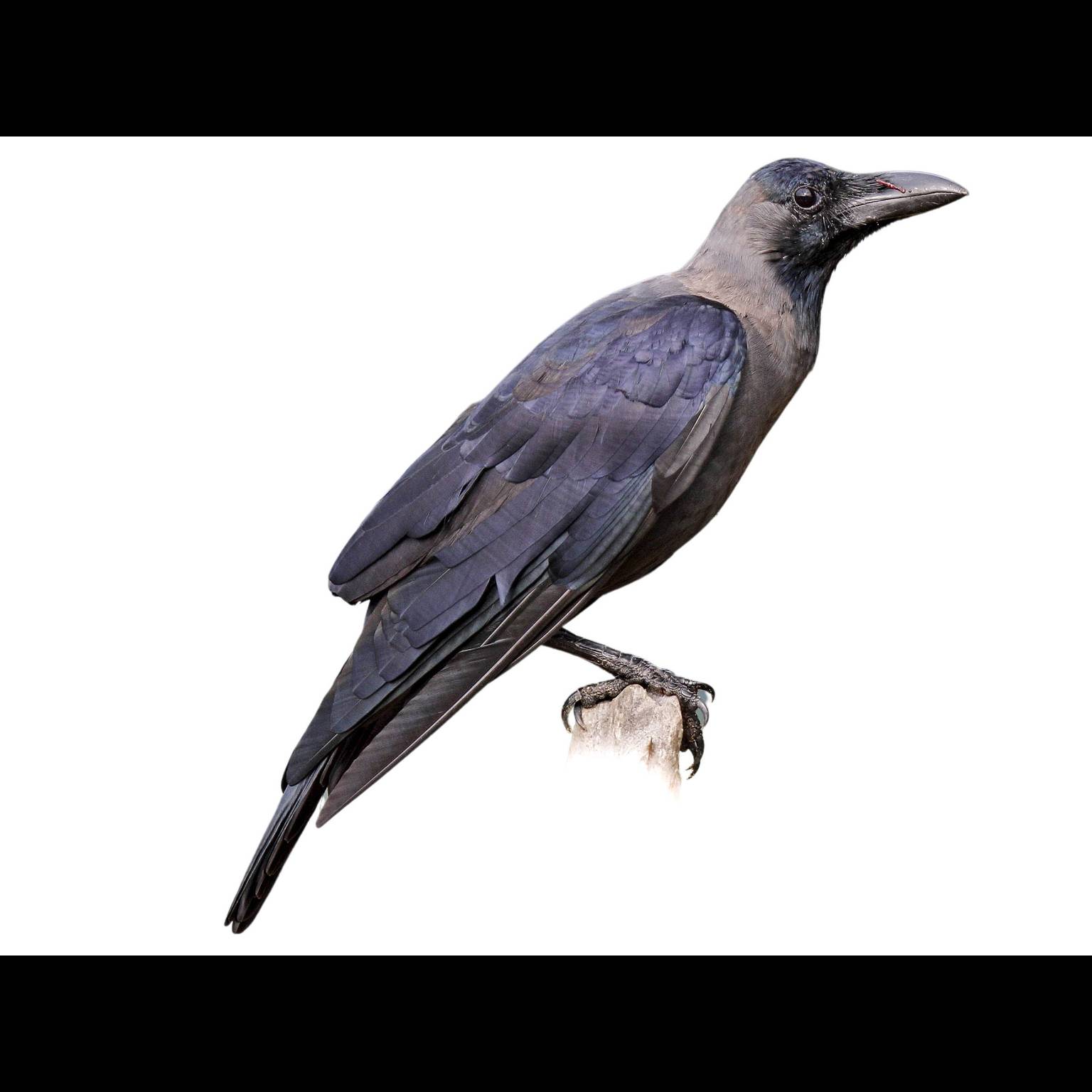
The House Crow (Corvus splendens), known in Malay as Burung Gagak Rumah, is a medium-sized passerine bird of the crow family that is native to the Indian subcontinent and parts of Southeast Asia. It is a highly adaptable and opportunistic species, thriving in urban and suburban environments due to its commensal relationship with humans. It is often considered a pest due to its scavenging habits and potential to spread disease, but also plays a role in waste management in some areas. Its intelligence and social behavior are notable characteristics.
Ukuran dan masa hidup
- Panjang
- 40-43 cm (16-17 in)
- Bentang sayap
- 76-85 cm (30-33 in)
- Berat
- 250-350 g (8.8-12.3 oz)
- Masa hidup
- 6-10 years in the wild, up to 15 years in captivity
- Makanan
- Omnivore, highly opportunistic. Feeds on human refuse, insects, small vertebrates (lizards, rodents, nestlings), eggs, fruits, seeds, and nectar.
Ciri fisik
- Bulu
- Overall glossy black plumage, but with a distinctive greyish-brown nape, neck, and upper breast. The rest of the body, including the head, wings, and tail, is a deep, iridescent black. The grey areas can vary in shade from pale ash-grey to darker sooty-grey.
- Bentuk paruh
- Stout, slightly decurved, and sharply pointed black beak.
- Warna mata
- Dark brown
- Warna kaki
- Black
- Ciri pembeda
- The most distinguishing feature is the combination of glossy black plumage with the contrasting grey nape, neck, and upper breast. Its relatively slender build compared to other crows is also a key feature. The tail is relatively short and square-tipped.
- Penampilan muda
- Juveniles resemble adults but have duller, less glossy black plumage and the grey areas are often less distinct and may appear more brownish. Their eyes may also appear slightly paler initially.
- Perubahan musiman
- No significant seasonal plumage changes. The plumage remains consistent throughout the year, though wear and tear can make it appear less glossy over time.
- Dimorfisme seksual
- Males and females are monomorphic, meaning they are visually identical in plumage and size. There are no discernible external differences between the sexes.
Cara identifikasi
- 1
Plumage Coloration
Look for the unique combination of glossy black body, wings, and tail, contrasted sharply with a greyish-brown nape, neck, and upper breast. This bicolored appearance is the most reliable field mark.
- 2
Size and Build
Note its medium size (smaller than most other crows in its range) and relatively slender build. It's not as bulky as a Large-billed Crow.
- 3
Beak
Observe the black, stout, and slightly decurved beak. It's not as massive as that of a Large-billed Crow.
- 4
Vocalizations
Listen for its characteristic harsh, repeated 'kaa-kaa' or 'caw-caw' calls. These are distinct from the deeper calls of larger crows.
- 5
Habitat
House Crows are almost exclusively found in close proximity to human settlements. If you see a crow in a busy urban or suburban area in its native range, it's very likely a House Crow.
Habitat dan persebaran
- Bioma
- Urban, suburban, agricultural lands, coastal areas, open woodlands, and human-modified landscapes.
- Persebaran geografis
- Native to the Indian subcontinent (India, Pakistan, Bangladesh, Sri Lanka, Maldives, Nepal, Bhutan) and parts of Southeast Asia (Myanmar, Thailand, Malaysia, Singapore). Introduced populations exist in various parts of the world, including East Africa, the Middle East, and Australia.
- Rentang ketinggian
- Primarily found in lowlands and up to approximately 2,000 meters (6,500 feet) in some parts of its native range, especially in human-dominated areas.
- Lingkungan yang disukai
- Highly commensal with humans, preferring areas with human habitation, such as towns, cities, villages, ports, and agricultural areas. They are rarely found in dense forests or remote wilderness.
Perilaku
- Waktu aktivitas
- Diurnal. Most active during daylight hours, particularly in the morning and late afternoon. Roosts communally at night.
- Kebiasaan makan
- Highly opportunistic and omnivorous. Scavenges extensively on human food waste, carrion, and refuse. Also actively forages for insects, worms, small reptiles, amphibians, eggs, nestlings of other birds, fruits, and seeds. Known to raid crops and poultry farms. Often forages in groups.
- Perilaku sosial
- Highly social birds, often found in pairs or small family groups, but can form large communal roosts, sometimes numbering in the thousands, especially outside the breeding season. They are intelligent and exhibit complex social interactions, including cooperative foraging and mobbing predators.
- Pola terbang
- Direct, strong, and purposeful flight with steady wing beats. Can also glide for short distances. Often seen soaring on thermals. Agile in flight, especially when pursuing prey or evading threats.
- Pola migrasi
- Resident throughout its range. Does not undertake seasonal migrations. Local movements may occur in response to food availability.
- Teritorialitas
- Pairs defend a breeding territory during the nesting season. Outside of breeding, they are less territorial and often forage in communal groups.
Kicauan dan suara
- Kicauan
- The House Crow does not have a melodious song. Its vocalizations are primarily harsh calls.
- Panggilan
- A variety of harsh, guttural calls. The most common call is a loud, distinctive 'kaa-kaa' or 'caw-caw', often repeated. They also produce a 'kraa-kraa' or 'kwaa-kwaa' sound, sometimes with a slightly nasal quality. Alarm calls are sharper and more insistent. They can also mimic other bird calls and sounds from their environment.
- Kapan bersuara
- Vocalizes throughout the day, especially during dawn and dusk, and when interacting with other crows, defending territory, or alarming others to potential threats.
Reproduksi
- Musim kawin
- Varies geographically, but generally between March and July in most parts of its range, coinciding with warmer months and increased food availability.
- Kebiasaan bersarang
- Nests are typically large, untidy structures made of sticks, twigs, and often incorporating human-made materials like wire, plastic, and cloth. They are usually placed high in trees, often near human habitation, but also on artificial structures like telephone poles, buildings, and pylons. Both sexes participate in nest building.
- Jumlah telur
- Typically 3-6 eggs, but can range from 2-7 eggs.
- Deskripsi telur
- Eggs are typically pale blue-green to greenish-blue, heavily marked with dark brown, olive, or grey spots and blotches, particularly at the broader end. They are oval to sub-elliptical in shape.
- Masa inkubasi
- 16-17 days, primarily by the female.
- Masa terbang
- 21-28 days after hatching. Young birds remain dependent on parents for some time after fledging.
- Perawatan orang tua
- Both parents participate in feeding and caring for the young. The female primarily incubates, while the male brings food. After hatching, both parents forage for food to feed the nestlings.
Di mana ditemukan
Urban and Suburban Areas
Look in cities, towns, villages, parks, gardens, and residential areas where human activity is prevalent. They are common around markets, garbage dumps, and food establishments.
Coastal Areas and Ports
Often found in port cities and coastal towns, scavenging for food scraps.
Agricultural Lands
Can be seen in agricultural areas, especially near human dwellings or where crops are grown.
Tips lapangan
- Listen for Calls. Their distinctive 'kaa-kaa' calls are often the first indication of their presence, especially in noisy urban environments.
- Observe Scavenging Behavior. Look for them near sources of human food waste, such as open bins, markets, or outdoor eating areas. They are bold and often approach humans.
- Check Roosts at Dusk. At dusk, large numbers of House Crows often gather at communal roosts in tall trees or on buildings, providing an opportunity to see many individuals.
- Look for the Grey Patch. When observing, specifically look for the grey nape and breast to confirm identification and differentiate it from other all-black crow species.
Spesies serupa
Large-billed Crow
Corvus macrorhynchos
The Large-billed Crow is entirely glossy black, lacking the grey nape and breast of the House Crow. It is also generally larger with a noticeably heavier and more robust bill. Its calls are typically deeper and more resonant.
Carrion Crow
Corvus corone
The Carrion Crow is entirely black, similar to the Large-billed Crow, and lacks the grey coloration of the House Crow. It is also generally larger and more robust than the House Crow. Its range does not typically overlap with the native range of the House Crow in Southeast Asia.
Rook
Corvus frugilegus
Rooks are entirely black, but adults have a distinctive bare, whitish patch of skin at the base of the bill. They are also generally larger than House Crows and have a more pointed head shape. Their calls are also distinct.
Fakta singkat
- Native Range:
- Indian subcontinent and parts of Southeast Asia
- Habitat Preference:
- Urban and human-modified environments
- Diet:
- Omnivorous scavenger
- Sociality:
- Highly social, forms large roosts
- Conservation Status:
- Least Concern (but considered an invasive pest in some introduced ranges)
Fakta menarik
- House Crows are known for their intelligence and problem-solving abilities, often observed using tools or devising strategies to obtain food.
- They have a remarkable ability to adapt to human environments, leading to their successful colonization of new areas as an invasive species.
- In some cultures, House Crows are associated with folklore and superstitions, sometimes seen as messengers or omens.
- Their communal roosts can be incredibly large, with thousands of individuals gathering together, creating a significant noise and mess.
Klasifikasi ilmiah
- Kerajaan
- Animalia
- Filum
- Chordata
- Kelas
- Aves
- Ordo
- Passeriformes
- Famili
- Corvidae
- Genus
- Corvus
- Spesies
- Corvus splendens
Jelajahi House Crow
Identifikasi burung di mana saja
Gratis di iOS, Android, dan Web. Identifikasi foto & suara, database spesies lengkap, dan daftar pribadi Anda.