
Melihat burung? Identifikasi seketika dengan aplikasi Birdby
Buka aplikasiTentang
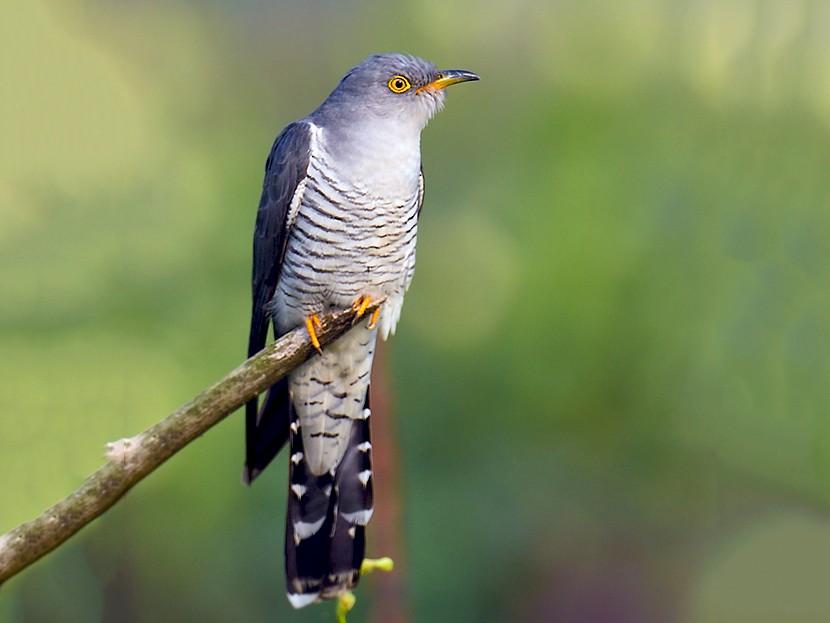
The Common Cuckoo is a medium-sized, brood-parasitic bird found across Eurasia and Africa. It is renowned for its distinctive 'cuck-oo' call and its unique reproductive strategy of laying eggs in the nests of other bird species.
Ukuran dan masa hidup
- Panjang
- 32-34 cm
- Bentang sayap
- 55-60 cm
- Berat
- 105-130 g (male), 115-140 g (female)
- Masa hidup
- 6-8 years (up to 12 years recorded)
- Makanan
- Insectivore, primarily caterpillars (especially hairy ones avoided by other birds)
Ciri fisik
- Bulu
- Adult males typically have slate-grey upperparts, head, and chest, with white underparts finely barred with black. Adult females can be similar to males (grey morph) or have rufous-brown upperparts and head, heavily barred with black (hepatic morph).
- Bentuk paruh
- Relatively slender, slightly downcurved, dark grey to black with a yellowish base to the lower mandible.
- Warna mata
- Bright yellow eye-ring and iris in adults.
- Warna kaki
- Short, strong, and yellow.
- Ciri pembeda
- Long, wedge-shaped tail, pointed wings, and a hawk-like silhouette in flight. The barred underparts are a key feature.
- Penampilan muda
- Juveniles are typically dark grey-brown on the upperparts, heavily barred with rufous and black, giving a scaly appearance. They have a white nape patch and a white-barred belly. The eye-ring and iris are duller, often brownish-yellow.
- Perubahan musiman
- No significant seasonal plumage changes in adults, though plumage can become worn by late summer. Juveniles molt into adult-like plumage in their first autumn/winter.
- Dimorfisme seksual
- Males are generally slightly larger and more uniformly grey. Females can be grey morph (similar to male but often with a rufous wash on the breast) or hepatic morph (distinctly rufous-brown and barred).
Cara identifikasi
- 1
Call
The male's distinctive 'cuck-oo' call is the most reliable and often the first sign of its presence. Listen for the bubbling call of the female.
- 2
Flight Silhouette
Observe its flight. It has a hawk-like silhouette with pointed wings and a long, wedge-shaped tail. It often flies with rapid wing beats followed by glides.
- 3
Plumage (Adult Male)
Look for uniform slate-grey upperparts, head, and chest, contrasting with white underparts finely barred with black. Yellow eye-ring and legs are also key.
- 4
Plumage (Adult Female - Hepatic Morph)
If you see a rufous-brown bird with heavy black barring on the upperparts and head, and barred underparts, it's likely a hepatic female cuckoo.
- 5
Plumage (Juvenile)
Look for a scaly, dark grey-brown upperparts with rufous and black barring, a white nape patch, and barred underparts. Dull yellow eye-ring.
- 6
Behavior
Cuckoos are often secretive, perching quietly in trees or shrubs. They are not typically seen feeding young, as they are brood parasites.
Habitat dan persebaran
- Bioma
- Forests, woodlands, scrublands, heathlands, grasslands, agricultural areas, and open country with scattered trees.
- Persebaran geografis
- Breeds across most of Europe and Asia, from the Atlantic to the Pacific. Winters in sub-Saharan Africa and parts of Southeast Asia.
- Rentang ketinggian
- Sea level up to 3,000 meters in some mountainous regions.
- Lingkungan yang disukai
- Prefers open or semi-open habitats with a mix of trees, shrubs, and open ground, often near water. The presence of suitable host species is a critical factor.
Perilaku
- Waktu aktivitas
- Diurnal.
- Kebiasaan makan
- Primarily insectivorous, specializing in large, hairy caterpillars (e.g., Lasiocampidae, Arctiidae) that are toxic or unpalatable to many other birds. They pluck caterpillars from foliage or the ground. Also consumes other insects like beetles, grasshoppers, and larvae.
- Perilaku sosial
- Solitary for most of its life, except during the breeding season when males establish territories and females seek out host nests. Not social outside of breeding interactions.
- Pola terbang
- Strong, direct, and hawk-like flight with rapid wing beats, often gliding. Can be mistaken for a small raptor, especially a Eurasian Sparrowhawk (Accipiter nisus).
- Pola migrasi
- Long-distance migratory. Breeds in temperate Eurasia and migrates south to wintering grounds in tropical Africa and Southeast Asia. Migration occurs mainly at night.
- Teritorialitas
- Males are highly territorial during the breeding season, defending their calling posts and display areas. Females are not territorial in the traditional sense but maintain a 'laying range' where they monitor host nests.
Kicauan dan suara
- Kicauan
- The iconic 'cuck-oo' call, typically given by the male. The first syllable is higher pitched and louder, followed by a slightly lower, softer second syllable. It can be repeated many times.
- Panggilan
- Females have a distinctive bubbling or trilling call, often described as 'kwik-kwik-kwik' or 'whit-whit-whit', particularly when agitated or after laying an egg. Males also have a 'hup-hup-hup' call.
- Kapan bersuara
- Males call frequently from April to July during the breeding season, primarily in the morning and evening, but also throughout the day. Females call less frequently, mainly around egg-laying.
Reproduksi
- Musim kawin
- April to July in temperate breeding grounds.
- Kebiasaan bersarang
- Obligate brood parasite. Does not build its own nest. Females lay their eggs in the nests of over 100 different host species, though individual females often specialize in one or a few host species. Common hosts include Dunnock, Meadow Pipit, Reed Warbler, and Pied Wagtail.
- Jumlah telur
- A female cuckoo lays one egg per host nest, but can lay 12-25 eggs in a season across multiple host nests.
- Deskripsi telur
- Eggs are typically small for the cuckoo's size, often mimicking the size, color, and pattern of the host species' eggs. This mimicry is crucial for successful parasitism. Eggs can be white, blue, green, or spotted, depending on the host race.
- Masa inkubasi
- 11-13 days, typically shorter than most host species, allowing the cuckoo chick to hatch first.
- Masa terbang
- 17-21 days. The cuckoo chick usually ejects host eggs or young from the nest shortly after hatching, ensuring it receives all parental care.
- Perawatan orang tua
- None from the biological parents. The cuckoo chick is entirely raised by the unwitting host parents.
Di mana ditemukan
Woodlands and Forests
Look in deciduous and mixed woodlands, especially those with open clearings or edges.
Heathlands and Moorlands
Often found in open heathland and moorland areas where host species like Meadow Pipits are abundant.
Reedbeds
In areas with extensive reedbeds, as Reed Warblers are common hosts.
Agricultural Landscapes
Can be found in agricultural areas with hedgerows, scattered trees, and scrub.
Tips lapangan
- Listen for the call. The male's 'cuck-oo' call is the most reliable way to detect its presence, especially from April to July. Learn to distinguish it from other bird calls.
- Scan for hawk-like birds. Due to its flight and silhouette, it can be mistaken for a small raptor. Pay attention to the lack of a hooked beak and prominent talons.
- Look for host activity. While difficult, observing small passerines aggressively mobbing a cuckoo can indicate its presence, as they recognize it as a threat to their nests.
- Be patient and observant. Cuckoos can be elusive. Find a good vantage point in suitable habitat and wait quietly, listening and scanning the trees and open areas.
Spesies serupa
Eurasian Sparrowhawk
Accipiter nisus
Common Cuckoos have a longer, more pointed tail, and their flight is often more direct and less agile than a Sparrowhawk. Cuckoos lack the prominent supraorbital ridge (brow) of a raptor, giving them a 'gentler' facial expression. The barring on the cuckoo's underparts is finer and more regular than the broader barring of a female Sparrowhawk. Cuckoos also have yellow legs, while Sparrowhawks have yellow legs but with prominent talons.
Great Spotted Cuckoo
Clamator glandarius
The Great Spotted Cuckoo is larger, has a prominent crest, and is heavily spotted on the upperparts. Its underparts are whiter and less barred than the Common Cuckoo. Its call is also very different.
Oriental Cuckoo
Cuculus optatus
Very similar in appearance to the Common Cuckoo, especially the grey morph. Key differences are subtle: Oriental Cuckoo often has a slightly darker grey throat and breast, and the barring on the flanks can be slightly coarser. The call is distinct: a two-note 'hoo-hoo' or three-note 'hoo-hoo-hoo' rather than the Common Cuckoo's 'cuck-oo'.
Fakta singkat
- Brood Parasite:
- Lays eggs in other birds' nests.
- Diet Specialization:
- Eats hairy caterpillars.
- Migration:
- Long-distance migrant to Africa and Asia.
- Call:
- Iconic 'cuck-oo' call of the male.
- Mimicry:
- Eggs often mimic host eggs.
Fakta menarik
- The word 'cuckoo' is onomatopoeic, derived directly from the male's call.
- Female cuckoos can lay up to 25 eggs in a single breeding season, each in a different host nest.
- The cuckoo chick typically ejects all host eggs or young from the nest within hours or days of hatching, ensuring it receives all food and attention.
- Some female cuckoos specialize in parasitizing a particular host species, and their eggs have evolved to mimic the eggs of that specific host.
- The Common Cuckoo is a symbol of spring in many cultures and its call has been incorporated into numerous folk songs and poems.
Klasifikasi ilmiah
- Kerajaan
- Animalia
- Filum
- Chordata
- Kelas
- Aves
- Ordo
- Cuculiformes
- Famili
- Cuculidae
- Genus
- Cuculus
- Spesies
- Cuculus canorus
Jelajahi Common Cuckoo
Identifikasi burung di mana saja
Gratis di iOS, Android, dan Web. Identifikasi foto & suara, database spesies lengkap, dan daftar pribadi Anda.