
Melihat burung? Identifikasi seketika dengan aplikasi Birdby
Buka aplikasiTentang
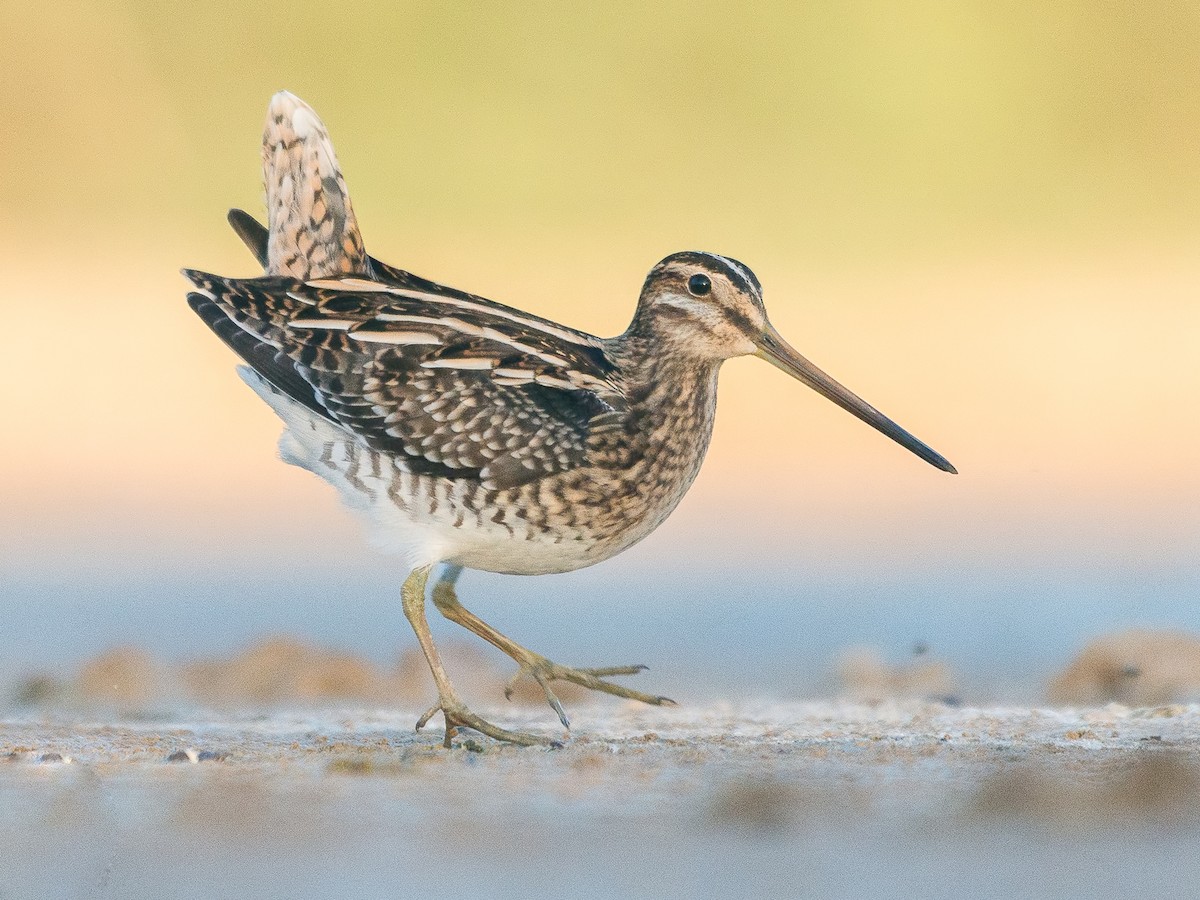
The Common Snipe is a medium-sized, cryptically plumaged wading bird with a very long, straight bill. It is known for its distinctive 'drumming' display flight and its preference for wet, marshy habitats.
Ukuran dan masa hidup
- Panjang
- 23-28 cm (9.1-11.0 in)
- Bentang sayap
- 39-45 cm (15-18 in)
- Berat
- 80-140 g (2.8-4.9 oz), occasionally up to 180 g
- Masa hidup
- Typically 2-5 years in the wild, with records up to 10 years.
- Makanan
- Insectivore, primarily feeding on invertebrates.
Ciri fisik
- Bulu
- Upperparts are mottled brown, black, and buff, providing excellent camouflage. The head has prominent dark and pale stripes (crown stripe, supercilium, eye-stripe). Underparts are whitish with streaking on the breast and flanks. The tail is short, wedge-shaped, and rufous-orange at the sides, often visible in flight.
- Bentuk paruh
- Very long (6-7 cm), straight, slender, and dark-tipped bill, pale at the base.
- Warna mata
- Dark brown.
- Warna kaki
- Greenish-grey to yellowish-green.
- Ciri pembeda
- Extremely long bill, cryptic brown streaky plumage, prominent head stripes, and a short, fanned rufous tail in flight. The pointed wings are also a key feature in flight.
- Penampilan muda
- Juveniles resemble adults but often have paler, less distinct streaking on the breast and flanks, and their plumage may appear slightly fresher or less worn.
- Perubahan musiman
- No significant seasonal plumage changes. Breeding and non-breeding plumages are essentially identical.
- Dimorfisme seksual
- Males and females are generally monomorphic in plumage and size, making them difficult to distinguish visually in the field.
Cara identifikasi
- 1
Long Bill
Look for the exceptionally long, straight bill, which is a primary identification feature.
- 2
Head Pattern
Observe the distinct dark and pale stripes on the head: a pale central crown stripe, dark lateral crown stripes, a pale supercilium (eyebrow), and a dark eye-stripe.
- 3
Plumage Camouflage
Note the intricate mottled brown, black, and buff plumage on the upperparts, designed for blending into marshy vegetation.
- 4
Flight Pattern
When flushed, look for the characteristic rapid, erratic, zig-zagging flight, often accompanied by a sharp 'scaap' call.
- 5
Tail in Flight
In flight, especially when taking off, look for the short, fanned tail with rufous-orange sides.
- 6
Drumming Display
Listen for the unique 'drumming' sound produced by the male's tail feathers during its aerial display, particularly during the breeding season.
Habitat dan persebaran
- Bioma
- Wetlands, marshes, bogs, fens, wet meadows, tundra, and damp grasslands.
- Persebaran geografis
- Widespread breeding range across the Palearctic and North America. Winters in southern Europe, Africa, South Asia, and Central and South America.
- Rentang ketinggian
- Primarily lowlands, but can be found at higher altitudes in suitable wetland habitats, especially during breeding season.
- Lingkungan yang disukai
- Areas with dense, low vegetation for cover, soft muddy ground for probing, and shallow water. Requires a mosaic of open wet areas and tussocks for nesting and foraging.
Perilaku
- Waktu aktivitas
- Primarily crepuscular and nocturnal, especially when foraging, but can be active during the day, particularly during breeding season or when disturbed.
- Kebiasaan makan
- Probes its long bill deep into soft mud and soil to extract invertebrates such as worms (especially earthworms), insect larvae (e.g., cranefly larvae), molluscs, and crustaceans. It uses sensitive nerve endings at the tip of its bill to detect prey. Occasionally consumes plant material.
- Perilaku sosial
- Generally solitary or found in loose groups, especially outside the breeding season. During migration, they may form larger flocks.
- Pola terbang
- Typically takes off with a zig-zagging, erratic flight pattern, often accompanied by a harsh 'scaap' call, before settling into a more direct, swift flight. During display, males perform a spectacular 'drumming' flight, climbing high and then diving, producing a unique sound with vibrating outer tail feathers.
- Pola migrasi
- Migratory across much of its range. Northern populations move south for the winter, while some southern populations may be resident or undertake shorter movements. Migrates at night.
- Teritorialitas
- Males are territorial during the breeding season, defending their display and nesting areas. They perform aerial displays to attract mates and deter rivals.
Kicauan dan suara
- Kicauan
- The most distinctive 'song' is the 'drumming' or 'bleating' sound produced by the vibrating outer tail feathers during the male's display flight. It's a hollow, pulsating sound, often described as 'woo-woo-woo-woo'.
- Panggilan
- A sharp, explosive 'scaap' or 'ketch' call, often given when flushed from cover. Also a softer 'chip-chip-chip' call.
- Kapan bersuara
- Calls are given year-round, especially when disturbed. Drumming display is primarily heard during the breeding season, from spring to early summer, often at dawn and dusk.
Reproduksi
- Musim kawin
- April to July in most parts of its range.
- Kebiasaan bersarang
- Nests on the ground, typically in a well-concealed hollow or scrape among dense vegetation (e.g., tussocks of grass, sedges) in wet meadows or bogs. The nest is lined with grass and leaves.
- Jumlah telur
- Usually 4 eggs.
- Deskripsi telur
- Typically 4 eggs, olive-buff to greenish-brown, heavily blotched and spotted with dark brown or black, especially at the broader end. Pear-shaped.
- Masa inkubasi
- 18-21 days, primarily by the female.
- Masa terbang
- Chicks are precocial and leave the nest shortly after hatching. They are able to feed themselves within a few days and fledge (become capable of flight) at around 19-20 days.
- Perawatan orang tua
- Mainly by the female, though the male may assist in guarding the brood. Often, the female will take the first two chicks and the male the last two, leading them to separate feeding areas.
Di mana ditemukan
Wetlands and Marshes
These are prime habitats. Look in areas with shallow water, dense reeds, sedges, and tussocky grass.
Wet Meadows and Bogs
Areas with soft, muddy ground suitable for probing are ideal. Often found near the edges of ponds, lakes, and slow-moving rivers.
Tundra
In northern breeding grounds, they inhabit wet tundra environments.
Tips lapangan
- Be Patient and Quiet. Common Snipes are incredibly well-camouflaged and often remain motionless until approached very closely. Move slowly and scan carefully.
- Listen for Calls. Their 'scaap' call is often the first indication of their presence, especially when they are flushed. During breeding season, listen for the male's drumming display.
- Look for Movement. Sometimes, a slight movement in the vegetation or the bobbing of their head while probing can give them away.
- Use Optics. Binoculars are essential for observing their subtle plumage details and long bill, even if you manage to spot one.
- Check Muddy Edges. Focus your search on the muddy edges of water bodies or areas where the ground is soft and damp, as this is where they forage.
Spesies serupa
Great Snipe
Gallinago media
The Great Snipe is larger and heavier, has a shorter bill relative to its body size, and lacks the prominent pale supercilium of the Common Snipe. Its flight is typically straighter and less erratic when flushed, and it lacks the drumming display. The tail has more white on the outer feathers.
Jack Snipe
Lymnocryptes minimus
The Jack Snipe is significantly smaller, has a shorter bill, and lacks the distinct pale crown stripe and supercilium. Its head pattern is plainer. When flushed, it flies low and silently for a short distance before dropping back into cover, often without the zig-zag flight or 'scaap' call of the Common Snipe. It also has a distinctive 'rocking' gait when walking.
Pin-tailed Snipe
Gallinago stenura
Found in Asia, it is very similar to the Common Snipe but has distinctive stiff, pin-like outer tail feathers (hence the name). Identification usually requires a good view of the tail or in-hand examination. Its call is also different.
Fakta singkat
- Scientific Name:
- Gallinago gallinago
- Family:
- Scolopacidae (Sandpipers and allies)
- Diet:
- Invertebrates (worms, insect larvae)
- Habitat:
- Wetlands, marshes, wet meadows
- Distinguishing Feature:
- Very long bill, cryptic plumage, zig-zag flight, drumming display
- Conservation Status:
- Least Concern
Fakta menarik
- The Common Snipe's 'drumming' sound is not vocal but is produced by air rushing over its specially adapted outer tail feathers during a high-speed dive.
- Their eyes are set far back on their head, giving them a wide field of vision (almost 360 degrees) to detect predators while their bill is buried in the mud.
- The term 'sniper' originated from hunters who found it extremely difficult to shoot snipes due to their erratic flight pattern.
- Common Snipes can 'taste' their prey while their bill is still in the mud, thanks to sensitive nerve endings at the tip of their bill.
Klasifikasi ilmiah
- Kerajaan
- Animalia
- Filum
- Chordata
- Kelas
- Aves
- Ordo
- Charadriiformes
- Famili
- Scolopacidae
- Genus
- Gallinago
- Spesies
- Gallinago gallinago
Jelajahi Common Snipe
Identifikasi burung di mana saja
Gratis di iOS, Android, dan Web. Identifikasi foto & suara, database spesies lengkap, dan daftar pribadi Anda.