
Melihat burung? Identifikasi seketika dengan aplikasi Birdby
Buka aplikasiTentang
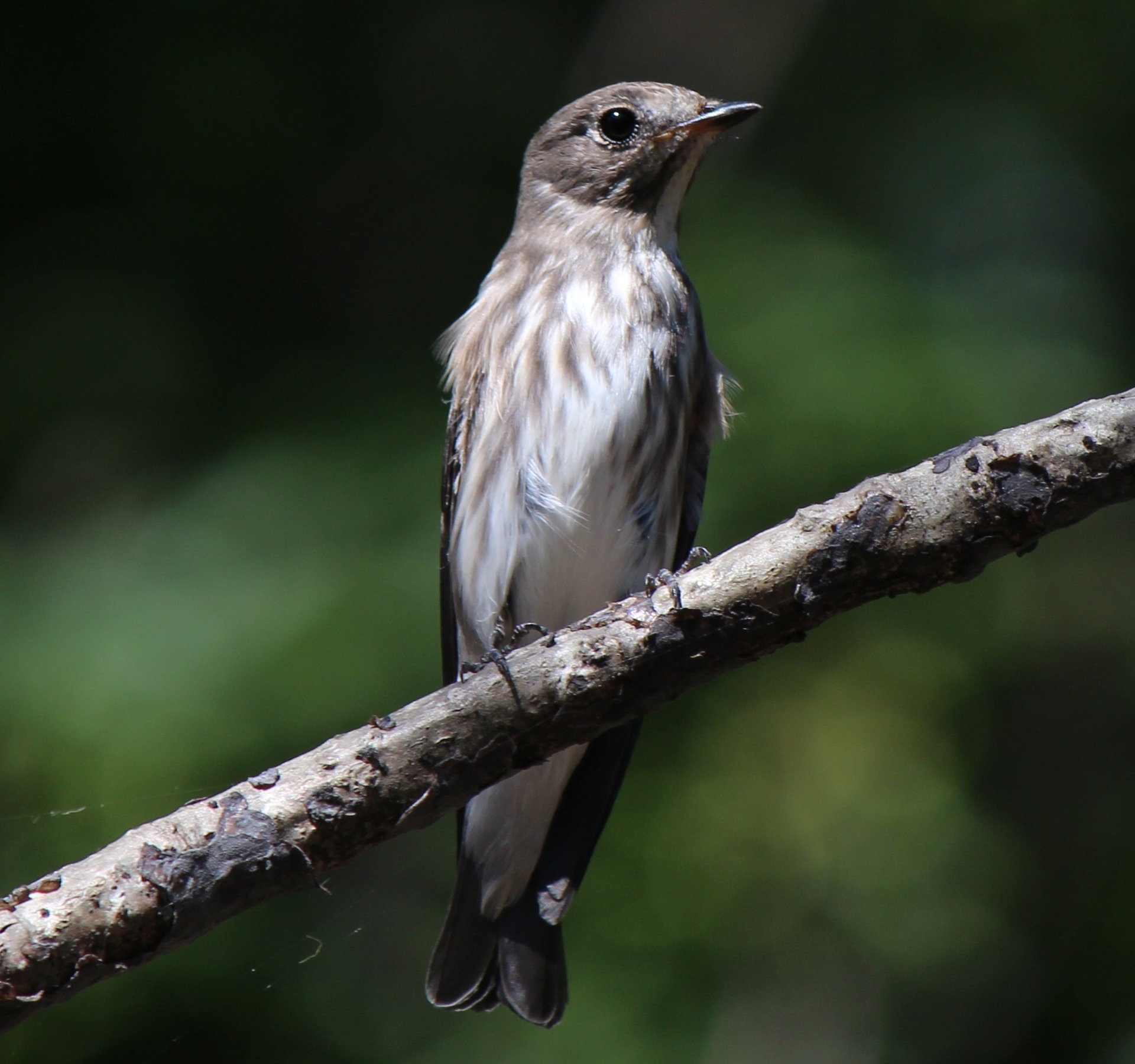
The Grey-streaked Flycatcher, known in Indonesian as Sikatan Rimba-bintik, is a small passerine bird belonging to the Old World flycatcher family. It is a migratory species, breeding in Northeast Asia and wintering across Southeast Asia, including Indonesia. It is characterized by its upright posture, relatively long wings, and distinctive streaking on its underparts.
Ukuran dan masa hidup
- Panjang
- 12.5-15 cm
- Bentang sayap
- 22-25 cm
- Berat
- 10-18 g
- Masa hidup
- 3-5 years (estimated in the wild)
- Makanan
- Insectivore
Ciri fisik
- Bulu
- Upperparts are plain grey-brown, often appearing slightly olive-tinged. Underparts are whitish with prominent grey-brown streaking on the throat, breast, and flanks, which gives the bird its common name. It has a distinct pale eye-ring and a pale loral stripe. The wings are dark with two indistinct pale wing-bars, and the tail is dark.
- Bentuk paruh
- Small, flattened, and broad-based, typical of an insectivorous flycatcher, dark horn-colored with a paler base to the lower mandible.
- Warna mata
- Dark brown.
- Warna kaki
- Dark grey to blackish.
- Ciri pembeda
- The combination of plain grey-brown upperparts, prominent grey streaking on the whitish underparts, a pale eye-ring, and a pale loral stripe are key identification features. Its upright posture when perched is also characteristic.
- Penampilan muda
- Juveniles resemble adults but may have a slightly scaly appearance on the upperparts due to pale feather fringes, and the streaking on the underparts might be less defined or more mottled.
- Perubahan musiman
- No significant seasonal plumage changes. The plumage remains consistent throughout the year, though wear and tear can make colors appear duller or streaking less crisp.
- Dimorfisme seksual
- None significant; males and females are generally indistinguishable in plumage.
Cara identifikasi
- 1
Underpart Streaking
Look for distinct, relatively broad grey-brown streaks on the throat, breast, and flanks against a whitish background. This is the most reliable field mark.
- 2
Eye-ring and Loral Stripe
Note the prominent pale eye-ring and the pale stripe extending from the base of the bill to the eye (loral stripe). These contrast with the darker head.
- 3
Upperparts
Observe the plain, uniform grey-brown upperparts, lacking any strong patterns or colors.
- 4
Posture and Behavior
Watch for its characteristic upright posture on a perch and its habit of sallying out to catch insects in flight.
- 5
Wing-bars
Look for two indistinct pale wing-bars on the dark wings, though these can be subtle.
Habitat dan persebaran
- Bioma
- Temperate forests, taiga, subtropical and tropical moist lowland forests, mangroves, and sometimes gardens and parks during migration.
- Persebaran geografis
- Breeds in Northeast Asia (Siberia, Sakhalin, Kuril Islands, Hokkaido, Honshu). Migrates through eastern China, Korea, Japan, and winters across Southeast Asia, including the Philippines, Borneo, Sumatra, Java, and other Indonesian islands, as well as New Guinea.
- Rentang ketinggian
- Typically found from sea level up to 1,500 meters, occasionally higher during migration.
- Lingkungan yang disukai
- Prefers open woodlands, forest edges, clearings, and areas with scattered trees and shrubs. During migration, it can be found in a wider variety of wooded habitats, including coastal scrub and urban parks.
Perilaku
- Waktu aktivitas
- Diurnal.
- Kebiasaan makan
- Primarily an aerial insectivore. It typically perches on an exposed branch, scanning for flying insects, then sallies out to catch them in mid-air before returning to the same or a different perch. It may also glean insects from foliage.
- Perilaku sosial
- Generally solitary, especially during migration and in wintering grounds. May occasionally be seen in loose mixed-species foraging flocks.
- Pola terbang
- Direct and agile when sallying for insects. Otherwise, flight is typically undulating over longer distances.
- Pola migrasi
- A long-distance migratory species. It breeds in Northeast Asia during the boreal summer and migrates south to Southeast Asia for the boreal winter. It is a common passage migrant and winter visitor in Indonesia.
- Teritorialitas
- Exhibits territorial behavior during the breeding season. In wintering grounds, it is less territorial but may defend a foraging patch.
Kicauan dan suara
- Kicauan
- The song, primarily heard on breeding grounds, is a series of thin, high-pitched, somewhat squeaky notes, often described as a 'tsee-tsee-tsee-tsee' or 'swee-swee-swee'. It is not particularly loud or complex.
- Panggilan
- Common calls include a soft, thin 'tsip' or 'tseet', and a slightly harsher 'churr' or 'trrr' when agitated.
- Kapan bersuara
- Most vocal during the breeding season. Calls are heard more frequently during migration and in wintering grounds, especially when foraging or disturbed.
Reproduksi
- Musim kawin
- May to July in its breeding range.
- Kebiasaan bersarang
- Nests are typically cup-shaped, built in the fork of a tree branch or on a horizontal branch, often well-concealed. Constructed from moss, lichens, rootlets, and spider silk.
- Jumlah telur
- 3-5 eggs.
- Deskripsi telur
- Typically 3-5 eggs, pale greenish-blue or whitish, often speckled with reddish-brown or purplish spots, particularly at the broader end.
- Masa inkubasi
- Approximately 12-14 days.
- Masa terbang
- Chicks fledge around 12-14 days after hatching.
- Perawatan orang tua
- Both parents participate in incubation and feeding of the young.
Di mana ditemukan
Forest Edges
Often found at the interface between dense forest and more open areas, such as clearings or roadsides.
Open Woodlands
Prefers woodlands with a relatively open understory, allowing space for aerial foraging.
Parks and Gardens
During migration, they can be found in urban and suburban green spaces with mature trees.
Mangroves and Coastal Scrub
In wintering grounds, especially in Southeast Asia, they may utilize coastal habitats.
Tips lapangan
- Look for movement. These birds are often inconspicuous when perched, but their sallying flights for insects make them noticeable. Watch for quick, darting movements from a perch.
- Scan mid-canopy. They typically perch in the mid-story of trees, often on exposed branches, providing a good vantage point for insect hunting.
- Listen for calls. While not a strong singer, their soft 'tsip' calls can help locate them, especially during migration.
- Patience is key. Flycatchers can remain still for extended periods. Patience and careful scanning of potential perches are often rewarded.
Spesies serupa
Dark-sided Flycatcher
Muscicapa sibirica
The Dark-sided Flycatcher has darker, more uniform grey-brown upperparts, and the streaking on its underparts is typically confined to the flanks, appearing less extensive and often smudgier than the Grey-streaked Flycatcher. It also lacks the prominent pale loral stripe and often has a less distinct eye-ring. Its overall appearance is generally darker and less streaky below.
Asian Brown Flycatcher
Muscicapa dauurica
The Asian Brown Flycatcher is generally plainer, lacking the prominent streaking on the breast and flanks that characterizes the Grey-streaked Flycatcher. It has a more uniform brownish-grey plumage and a less distinct eye-ring. Its overall appearance is 'cleaner' below.
Brown-streaked Flycatcher
Muscicapa williamsoni
The Brown-streaked Flycatcher is very similar and was formerly considered a subspecies of Grey-streaked Flycatcher. It is generally slightly smaller, with a shorter primary projection, and often has a more rufous tinge to its upperparts and flanks. The streaking on the underparts can be finer and browner. Field identification can be challenging and often requires careful observation of subtle differences in plumage tone and structure.
Fakta singkat
- Status in Indonesia:
- Common winter visitor and passage migrant
- Dietary Niche:
- Specialized aerial insectivore
- Migration Distance:
- Long-distance migrant, covering thousands of kilometers
- Perching Style:
- Upright posture on exposed branches
Fakta menarik
- The 'griseisticta' in its scientific name directly translates to 'grey-streaked', referring to its distinctive plumage.
- Despite its small size, the Grey-streaked Flycatcher undertakes an impressive annual migration between its breeding grounds in Northeast Asia and its wintering grounds in Southeast Asia.
- It is one of several 'brown flycatchers' in the genus Muscicapa, which can be challenging to distinguish in the field due to their subtle differences.
Klasifikasi ilmiah
- Kerajaan
- Animalia
- Filum
- Chordata
- Kelas
- Aves
- Ordo
- Passeriformes
- Famili
- Muscicapidae
- Genus
- Muscicapa
- Spesies
- Muscicapa griseisticta
Jelajahi Sikatan Rimba-bintik
Identifikasi burung di mana saja
Gratis di iOS, Android, dan Web. Identifikasi foto & suara, database spesies lengkap, dan daftar pribadi Anda.