
Melihat burung? Identifikasi seketika dengan aplikasi Birdby
Buka aplikasiTentang
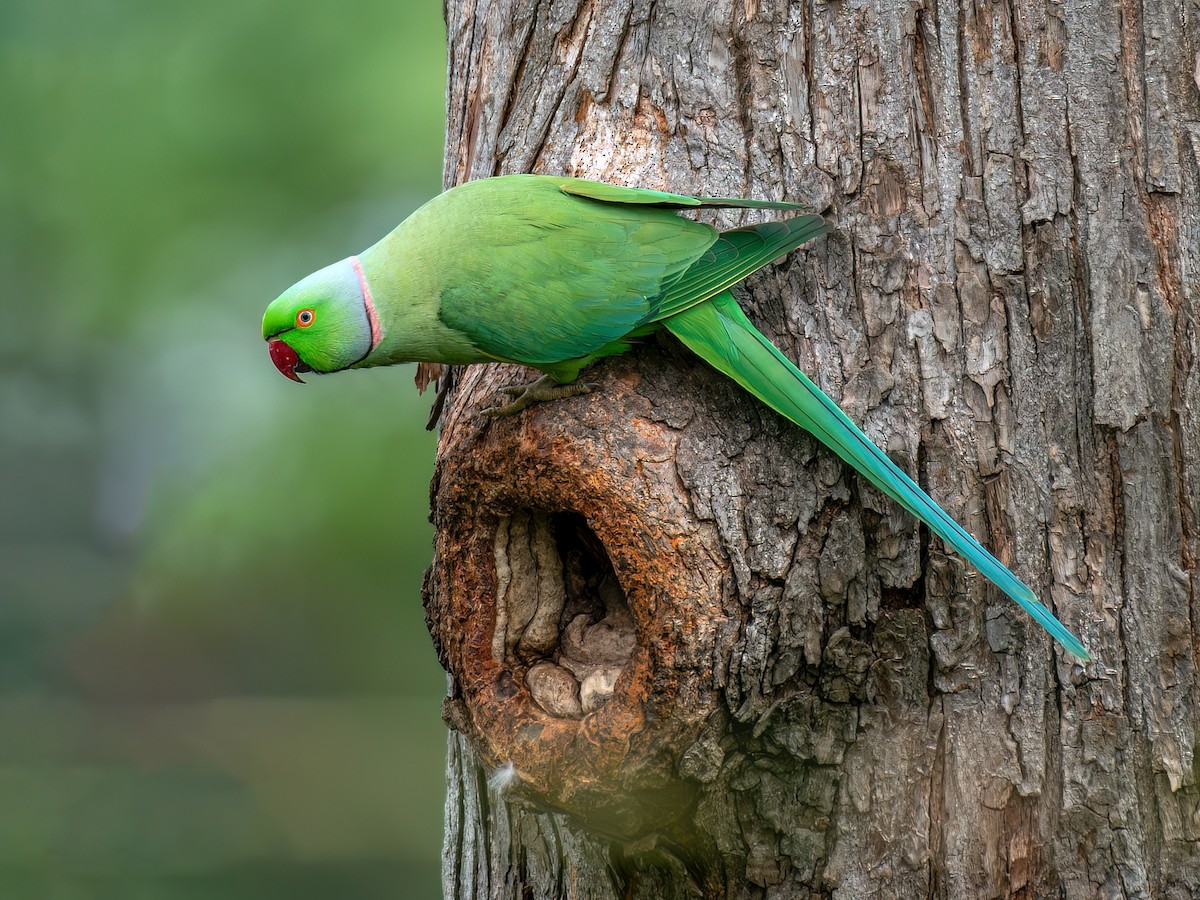
The Rose-ringed Parakeet, also known as the Ringneck Parrot, is a medium-sized, long-tailed parrot, predominantly green, with a distinctive red and black neck ring in adult males. It is a highly adaptable species, native to parts of Africa and the Indian subcontinent, but has established feral populations in many urban areas worldwide due to escapes from captivity. Known for its intelligence and vocalizations, it is a common sight in parks, gardens, and agricultural lands.
Ukuran dan masa hidup
- Panjang
- 38-42 cm (including tail)
- Bentang sayap
- 42-48 cm
- Berat
- 115-140 g
- Masa hidup
- Up to 20-30 years in the wild, longer in captivity
- Makanan
- Herbivore (primarily granivorous and frugivorous)
Ciri fisik
- Bulu
- Predominantly bright green plumage. The underside is often paler yellowish-green. The flight feathers are darker green with bluish tips. The underside of the tail is yellow.
- Bentuk paruh
- Strong, hooked, and reddish-pink to dark red beak, with a paler tip.
- Warna mata
- Pale yellow iris with a reddish-orange orbital ring.
- Warna kaki
- Greyish-pink to grey
- Ciri pembeda
- Long, pointed tail, which accounts for a significant portion of its total length. The distinctive neck ring in males is a key feature.
- Penampilan muda
- Juveniles resemble adult females but have a shorter tail, a paler, more orange-red beak, and a duller green plumage. The neck ring is absent in both sexes until they are about 18-36 months old.
- Perubahan musiman
- No significant seasonal plumage changes. Plumage remains consistent year-round, with changes primarily related to age and sex.
- Dimorfisme seksual
- Adult males possess a prominent black and pink/red neck ring. The black forms a narrow stripe from the lower mandible to the nape, bordered by a pinkish-red band on the hindneck. Adult females typically lack the black neck ring, or it is present as a faint greyish-green shadow, and the pinkish-red band is absent or much less defined. Their plumage is generally duller.
Cara identifikasi
- 1
Size and Shape
Medium-sized, slender parrot with a very long, pointed tail that makes up almost half its total length.
- 2
Plumage Color
Overall bright grass-green plumage. Look for paler yellowish-green on the underside.
- 3
Male Neck Ring
Adult males have a distinctive black chin stripe extending to a narrow black collar, bordered by a pinkish-red band on the hindneck. This is the most reliable field mark for adult males.
- 4
Female/Juvenile Appearance
Females and juveniles lack the prominent black and pink neck ring, or it is very faint/greyish. Juveniles also have shorter tails and paler beaks.
- 5
Beak Color
Strong, hooked beak that is reddish-pink to dark red, with a paler tip.
- 6
Vocalization
Listen for their loud, shrill, and often repetitive 'kree-kree-kree' or 'kya-kya-kya' calls, especially when in flight or in flocks.
- 7
Flight Pattern
Observe their strong, direct flight with rapid wing beats, often in noisy groups.
Habitat dan persebaran
- Bioma
- Forest edges, open woodlands, savannas, semi-arid regions, agricultural areas, urban parks, and suburban gardens.
- Persebaran geografis
- Native to a broad belt across Africa (from Mauritania to Ethiopia and Somalia) and the Indian subcontinent (from Pakistan to Bangladesh and southern India). Feral populations are established in numerous countries worldwide, including much of Western Europe, the Middle East, Japan, and parts of North America.
- Rentang ketinggian
- Sea level up to approximately 1,600 meters (5,200 feet).
- Lingkungan yang disukai
- Prefers areas with scattered trees, open country, and human-modified landscapes where food sources are abundant. Highly adaptable to urban environments.
Perilaku
- Waktu aktivitas
- Diurnal, most active during early morning and late afternoon.
- Kebiasaan makan
- Feeds on a wide variety of seeds, nuts, fruits, berries, blossoms, and nectar. They are often considered agricultural pests due to their consumption of cultivated crops like maize, sunflower, and various fruits. They forage in trees and on the ground.
- Perilaku sosial
- Highly social birds, typically found in pairs or small family groups during the breeding season, but forming large, noisy flocks outside of breeding. Roost communally in large numbers.
- Pola terbang
- Strong, direct, and swift flight with rapid wing beats. Often flies in noisy flocks, especially at dawn and dusk when commuting to and from roosting sites.
- Pola migrasi
- Generally resident throughout their native and introduced ranges. Some local movements may occur in response to food availability.
- Teritorialitas
- Pairs defend their nesting cavity during the breeding season, but are generally tolerant of other parakeets outside of this period, especially at communal roosts and feeding sites.
Kicauan dan suara
- Kicauan
- Does not have a complex song. Vocalizations are primarily calls.
- Panggilan
- Loud, shrill, and piercing 'kree-kree-kree' or 'kya-kya-kya' calls. They also produce a variety of squawks, screeches, and chattering sounds. Their calls are often described as harsh and metallic.
- Kapan bersuara
- Most vocal during flight, when foraging, and especially at communal roosts at dawn and dusk. They are generally noisy birds.
Reproduksi
- Musim kawin
- Varies geographically. In India, typically November-June; in Africa, August-November. In introduced populations, often February-June.
- Kebiasaan bersarang
- Cavity nesters, utilizing natural tree hollows, old woodpecker holes, or even crevices in buildings. They do not add nesting material, but may enlarge existing cavities.
- Jumlah telur
- 2-6 eggs, most commonly 3-4.
- Deskripsi telur
- Typically 2-6 white, oval eggs, measuring approximately 30 x 24 mm.
- Masa inkubasi
- 22-24 days, primarily by the female.
- Masa terbang
- Approximately 7 weeks (45-55 days) after hatching. Young remain dependent on parents for some time after fledging.
- Perawatan orang tua
- Both parents participate in feeding the chicks. The female primarily incubates, while the male brings food to the female and later to the chicks.
Di mana ditemukan
Urban Parks and Gardens
Common in city parks, botanical gardens, and suburban areas with mature trees, especially in introduced ranges.
Agricultural Lands
Frequently found in areas with orchards, grain fields, and plantations, where they can find abundant food.
Open Woodlands and Savannas
In native ranges, they inhabit open woodlands, savannas, and semi-arid regions with scattered trees.
Communal Roosts
Look for large flocks gathering at specific trees or groves at dawn and dusk.
Tips lapangan
- Listen for Calls. Their loud, distinctive calls often give away their presence before they are seen. Listen for their shrill screeches.
- Look in Trees. They spend a lot of time foraging in the canopy of trees. Scan fruit trees, seed-bearing trees, and flowering plants.
- Observe Flocks. Outside of breeding season, they are often in flocks. Look for groups flying overhead or congregating at feeding sites or roosts.
- Visit at Dawn/Dusk. They are most active and vocal during these times, especially when commuting to and from communal roosts.
- Check for Feral Populations. In many non-native regions, they are common in urban areas. Check local birding guides for known feral populations.
Spesies serupa
Alexandrine Parakeet
Psittacula eupatria
The Alexandrine Parakeet is significantly larger (up to 58 cm) with a heavier, all-red beak. Males also have a black neck ring, but it is broader and less distinct than the Rose-ringed, and they possess a prominent maroon patch on the wing coverts, which is absent in the Rose-ringed Parakeet.
Plum-headed Parakeet
Psittacula cyanocephala
Smaller than the Rose-ringed Parakeet. Males have a distinctive plum-colored head with a black neck collar, and females have a greyish-blue head. Lacks the prominent red and black neck ring of the male Rose-ringed Parakeet.
Slaty-headed Parakeet
Psittacula himalayana
Has a greyish-blue head and a maroon patch on the wing, similar to the Alexandrine, but is smaller. The male lacks the distinct black and pink neck ring of the Rose-ringed Parakeet.
Fakta singkat
- Common Name:
- Rose-ringed Parakeet
- Scientific Name:
- Psittacula krameri
- Family:
- Psittaculidae
- Native Range:
- Africa and Indian Subcontinent
- Introduced Range:
- Worldwide (Europe, Middle East, Asia, Americas)
- Diet:
- Seeds, fruits, nuts, blossoms, nectar
- Conservation Status:
- Least Concern
- Key ID Feature (Male):
- Black and pink/red neck ring
- Vocalization:
- Loud, shrill 'kree-kree-kree' calls
Fakta menarik
- The Rose-ringed Parakeet is one of the most widely distributed parrot species in the world, largely due to its success as an introduced species.
- They are highly intelligent birds and can be taught to mimic human speech, which contributes to their popularity as pets.
- Feral populations in Europe, particularly in the UK and Netherlands, have grown significantly and are a subject of ecological study due to their potential impact on native species.
- Despite their bright green plumage, they can be surprisingly well-camouflaged among foliage.
- They are known to form large, spectacular communal roosts, sometimes numbering in the thousands, especially outside the breeding season.
Klasifikasi ilmiah
- Kerajaan
- Animalia
- Filum
- Chordata
- Kelas
- Aves
- Ordo
- Psittaciformes
- Famili
- Psittaculidae
- Genus
- Psittacula
- Spesies
- Psittacula krameri
Jelajahi Rose-ringed Parakeet
Identifikasi burung di mana saja
Gratis di iOS, Android, dan Web. Identifikasi foto & suara, database spesies lengkap, dan daftar pribadi Anda.