
Melihat burung? Identifikasi seketika dengan aplikasi Birdby
Buka aplikasiTentang
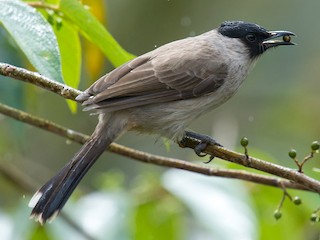
The Sooty-headed Bulbul (Pycnonotus aurigaster), known locally as Cucak Kutilang, is a common and widespread passerine bird in Southeast Asia. It is characterized by its distinctive sooty-black head, white throat, and bright yellow vent. This adaptable species thrives in a variety of open and disturbed habitats, often found in close proximity to human settlements.
Ukuran dan masa hidup
- Panjang
- 19-21 cm
- Bentang sayap
- 28-32 cm
- Berat
- 25-35 g
- Masa hidup
- 5-7 years in the wild, up to 10 years in captivity
- Makanan
- Omnivore (primarily frugivorous and insectivorous)
Ciri fisik
- Bulu
- Adults have a distinctive sooty-black head and nape, contrasting sharply with a clean white throat and upper breast. The back and wings are olive-brown, and the underparts are whitish to pale grey, becoming bright yellow on the vent and undertail coverts. The tail is dark brown with white tips on the outer rectrices.
- Bentuk paruh
- Slender, slightly decurved, and black.
- Warna mata
- Dark brown.
- Warna kaki
- Dark grey to black.
- Ciri pembeda
- The combination of a sooty-black head, white throat, and bright yellow vent is diagnostic. The white tips on the outer tail feathers are also a good field mark.
- Penampilan muda
- Juveniles resemble adults but have a duller, more brownish-grey head, less distinct white throat, and paler yellow on the vent. Their plumage is generally softer and less defined.
- Perubahan musiman
- No significant seasonal plumage changes are observed.
- Dimorfisme seksual
- Males and females are monomorphic in plumage and size, making them difficult to distinguish visually in the field.
Cara identifikasi
- 1
Head and Throat Coloration
Look for the striking contrast of a sooty-black head and nape against a clean white throat. This is the most reliable field mark.
- 2
Vent Color
Observe the bright yellow undertail coverts (vent). This yellow patch is prominent and diagnostic.
- 3
Back and Wing Color
Note the olive-brown coloration of the back and wings, which contrasts with the head and underparts.
- 4
Tail Tips
Look for white tips on the outer tail feathers, especially visible when the bird fans its tail.
- 5
Vocalizations
Listen for its characteristic cheerful, bubbling, and chattering song, often including 'kutilang-kutilang' calls.
- 6
Habitat
Often found in open, disturbed habitats, gardens, and urban areas, making it a common sight in human-modified landscapes.
Habitat dan persebaran
- Bioma
- Tropical and subtropical moist lowland forests, shrublands, grasslands, rural gardens, urban areas.
- Persebaran geografis
- Southeast Asia, including Myanmar, Thailand, Laos, Cambodia, Vietnam, Peninsular Malaysia, Sumatra, Java, Bali, and Borneo.
- Rentang ketinggian
- Sea level up to 1,500 meters, occasionally higher.
- Lingkungan yang disukai
- Highly adaptable, preferring open woodlands, forest edges, secondary growth, plantations, parks, gardens, and cultivated areas. It is often found in disturbed habitats and human-modified landscapes.
Perilaku
- Waktu aktivitas
- Diurnal.
- Kebiasaan makan
- Forages actively in trees and shrubs, often in the mid-canopy or lower strata. Its diet consists mainly of fruits (especially figs, berries, and cultivated fruits), insects (grasshoppers, beetles, caterpillars), and sometimes nectar. It will also visit bird feeders for fruit.
- Perilaku sosial
- Typically seen in pairs or small family groups. Outside the breeding season, they may form larger, loose flocks, sometimes associating with other bulbul species or mixed-species foraging flocks. They are generally quite vocal and conspicuous.
- Pola terbang
- Direct and undulating flight, often with rapid wing beats. It can be quite agile when maneuvering through dense vegetation.
- Pola migrasi
- Resident and non-migratory throughout its range.
- Teritorialitas
- Pairs defend a breeding territory, especially during the nesting season, but are generally less territorial outside of this period.
Kicauan dan suara
- Kicauan
- A varied and cheerful song, often described as a series of bubbling, chattering, and whistling notes. It can be quite melodious and repetitive, with phrases like 'chup-chup-chup-chup' or 'chick-a-pew-chick-a-pew'.
- Panggilan
- Common calls include a sharp 'chip' or 'chick', a scolding 'churr', and a rapid, excited 'kutilang-kutilang' (which gives it its Indonesian name). Alarm calls are harsher and more insistent.
- Kapan bersuara
- Vocalizes frequently throughout the day, especially in the early morning and late afternoon. Calls are more intense during the breeding season.
Reproduksi
- Musim kawin
- Varies geographically, but generally throughout the year with peaks during the wet season (e.g., March-July in parts of Southeast Asia).
- Kebiasaan bersarang
- Nests are typically cup-shaped, loosely constructed from twigs, rootlets, leaves, and grass, often lined with finer materials. They are usually placed in a fork of a small tree or shrub, 1-3 meters above the ground, often in dense foliage for concealment.
- Jumlah telur
- 2-3 eggs.
- Deskripsi telur
- Typically 2-3 eggs, pale pinkish-white to creamy, heavily spotted and blotched with reddish-brown or purplish-grey, particularly at the larger end.
- Masa inkubasi
- Approximately 12-14 days.
- Masa terbang
- Chicks fledge around 12-14 days after hatching.
- Perawatan orang tua
- Both parents participate in nest building, incubation, and feeding of the young.
Di mana ditemukan
Urban Parks and Gardens
Common in city parks, botanical gardens, and residential areas with trees and shrubs.
Agricultural Areas
Frequently found in fruit orchards, plantations (e.g., oil palm, rubber), and cultivated lands.
Forest Edges and Secondary Growth
Abundant in the transitional zones between forests and open areas, and in regenerating forests.
Roadsides and Open Woodlands
Often seen perched on wires or branches along roadsides and in scattered tree cover.
Tips lapangan
- Listen for its song. Its distinctive and often repetitive song is a good way to locate it, even before seeing it.
- Check fruiting trees. Sooty-headed Bulbuls are highly frugivorous; look for them feeding on berries and small fruits in trees and shrubs.
- Observe in open areas. Unlike some shyer forest birds, this species is quite bold and often forages in the open, making it easier to spot.
- Look for movement in foliage. They are active foragers, constantly moving through branches and leaves in search of food.
Spesies serupa
Yellow-vented Bulbul
Pycnonotus goiavier
The Yellow-vented Bulbul has a brown head with a white supercilium and a white throat, lacking the sooty-black head of the Sooty-headed Bulbul. Its yellow vent is also present but the head pattern is distinctly different.
Black-headed Bulbul
Pycnonotus atriceps
The Black-headed Bulbul has an entirely glossy black head and throat, with a bright yellow body and a blue eye-ring. It lacks the white throat and olive-brown back of the Sooty-headed Bulbul.
Streak-eared Bulbul
Pycnonotus conradi
The Streak-eared Bulbul has a greyish-brown head with fine white streaking on the ear-coverts, and a white throat. It lacks the solid sooty-black head and bright yellow vent of the Sooty-headed Bulbul.
Fakta singkat
- Common Name:
- Sooty-headed Bulbul (Cucak Kutilang)
- Scientific Name:
- Pycnonotus aurigaster
- Family:
- Pycnonotidae (Bulbuls)
- Diet:
- Omnivore (fruits, insects, nectar)
- Habitat:
- Open woodlands, gardens, urban areas, forest edges
- Conservation Status:
- Least Concern
- Key ID Feature:
- Sooty-black head, white throat, bright yellow vent
Fakta menarik
- The Indonesian name 'Kutilang' is onomatopoeic, derived from its characteristic call.
- It is one of the most common and familiar birds in many parts of Southeast Asia, often seen in urban environments.
- Despite its commonality, its adaptability to human-modified landscapes highlights its ecological resilience.
- It plays a role in seed dispersal due to its frugivorous diet.
Klasifikasi ilmiah
- Kerajaan
- Animalia
- Filum
- Chordata
- Kelas
- Aves
- Ordo
- Passeriformes
- Famili
- Pycnonotidae
- Genus
- Pycnonotus
- Spesies
- P. aurigaster
Jelajahi Sooty-headed Bulbul
Identifikasi burung di mana saja
Gratis di iOS, Android, dan Web. Identifikasi foto & suara, database spesies lengkap, dan daftar pribadi Anda.