
Melihat burung? Identifikasi seketika dengan aplikasi Birdby
Buka aplikasiTentang
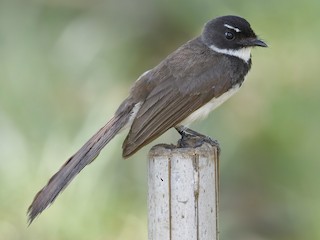
The Pied Fantail (Rhipidura javanica) is a small, active passerine bird known for its distinctive fanned tail and acrobatic flight. It is a common and widespread species across Southeast Asia, often found in open woodlands, gardens, and disturbed habitats. Its characteristic tail-fanning and agile insect-hawking behavior make it a conspicuous and easily identifiable bird.
Ukuran dan masa hidup
- Panjang
- 18-19.5 cm
- Bentang sayap
- 20-23 cm
- Berat
- 8-12 g
- Masa hidup
- 3-5 years in the wild
- Makanan
- Insectivore
Ciri fisik
- Bulu
- Adults have a glossy black head, upperparts, and breast band, contrasting sharply with a white throat and belly. The tail is long and graduated, black with white outer tail feathers, which are prominently fanned during foraging and display. A distinct white supercilium (eyebrow stripe) is present, and a small white spot is often visible behind the eye. The wings are dark with some paler edging on the flight feathers.
- Bentuk paruh
- Small, fine, and black, adapted for catching insects in flight. It has prominent rictal bristles around the base.
- Warna mata
- Dark brown
- Warna kaki
- Dark grey to black
- Ciri pembeda
- The most distinctive features are the constantly fanned, black-and-white tail, the bold white supercilium, and the contrasting black breast band against a white throat and belly. Its restless, acrobatic movements are also key.
- Penampilan muda
- Juveniles resemble adults but have duller plumage, often with brownish-tinged upperparts and a less distinct breast band. The white supercilium may be less pronounced, and the white on the outer tail feathers might be less extensive or tinged buffy.
- Perubahan musiman
- No significant seasonal plumage changes are observed.
- Dimorfisme seksual
- Males and females are monomorphic, appearing identical in plumage.
Cara identifikasi
- 1
Tail Fanning
Look for its constantly fanned, black-and-white tail, which is a primary identification feature and behavior.
- 2
Plumage Pattern
Note the sharp contrast between the glossy black upperparts and breast band, and the pure white throat and belly. The white supercilium is also a key mark.
- 3
Behavior
Observe its restless, acrobatic flight and foraging style, darting out from perches to catch insects.
- 4
Vocalization
Listen for its distinctive squeaky, high-pitched song and sharp 'chip' calls.
- 5
Habitat
It is commonly found in open, disturbed habitats, gardens, and forest edges, making it a familiar sight in many populated areas.
Habitat dan persebaran
- Bioma
- Tropical and subtropical moist lowland forests, mangroves, shrublands, gardens, rural areas, urban parks.
- Persebaran geografis
- Southeast Asia, including the Malay Peninsula, Sumatra, Java, Borneo, and the Philippines. Its range extends from Myanmar and Thailand south through Malaysia and Indonesia.
- Rentang ketinggian
- Primarily lowlands, typically from sea level up to 1,000 meters, occasionally higher in some areas.
- Lingkungan yang disukai
- Prefers open or semi-open habitats with scattered trees and shrubs, forest edges, secondary growth, plantations, and human-modified landscapes. It is less common in dense, undisturbed primary forest interiors.
Perilaku
- Waktu aktivitas
- Diurnal, most active during the morning and late afternoon.
- Kebiasaan makan
- Primarily an aerial insectivore. It actively forages by making short, agile flights from a perch to catch insects in mid-air, often performing acrobatic twists and turns. It frequently fans and wags its tail while perched and during flight, which is thought to flush out insects. It also gleans insects from foliage.
- Perilaku sosial
- Typically seen singly or in pairs. They are generally quite tame and approachable, often allowing close observation. They may join mixed-species foraging flocks, especially in forest edge habitats.
- Pola terbang
- Erratic, agile, and highly maneuverable, characterized by frequent changes in direction, hovering, and rapid wing beats. The fanned tail acts as a rudder, aiding in its aerial acrobatics.
- Pola migrasi
- Resident and non-migratory throughout its range.
- Teritorialitas
- Pairs maintain small territories, especially during the breeding season, defending them against conspecifics.
Kicauan dan suara
- Kicauan
- A series of sweet, high-pitched, often squeaky or scratchy notes, sometimes described as a 'squeaky wheel' sound. It can be quite varied, incorporating trills and whistles, often delivered in short, repetitive phrases.
- Panggilan
- Common calls include a sharp 'chip' or 'tchip' note, often given when agitated or interacting with other birds. A softer, more conversational 'chick-chick' is also heard.
- Kapan bersuara
- Vocalizes throughout the day, particularly during the breeding season and when foraging or interacting with other birds.
Reproduksi
- Musim kawin
- Varies geographically, but generally occurs during the warmer, wetter months, often peaking from March to July in many parts of its range.
- Kebiasaan bersarang
- Builds a small, neat, cup-shaped nest typically made of fine grasses, rootlets, and spider silk, often decorated with lichen or moss on the exterior. The nest is usually placed on a thin horizontal branch or fork, often at a low to medium height (1-5 meters) above the ground. The nest has a distinctive 'stem' or 'tail' of material hanging below it, giving it a characteristic appearance.
- Jumlah telur
- 2-3 eggs
- Deskripsi telur
- Typically 2-3 eggs, whitish or pale cream in color, often speckled or blotched with reddish-brown or grey markings, particularly at the broader end.
- Masa inkubasi
- Approximately 12-14 days
- Masa terbang
- Chicks fledge around 12-14 days after hatching.
- Perawatan orang tua
- Both parents participate in nest building, incubation, and feeding of the young. They are diligent parents, often raising multiple broods in a single breeding season.
Di mana ditemukan
Urban Parks and Gardens
Often found in well-vegetated urban areas, including parks, botanical gardens, and even large residential gardens.
Forest Edges and Secondary Growth
Common along the margins of forests, in regenerating clearings, and areas with mixed scrub and trees.
Mangroves and Coastal Areas
Can be found in mangrove forests and other coastal vegetation.
Plantations
Frequently inhabits agricultural plantations, such as rubber or oil palm, where there is suitable undergrowth and insect prey.
Tips lapangan
- Look for movement. Pied Fantails are constantly on the move, fanning their tails and flitting between perches. Their erratic movements often draw attention.
- Listen for calls. Their distinctive squeaky song and sharp calls can help locate them, even when hidden in foliage.
- Check mid-level vegetation. They typically forage in the understory and mid-canopy, often perching on exposed branches or twigs.
- Observe foraging behavior. Watch for their characteristic aerial hawking, where they sally out to catch insects and return to a perch.
Spesies serupa
Malaysian Pied Fantail
Rhipidura perlata
The Malaysian Pied Fantail is generally found at higher elevations and has a more mottled or scaled appearance on its upperparts and breast, lacking the clean black breast band of R. javanica. Its tail is also less extensively white on the outer feathers.
White-browed Fantail
Rhipidura aureola
Found further north in South Asia and parts of Southeast Asia. It has a more prominent white supercilium and a white throat, but its underparts are buffy or yellowish, not pure white, and its breast band is less distinct or absent. The tail pattern is also different, with less white.
Black-naped Monarch
Hypothymis azurea
While also an active insectivore, the Black-naped Monarch is predominantly blue with a black nape patch and breast band (in males). It lacks the prominent white supercilium and the distinctive black-and-white fanned tail of the Pied Fantail. Its movements are also less frenetic.
Fakta singkat
- Tail:
- Constantly fanned, black with white outer feathers
- Plumage:
- Black upperparts, white throat/belly, black breast band, white supercilium
- Behavior:
- Acrobatic, restless insectivore
- Habitat:
- Open woodlands, gardens, forest edges
- Vocalization:
- Squeaky, high-pitched song; sharp 'chip' calls
Fakta menarik
- The 'fantail' name comes from its habit of fanning its tail, which is not only for display but also helps flush out insects for capture.
- Despite its small size, the Pied Fantail is an incredibly agile flyer, capable of complex aerial maneuvers to catch fast-moving insects.
- Its nest, often adorned with lichen, is a marvel of avian architecture, typically featuring a distinctive 'stem' hanging below the cup.
- Pied Fantails are often quite fearless and can be observed at close quarters, making them a favorite among birdwatchers in their range.
Klasifikasi ilmiah
- Kerajaan
- Animalia
- Filum
- Chordata
- Kelas
- Aves
- Ordo
- Passeriformes
- Famili
- Rhipiduridae
- Genus
- Rhipidura
- Spesies
- Rhipidura javanica
Jelajahi Pied Fantail
Identifikasi burung di mana saja
Gratis di iOS, Android, dan Web. Identifikasi foto & suara, database spesies lengkap, dan daftar pribadi Anda.