
Melihat burung? Identifikasi seketika dengan aplikasi Birdby
Buka aplikasiTentang
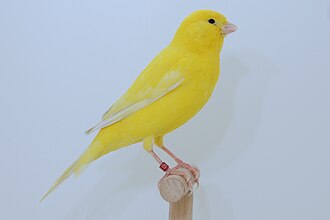
The Domestic Canary is a domesticated form of the wild Canary (Serinus canaria), a small finch native to the Macaronesian islands. Bred for centuries, primarily for its singing ability and diverse color mutations, it is one of the most popular cage birds worldwide. While its wild ancestor is a drab greenish-yellow, domestic canaries exhibit a vast array of colors, sizes, and feather types.
Ukuran dan masa hidup
- Panjang
- 12.5-14 cm
- Bentang sayap
- 20-23 cm
- Berat
- 15-20 g
- Masa hidup
- 10-15 years (in captivity)
- Makanan
- Granivore (seeds, supplemented with fruits, vegetables, and insects)
Ciri fisik
- Bulu
- Highly variable due to selective breeding. Common colors include yellow, orange, red, white, brown, and various variegated patterns. Feather types can range from smooth and sleek to frilled, crested, or having elaborate feathering (e.g., Gloster Fancy, Norwich, Border Fancy). The wild ancestor is typically greenish-yellow with streaked underparts.
- Bentuk paruh
- Small, conical, and pointed, adapted for cracking seeds. Color varies from horn-colored to pinkish or yellowish, often matching leg color.
- Warna mata
- Dark brown to black, often appearing as a small, bright bead.
- Warna kaki
- Typically pinkish-grey to flesh-colored, with small, delicate feet adapted for perching.
- Ciri pembeda
- Its small size, conical beak, and often vibrant, uniform coloration (in many varieties) are distinctive. The wide range of breeds means specific features like crests, frills, or body shapes can be highly characteristic of a particular type.
- Penampilan muda
- Juveniles often have duller plumage than adults, sometimes with faint streaking, particularly in varieties that mimic the wild canary's coloration. Their songs are typically undeveloped 'chatter' before maturing into full song.
- Perubahan musiman
- No significant seasonal plumage changes in domestic canaries, as they are kept in controlled environments. Wild canaries may show slight variations in plumage brightness post-molt.
- Dimorfisme seksual
- Generally subtle in appearance. Males are typically more robust singers than females. In some color varieties, males may exhibit slightly brighter or more intense coloration, especially during breeding season, but this is not a reliable field mark across all breeds. Females may appear slightly smaller or have a more rounded head shape.
Cara identifikasi
- 1
Plumage Color and Type
Observe the bird's color (yellow, red, white, variegated) and feather structure (smooth, crested, frilled). This is the most immediate indicator of a domestic canary, as wild birds are more uniformly greenish-yellow.
- 2
Size and Build
Note the small, compact body size (12.5-14 cm). While some breeds are larger or smaller, they generally fit within this range. The conical beak is typical of a finch.
- 3
Song
Listen for the characteristic, complex, and melodious song, especially from males. The variety and sustained nature of the song are key identifiers, particularly in breeds specifically developed for singing.
- 4
Behavior in Captivity
If observed in a cage or aviary, its docile nature, readiness to feed from provided dishes, and interaction with its environment are indicative of a domestic bird.
Habitat dan persebaran
- Bioma
- Not applicable (primarily captive). The wild ancestor inhabits subtropical forests, woodlands, orchards, and gardens.
- Persebaran geografis
- Globally distributed in captivity. The wild ancestor is endemic to the Macaronesian islands (Canary Islands, Azores, Madeira).
- Rentang ketinggian
- Not applicable for domestic canaries. Wild canaries are found from sea level up to 2,000 meters.
- Lingkungan yang disukai
- Domestic canaries thrive in indoor aviaries or cages with stable temperatures, adequate lighting, and protection from predators and drafts. They require perches, food, water, and opportunities for bathing.
Perilaku
- Waktu aktivitas
- Diurnal, active during daylight hours.
- Kebiasaan makan
- Primarily granivorous, consuming a variety of small seeds (e.g., canary seed, niger, millet). In captivity, their diet is supplemented with fresh fruits (apple, pear), vegetables (broccoli, spinach), and occasionally small amounts of protein (e.g., egg food, mealworms) especially during breeding.
- Perilaku sosial
- Generally social birds, often kept in pairs or small groups in aviaries. Males can be territorial towards other males during breeding season. They are known for their docile nature towards humans.
- Pola terbang
- In captivity, flight is limited to short, rapid bursts within a cage or aviary. Wild canaries exhibit an undulating flight pattern typical of finches, with rapid wing beats followed by a glide.
- Pola migrasi
- Non-migratory (resident) in both domestic and wild forms.
- Teritorialitas
- Males can be territorial during breeding season, especially when competing for mates or nesting sites. In a cage setting, this can manifest as aggression towards other males.
Kicauan dan suara
- Kicauan
- Renowned for their complex and melodious songs, particularly males. The song is a continuous, varied series of trills, whistles, chirps, and rolls, often delivered with great enthusiasm. Different canary breeds are known for specific song types (e.g., Roller Canaries for soft, deep trills; Waterslager Canaries for water-like notes).
- Panggilan
- Common calls include a soft 'chip' or 'cheep' for contact, alarm calls that are sharper and more insistent, and begging calls from juveniles.
- Kapan bersuara
- Males sing most frequently and intensely during the breeding season to attract mates. They can sing throughout the day, especially in response to other birds or environmental stimuli.
Reproduksi
- Musim kawin
- Typically spring to early summer in temperate regions, but can be induced year-round in captivity with appropriate lighting and diet.
- Kebiasaan bersarang
- In captivity, they readily use open-cup nests or nest baskets provided by breeders. The female builds the nest using fine grasses, plant fibers, and soft materials. In the wild, nests are small, neat cups built in shrubs or trees.
- Jumlah telur
- 3-5 eggs, typically.
- Deskripsi telur
- Small, oval, pale blue or bluish-white eggs, often speckled with reddish-brown or purplish markings, particularly at the larger end.
- Masa inkubasi
- 13-14 days, primarily by the female.
- Masa terbang
- 14-21 days after hatching, young leave the nest but are still fed by parents for a period.
- Perawatan orang tua
- Both parents feed the young, though the female does most of the incubation and initial brooding. Males often feed the female on the nest and continue to feed fledglings.
Di mana ditemukan
Pet Stores
Widely available in pet stores globally, offering various breeds and colors.
Bird Breeders
Specialized breeders offer specific canary breeds, often with champion bloodlines for song or appearance.
Homes and Aviaries
Commonly kept as pets in private homes, aviaries, and sometimes in public bird exhibits.
Tips lapangan
- Observe in a controlled environment. Domestic canaries are almost exclusively found in captivity. Look for them in cages, aviaries, or bird shows.
- Listen for their song. Their distinctive, varied, and often loud song is a primary indicator, especially for males.
- Note plumage variations. The sheer diversity of colors and feather types (crests, frills) immediately distinguishes them from wild finches.
Spesies serupa
Wild Canary
Serinus canaria
The wild ancestor is typically smaller and has a more subdued greenish-yellow plumage with streaking, especially on the back and flanks. Domestic canaries exhibit a much wider range of colors, feather types, and often larger sizes due to selective breeding.
European Serin
Serinus serinus
Smaller than the wild canary, with a more compact body and a shorter tail. Males have brighter yellow on the face and breast, and more prominent streaking on the flanks. The song is a rapid, jingling trill, distinct from the canary's more varied melody.
Yellow-fronted Canary
Crithagra mozambica
Found in Africa, not Macaronesia. Males have a bright yellow face and underparts, with a grey nape and olive-green back. Distinctive black malar stripe. Song is a cheerful, varied warble, but structurally different from Serinus canaria.
Fakta singkat
- Primary Use:
- Pet bird, bred for song and appearance
- Origin:
- Domesticated from the Wild Canary (Serinus canaria) of the Macaronesian islands
- Vocalization:
- Famous for complex, melodious songs
- Color Diversity:
- Extremely wide range of colors and feather types due to breeding
- Diet in Captivity:
- Seed-based, supplemented with fruits, vegetables, and protein
Fakta menarik
- Canaries were historically used in coal mines as an early warning system for toxic gases, earning them the phrase 'canary in a coal mine'.
- There are over 20 recognized breeds of domestic canaries, categorized by color, song, or type (shape and feathering).
- The red factor canary was developed by cross-breeding a domestic canary with a Red Siskin (Spinus cucullatus) to introduce the red pigment.
- Male canaries can learn and mimic songs from other birds or even human-made sounds, though their natural song is highly prized.
Klasifikasi ilmiah
- Kerajaan
- Animalia
- Filum
- Chordata
- Kelas
- Aves
- Ordo
- Passeriformes
- Famili
- Fringillidae
- Genus
- Serinus
- Spesies
- Serinus canaria
Jelajahi Domestic Canary
Identifikasi burung di mana saja
Gratis di iOS, Android, dan Web. Identifikasi foto & suara, database spesies lengkap, dan daftar pribadi Anda.