
Melihat burung? Identifikasi seketika dengan aplikasi Birdby
Buka aplikasiTentang
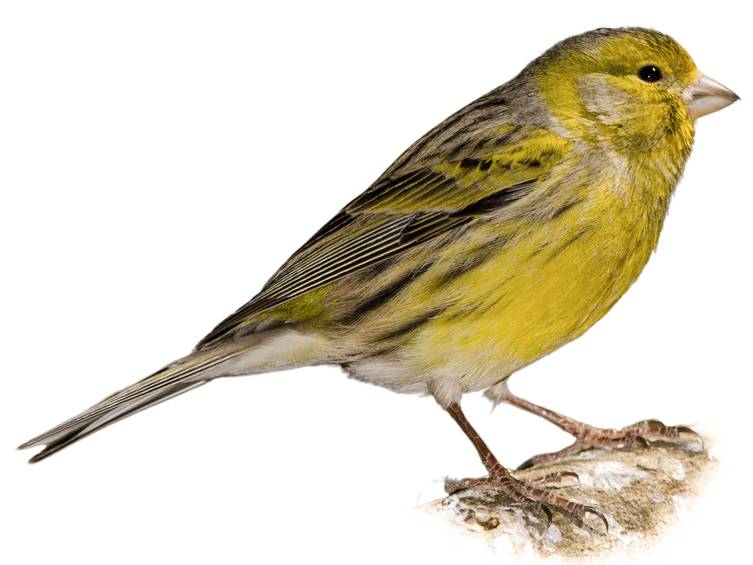
The Atlantic Canary, commonly known as the wild canary or 'Kenari' in some regions, is a small passerine bird belonging to the finch family. It is native to the Canary Islands, Azores, and Madeira. This species is the wild ancestor of the domestic canary, a popular cage bird known for its singing ability and various color mutations. Wild canaries are typically greenish-yellow with streaked underparts, exhibiting a more subdued coloration than many domestic varieties.
Ukuran dan masa hidup
- Panjang
- 12.5-13.5 cm
- Bentang sayap
- 20-23 cm
- Berat
- 12-20 g
- Masa hidup
- 5-10 years (in the wild), up to 15 years (in captivity)
- Makanan
- Granivore (primarily seeds, supplemented with some insects and plant material)
Ciri fisik
- Bulu
- Males typically have a yellowish-green head and underparts, becoming brighter yellow on the face and throat. The back is greyish-green with dark streaking. Rump is bright yellow. Wings and tail are dark with yellowish-green edgings. Females are generally duller, with more grey on the head and breast, and less extensive yellow. Juveniles are heavily streaked brown on a duller, greyish-buff background.
- Bentuk paruh
- Small, conical, and pointed, adapted for cracking seeds. Color is typically horn-colored or greyish.
- Warna mata
- Dark brown.
- Warna kaki
- Pinkish-brown to greyish-brown.
- Ciri pembeda
- Small size, conical bill, streaked back, and prominent yellow rump (especially in males). The overall greenish-yellow coloration is a key field mark for the wild form.
- Penampilan muda
- Juveniles are heavily streaked with dark brown on the head, back, and underparts, appearing much duller and browner than adults. They lack the bright yellow or greenish-yellow coloration of mature birds.
- Perubahan musiman
- Plumage changes are minimal between breeding and non-breeding seasons, primarily involving wear and tear. Males may appear slightly brighter after a fresh molt, but no dramatic color shifts occur.
- Dimorfisme seksual
- Males are generally brighter and more extensively yellow, particularly on the face and underparts. Females are duller, with more grey and less intense yellow, and heavier streaking on the flanks. This difference is more pronounced during the breeding season.
Cara identifikasi
- 1
Size and Shape
Look for a small, compact finch with a relatively short, conical bill.
- 2
Plumage Coloration
Observe the overall greenish-yellow plumage, especially the bright yellow rump. Males will be brighter yellow on the face and underparts, while females are duller and greyer.
- 3
Streaking
Note the dark streaking on the back and flanks, which is more pronounced in females and juveniles.
- 4
Song
Listen for its distinctive, rich, and varied song, a complex series of trills and whistles, often delivered from a high perch.
- 5
Habitat
Consider its native range in the Macaronesian islands and its preference for open woodlands, gardens, and cultivated areas.
Habitat dan persebaran
- Bioma
- Subtropical dry forest, shrubland, agricultural land, gardens, and urban areas.
- Persebaran geografis
- Endemic to the Macaronesian archipelagos of the Canary Islands, Azores, and Madeira (including Porto Santo and Desertas Islands).
- Rentang ketinggian
- Sea level up to 1,500 meters, occasionally higher.
- Lingkungan yang disukai
- Prefers open woodlands, orchards, gardens, cultivated areas, and laurel forests edges. They are often found in areas with scattered trees and shrubs, providing both foraging opportunities and cover.
Perilaku
- Waktu aktivitas
- Diurnal, active during daylight hours.
- Kebiasaan makan
- Primarily granivorous, feeding on a wide variety of small seeds from grasses, weeds, and cultivated plants. They also consume some small insects, especially during the breeding season to supplement protein for their young. Forages on the ground or in low vegetation.
- Perilaku sosial
- Highly social outside the breeding season, forming flocks that can number in the dozens or even hundreds. During the breeding season, they become more territorial and are typically seen in pairs.
- Pola terbang
- Undulating flight pattern, typical of finches, with rapid wing beats followed by a brief glide on closed wings.
- Pola migrasi
- Resident species throughout its range, with no significant migratory movements. Local movements may occur in response to food availability.
- Teritorialitas
- Males establish and defend small breeding territories during the nesting season, primarily through song. Outside of breeding, they are not territorial.
Kicauan dan suara
- Kicauan
- The song is a complex, varied, and melodious series of trills, whistles, and chirps, often delivered from a prominent perch. It is rich and sustained, with rapid changes in pitch and tempo. The wild canary's song is the basis for the highly prized songs of domestic canaries.
- Panggilan
- Common calls include a sharp 'chip' or 'chiff' contact call, a softer 'twee' or 'tew' call, and a rapid 'chittering' alarm call.
- Kapan bersuara
- Males sing most frequently during the breeding season (spring and early summer) to attract mates and defend territory. Calls are given year-round.
Reproduksi
- Musim kawin
- Typically from January to July, with peak activity in March-June. Can raise multiple broods per season.
- Kebiasaan bersarang
- Nests are cup-shaped, built by the female, usually in a tree or shrub at a height of 1-4 meters. Constructed from twigs, grass, moss, and roots, lined with finer materials like hair and feathers.
- Jumlah telur
- 3-5 eggs
- Deskripsi telur
- 3-5 eggs per clutch, pale blue or bluish-green, often with reddish-brown spots or speckles, particularly at the broader end. Approximately 17 x 13 mm.
- Masa inkubasi
- 13-14 days, primarily by the female.
- Masa terbang
- 14-21 days after hatching. Young are fed by both parents.
- Perawatan orang tua
- Both parents participate in feeding the nestlings and fledglings. The female primarily incubates, while the male often brings food to the incubating female.
Di mana ditemukan
Canary Islands
Common throughout all the main islands, particularly in agricultural areas, gardens, and pine forests.
Azores
Widespread across the archipelago, found in similar habitats to the Canary Islands.
Madeira Archipelago
Present on Madeira, Porto Santo, and the Desertas Islands, favoring open areas and cultivated land.
Tips lapangan
- Listen for the song. The distinctive, melodious song is often the first indication of a canary's presence. Males sing frequently from prominent perches.
- Check open woodlands and gardens. These birds prefer areas with a mix of trees, shrubs, and open ground for foraging. Look in orchards, parks, and cultivated fields.
- Observe feeding behavior. Canaries often forage on the ground for seeds. Look for small flocks pecking at the soil or on low vegetation.
- Look for yellow rump. In flight, the bright yellow rump can be a key identification feature, especially when seen from behind.
Spesies serupa
European Serin
Serinus serinus
The European Serin is slightly smaller and has more prominent streaking on the flanks and breast. Its yellow coloration is often brighter, especially on the rump, and it has a more distinct yellow supercilium (eyebrow stripe). The song is also similar but often described as more 'jingling' or 'tinkling'.
Citril Finch
Carduelis citrinella
The Citril Finch has a more olive-green plumage overall, with less yellow than the Atlantic Canary. It typically has a grey head and nape, contrasting with a yellowish throat and breast. Its range is primarily in mountainous regions of central and southern Europe.
Fakta singkat
- Native Range:
- Canary Islands, Azores, Madeira
- Wild Ancestor of:
- Domestic Canary
- Diet:
- Seeds, some insects
- Conservation Status:
- Least Concern
- Sociality:
- Flocking outside breeding season
Fakta menarik
- The domestic canary, famous for its singing and various color mutations, was bred from the wild Atlantic Canary starting in the 17th century.
- The name 'Canary Islands' is derived from the Latin 'Canariae Insulae' meaning 'Islands of the Dogs', not from the bird. The bird was named after the islands.
- Wild canaries are often much duller in color than their domestic counterparts, which have been selectively bred for vibrant yellows, oranges, reds, and other hues.
- Historically, canaries were used in coal mines as an early warning system for toxic gases due to their sensitivity to airborne pollutants.
Klasifikasi ilmiah
- Kerajaan
- Animalia
- Filum
- Chordata
- Kelas
- Aves
- Ordo
- Passeriformes
- Famili
- Fringillidae
- Genus
- Serinus
- Spesies
- Serinus canaria
Jelajahi Atlantic Canary
Identifikasi burung di mana saja
Gratis di iOS, Android, dan Web. Identifikasi foto & suara, database spesies lengkap, dan daftar pribadi Anda.