
Melihat burung? Identifikasi seketika dengan aplikasi Birdby
Buka aplikasiTentang
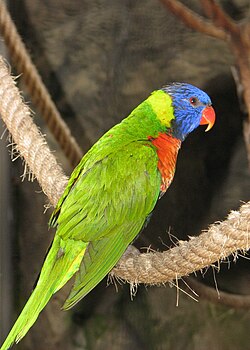
The Rainbow Lorikeet is a medium-sized, brightly colored parrot native to Australia. It is known for its vibrant plumage, active nature, and loud calls. These birds are highly social and often seen in large, noisy flocks. They are primarily nectar and pollen feeders, playing an important ecological role as pollinators.
Ukuran dan masa hidup
- Panjang
- 25-30 cm (10-12 in)
- Bentang sayap
- 38-45 cm (15-18 in)
- Berat
- 75-157 g (2.6-5.5 oz)
- Masa hidup
- 15-20 years in the wild, up to 30 years in captivity
- Makanan
- Nectar, pollen, fruits, seeds, some insects
Ciri fisik
- Bulu
- Adults have a deep blue head and belly, a green back, wings, and tail, and a bright orange-yellow breast with green barring. The nape is green-yellow. The underwing coverts are orange-red. The rump is green. The coloration is highly variable across subspecies, but the 'moluccanus' subspecies (formerly part of T. haematodus) exhibits this classic rainbow pattern.
- Bentuk paruh
- Orange-red, short, and stout, adapted for feeding on nectar and pollen.
- Warna mata
- Red-orange
- Warna kaki
- Grey
- Ciri pembeda
- The combination of blue head, green back, and orange-yellow breast with green barring is highly distinctive. Their brush-tipped tongue, though not visible in the field, is a unique adaptation for nectar feeding.
- Penampilan muda
- Juveniles have duller plumage compared to adults, with a brownish-black beak that gradually turns orange-red. Their eye color is typically brown, transitioning to red-orange as they mature.
- Perubahan musiman
- No significant seasonal plumage changes. Plumage remains consistent year-round.
- Dimorfisme seksual
- Males and females are monomorphic, meaning they look identical in plumage. DNA sexing or behavioral observation during breeding is required to distinguish sexes.
Cara identifikasi
- 1
Plumage Coloration
Look for the striking combination of a deep blue head, bright orange-yellow breast with green barring, and a green back, wings, and tail. This 'rainbow' pattern is key.
- 2
Vocalizations
Listen for their loud, shrill, and continuous screeching calls, especially when they are flying overhead or in large flocks.
- 3
Feeding Behavior
Observe them feeding on flowering trees and shrubs, often hanging upside down to access nectar. Their active and acrobatic feeding style is characteristic.
- 4
Flight Pattern
Note their fast, direct flight, often in tight, noisy flocks.
Habitat dan persebaran
- Bioma
- Subtropical and tropical forests, woodlands, urban parks, gardens, coastal scrub.
- Persebaran geografis
- Eastern Australia, from northern Queensland south to South Australia. Introduced populations exist in Perth (Western Australia), Tasmania, New Zealand, Hong Kong, and Florida (USA).
- Rentang ketinggian
- Sea level up to approximately 1,000 meters (3,300 feet).
- Lingkungan yang disukai
- Areas with abundant flowering trees and shrubs, particularly eucalyptus, melaleuca, and grevillea, as well as fruit orchards and urban areas with exotic plantings.
Perilaku
- Waktu aktivitas
- Diurnal, most active during early morning and late afternoon.
- Kebiasaan makan
- Primarily nectivorous and frugivorous. They use their brush-tipped tongues to extract nectar and pollen from flowers. They also consume soft fruits, berries, some seeds, and occasionally small insects or their larvae. They are often seen foraging in large, noisy groups.
- Perilaku sosial
- Highly social birds, typically found in pairs or small family groups, but often congregate in large, noisy flocks at communal feeding sites and roosts, sometimes numbering in the thousands.
- Pola terbang
- Fast, direct, and agile flight, often accompanied by loud screeching calls. They fly in tight flocks, especially when moving between feeding and roosting sites.
- Pola migrasi
- Generally resident, but may undertake local nomadic movements in response to the availability of flowering plants and fruit. They are not long-distance migrants.
- Teritorialitas
- Pairs defend their nest hollows during the breeding season, but feeding and roosting sites are often shared communally.
Kicauan dan suara
- Kicauan
- Not known for a distinct 'song' in the traditional sense. Their vocalizations are primarily a variety of loud, shrill, chattering, and screeching calls.
- Panggilan
- Loud, piercing, high-pitched screeches and squawks, often given in rapid succession, especially in flight or when disturbed. They also produce softer chattering sounds when feeding or perched.
- Kapan bersuara
- Most vocal during flight, at communal roosts, and when feeding, particularly at dawn and dusk.
Reproduksi
- Musim kawin
- Typically from August to January, but can vary geographically and with food availability.
- Kebiasaan bersarang
- Nests are made in tree hollows, usually high up in eucalypts or other large trees. They do not add nesting material, laying eggs directly on the decaying wood at the bottom of the hollow.
- Jumlah telur
- 1-3 eggs, most commonly 2.
- Deskripsi telur
- White, elliptical, smooth-shelled. Approximately 26-29 mm long and 21-23 mm wide.
- Masa inkubasi
- Approximately 23-26 days, primarily by the female.
- Masa terbang
- Chicks fledge around 7-8 weeks after hatching. They remain dependent on parents for several weeks post-fledging.
- Perawatan orang tua
- Both parents feed the young, though the female does most of the incubation. Young are fed regurgitated nectar and pollen.
Di mana ditemukan
Urban Parks and Gardens
Common in cities and suburbs with abundant flowering plants, especially exotic species like bottlebrush and grevillea.
Eucalypt Woodlands
Found in native eucalypt forests and woodlands, particularly where trees are flowering.
Coastal Areas
Often seen in coastal scrub and heathlands, especially those with flowering banksias and other nectar-rich plants.
Fruit Orchards
Can be a pest in fruit orchards, attracted to soft fruits.
Tips lapangan
- Listen for their calls. Their loud screeches often announce their presence before they are seen. Follow the sound.
- Look for flowering trees. They are highly attracted to flowering trees and shrubs, especially those with abundant nectar. Check eucalypts, bottlebrush, and grevillea.
- Visit at dawn or dusk. They are most active and vocal during these times, often flying to and from communal roosts.
- Observe in flocks. Rainbow Lorikeets are rarely solitary. Look for groups of birds, often feeding together or flying in tight formations.
Spesies serupa
Scaly-breasted Lorikeet
Trichoglossus chlorolepidotus
The Scaly-breasted Lorikeet has an entirely green head and body, with distinctive yellow 'scales' on its breast and belly. It lacks the blue head and red breast of the Rainbow Lorikeet.
Red-collared Lorikeet
Trichoglossus rubritorquis
Formerly considered a subspecies of T. haematodus, the Red-collared Lorikeet has a prominent orange-red collar on the nape, separating the blue head from the green back. Its breast is also more uniformly orange-red without the distinct green barring seen in the Rainbow Lorikeet (T. moluccanus).
Coconut Lorikeet
Trichoglossus haematodus
The Coconut Lorikeet (now restricted to New Guinea and surrounding islands) has a darker, more purplish-blue head, a broader yellow-green collar on the nape, and a more uniformly red breast with less prominent green barring compared to the Rainbow Lorikeet (T. moluccanus).
Fakta singkat
- Primary Diet:
- Nectar and Pollen
- Social Behavior:
- Highly Social, Flocking
- Vocalization:
- Loud Screeches and Chattering
- Ecological Role:
- Important Pollinator
- Native Range:
- Eastern Australia
Fakta menarik
- Rainbow Lorikeets have a specialized brush-tipped tongue, perfectly adapted for soaking up nectar and pollen from flowers.
- They are one of the most commonly seen and recognized birds in urban areas of eastern Australia due to their vibrant colors and noisy presence.
- Despite their bright colors, they can be surprisingly well-camouflaged when feeding among the foliage of flowering trees.
- Rainbow Lorikeets are known to be quite intelligent and can be taught to mimic human speech in captivity.
- Their nomadic movements are often dictated by the seasonal flowering of different plant species, ensuring a continuous food supply.
Klasifikasi ilmiah
- Kerajaan
- Animalia
- Filum
- Chordata
- Kelas
- Aves
- Ordo
- Psittaciformes
- Famili
- Psittaculidae
- Genus
- Trichoglossus
- Spesies
- Trichoglossus moluccanus
Jelajahi Rainbow Lorikeet
Identifikasi burung di mana saja
Gratis di iOS, Android, dan Web. Identifikasi foto & suara, database spesies lengkap, dan daftar pribadi Anda.