
Visto un uccello? Identificalo all'istante con l'app Birdby
Apri l'appInformazioni
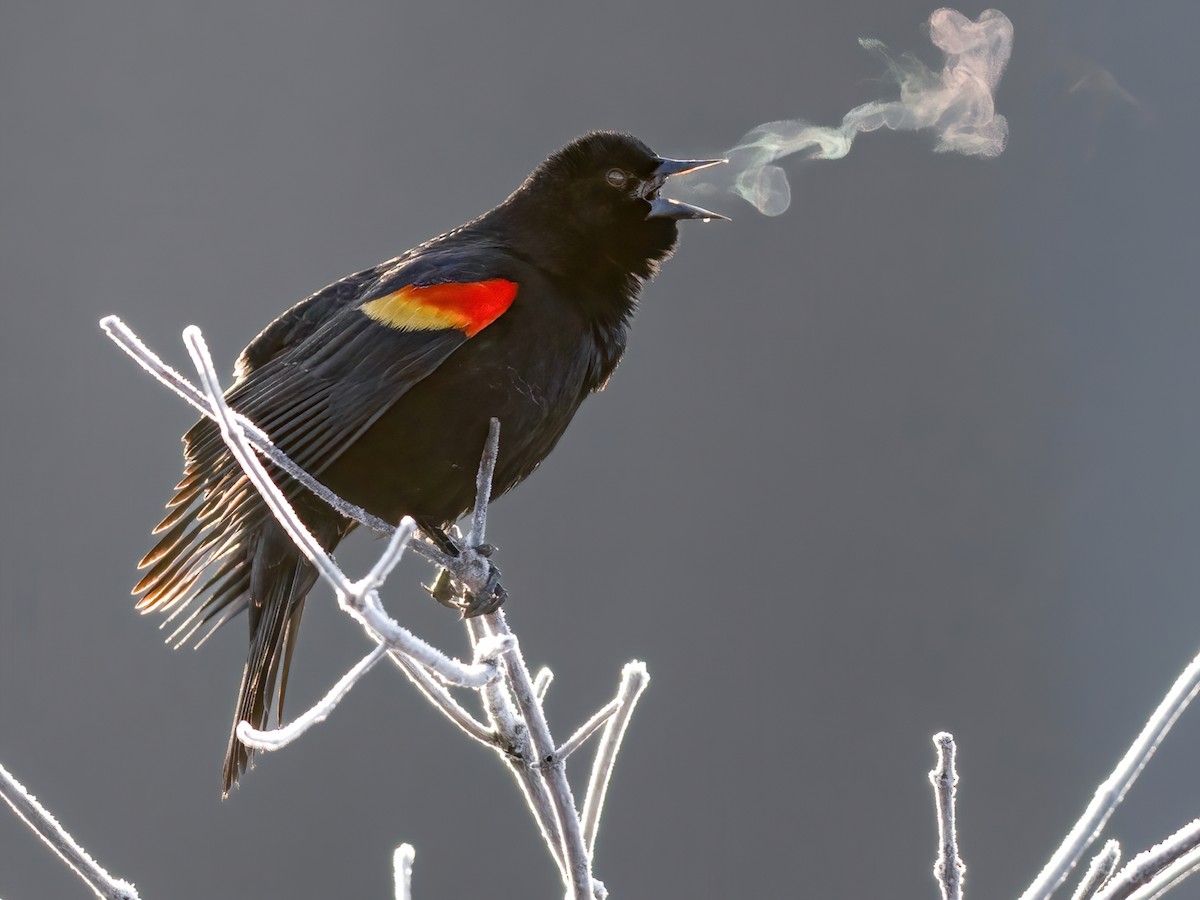
The Red-winged Blackbird is a medium-sized, sexually dimorphic passerine bird known for the male's striking red and yellow epaulets. It is one of the most abundant and widespread bird species in North America, commonly found in wetlands and open fields.
Dimensioni e longevità
- Lunghezza
- 17-23 cm (6.7-9.1 in)
- Apertura alare
- 31-40 cm (12.2-15.7 in)
- Peso
- 40-80 g (1.4-2.8 oz), males typically larger than females
- Longevità
- 2-5 years in the wild, up to 15 years recorded
- Dieta
- Omnivore, primarily insects during breeding season, seeds and grains in winter
Caratteristiche fisiche
- Piumaggio
- Adult males are glossy black with prominent red shoulder patches (epaulets) bordered by a narrow band of yellow. Females are streaky brown overall, resembling a large sparrow, with a pale eyebrow, streaked underparts, and sometimes a reddish or pinkish wash on the shoulders or throat. Juvenile males resemble females but may show some orange or reddish mottling on the shoulders.
- Forma del becco
- Conical, sharply pointed, black in color.
- Colore degli occhi
- Dark brown
- Colore delle zampe
- Black
- Caratteristiche distintive
- Male's bright red and yellow epaulets. Female's heavily streaked brown plumage with a pale supercilium and sharp, conical bill.
- Aspetto giovanile
- Juveniles of both sexes are streaky brown, similar to adult females. Young males gradually acquire black plumage and develop orange-red epaulets that become brighter with age. Juvenile females are indistinguishable from adult females in basic plumage.
- Cambiamenti stagionali
- Males maintain their breeding plumage year-round, though the red epaulets may be partially concealed by black feather tips in fresh fall plumage, becoming more exposed with wear. Females show little seasonal change, remaining streaky brown.
- Dimorfismo sessuale
- Highly sexually dimorphic. Males are entirely glossy black with vivid red and yellow shoulder patches. Females are duller, streaky brown, lacking the prominent red epaulets, though some may show a faint reddish tinge.
Come identificare
- 1
Male Plumage
Look for the unmistakable glossy black body with bright red shoulder patches (epaulets) bordered by yellow. These are visible even in flight.
- 2
Female Plumage
Identify females by their heavily streaked brown plumage, resembling a large sparrow. Note the pale eyebrow (supercilium) and sharp, conical bill. Some may show a faint reddish wash on the shoulders or throat.
- 3
Song
Listen for the distinctive, gurgling 'conk-la-ree!' song, often delivered from a high perch in a marsh or field.
- 4
Habitat
Check wetlands, marshes, wet meadows, and agricultural fields. They are rarely found far from water or dense vegetation.
- 5
Behavior
Observe males displaying their red epaulets during territorial disputes or courtship. Look for large flocks outside the breeding season, often foraging in open fields.
Habitat e areale
- Biomi
- Wetlands, marshes, wet meadows, agricultural fields, open woodlands, suburban areas.
- Areale geografico
- Breeds across most of North America, from Alaska and Canada south through the United States and into Central America. Winters throughout much of its breeding range in the southern and coastal regions, extending further south into Mexico and the Caribbean.
- Fascia altitudinale
- Sea level up to approximately 2,500 meters (8,200 feet).
- Ambienti preferiti
- Prefers areas with dense emergent vegetation (cattails, reeds) near water for nesting, and open fields or agricultural lands for foraging. Also common in roadside ditches and damp pastures.
Comportamento
- Periodo di attività
- Diurnal.
- Abitudini alimentari
- Forages on the ground, in low vegetation, and sometimes in trees. Diet consists of insects (dragonflies, damselflies, beetles, caterpillars, grasshoppers) during the breeding season, and seeds, grains (corn, oats, wheat), and fruits during the non-breeding season. They often probe in mud or under leaf litter for food.
- Comportamento sociale
- Highly social, especially outside the breeding season, forming large flocks, sometimes numbering in the thousands or millions, often mixed with other blackbird species, grackles, and starlings. During breeding, males are territorial, defending small territories where multiple females may nest (polygynous).
- Tipo di volo
- Strong, direct, and slightly undulating flight. Often flies in large, cohesive flocks outside the breeding season.
- Migrazione
- Northern populations are migratory, moving south for the winter. Southern populations are largely resident. Migratory movements occur in large flocks, often at night.
- Territorialità
- Males are highly territorial during the breeding season, aggressively defending their nesting territories against other males and predators. They display their red epaulets prominently during territorial disputes and courtship.
Canto e richiami
- Canto
- The male's song is a distinctive, gurgling 'conk-la-ree!' or 'o-ka-lee!', often delivered from a prominent perch. It's a liquid, musical trill followed by a buzzy note.
- Richiamo
- Common calls include a sharp 'check' or 'chick' call, a harsh 'teer' alarm call, and a variety of chattering and whistling notes within flocks.
- Quando vocalizza
- Males sing frequently during the breeding season, from early spring through summer, to attract mates and defend territory. Calls are heard year-round, especially when foraging in flocks.
Riproduzione
- Stagione riproduttiva
- Typically April to August, varying by latitude.
- Abitudini di nidificazione
- Nests are usually built by the female, often low in dense emergent vegetation (cattails, reeds, sedges) over water or in shrubs. The nest is a bulky cup woven from grasses, sedges, and leaves, lined with finer materials.
- Dimensione della covata
- 2-4 eggs, typically 3-4.
- Descrizione dell'uovo
- 3-5 eggs, pale blue-green to grayish, heavily marked with dark streaks, spots, and blotches, especially at the larger end.
- Periodo di incubazione
- 11-13 days, primarily by the female.
- Periodo di involo
- 10-14 days after hatching.
- Cure parentali
- Female primarily incubates and broods. Both parents feed the nestlings, though the female does the majority of the feeding. Males may defend multiple nests within their territory.
Dove trovarlo
Marshes and Wetlands
The primary habitat, especially during the breeding season. Look among cattails, reeds, and sedges.
Agricultural Fields
Commonly found foraging in cornfields, grain fields, and pastures, particularly outside the breeding season.
Roadside Ditches and Ponds
Often seen perched on fences or utility lines near water-filled ditches or small ponds.
Suburban Parks and Gardens
Can be found in areas with suitable wetland features or open grassy areas, especially during migration or winter.
Consigli sul campo
- Listen for the song. The male's 'conk-la-ree!' song is very distinctive and often the first indication of their presence, even when hidden in dense vegetation.
- Look for males on prominent perches. Males often perch on the tops of cattails, shrubs, fences, or utility lines to sing and display.
- Observe flock behavior. Outside the breeding season, look for large, often mixed-species, flocks foraging in open fields or roosting in dense vegetation.
- Scan marsh edges. They frequently forage along the edges of marshes and ponds, often walking on floating vegetation or probing in mud.
Specie simili
Tricolored Blackbird
Agelaius tricolor
Males have a narrower white border below the red epaulet, rather than yellow. Females are darker and less streaky than Red-winged Blackbirds, with a less prominent supercilium.
Brewer's Blackbird
Euphagus cyanocephalus
Males are entirely glossy black with no red epaulets and have pale yellow eyes. Females are duller gray-brown, not as heavily streaked as female Red-winged Blackbirds, and also have pale yellow eyes.
Rusty Blackbird
Euphagus carolinus
Males are glossy black with pale yellow eyes, but lack red epaulets. In non-breeding plumage, they show rusty feather edgings. Females are duller gray-brown with pale yellow eyes. Rusty Blackbirds prefer forested wetlands, while Red-winged Blackbirds prefer open wetlands.
Fatti rapidi
- Key ID Feature (Male):
- Glossy black with red and yellow shoulder patches
- Key ID Feature (Female):
- Heavily streaked brown with pale eyebrow
- Habitat:
- Wetlands, marshes, open fields
- Diet:
- Insects (breeding), seeds/grains (winter)
- Song:
- 'Conk-la-ree!'
- Sociality:
- Highly social, forms large flocks
Curiosità
- Red-winged Blackbirds are polygynous, meaning one male often mates with several females. A single male can have up to 15 females nesting in his territory, though 2-5 is more common.
- Males aggressively defend their territories, often chasing much larger birds, including hawks and crows, away from their nests.
- The red epaulets of the male are often covered by black feather tips in fresh fall plumage. As the feathers wear down over winter, the red becomes more exposed, making them appear brighter by spring without a full molt.
- They are one of the most abundant bird species in North America, with an estimated population of over 100 million individuals.
- During winter, Red-winged Blackbirds can form massive roosts, sometimes numbering in the millions, often mixed with other blackbird species, starlings, and grackles.
Classificazione scientifica
- Regno
- Animalia
- Phylum
- Chordata
- Classe
- Aves
- Ordine
- Passeriformes
- Famiglia
- Icteridae
- Genere
- Agelaius
- Specie
- Agelaius phoeniceus
Esplora Red-winged Blackbird
Identifica uccelli ovunque
Gratis su iOS, Android e Web. Identificazione per foto e suono, database completo e la tua lista personale.