
Visto un uccello? Identificalo all'istante con l'app Birdby
Apri l'appInformazioni
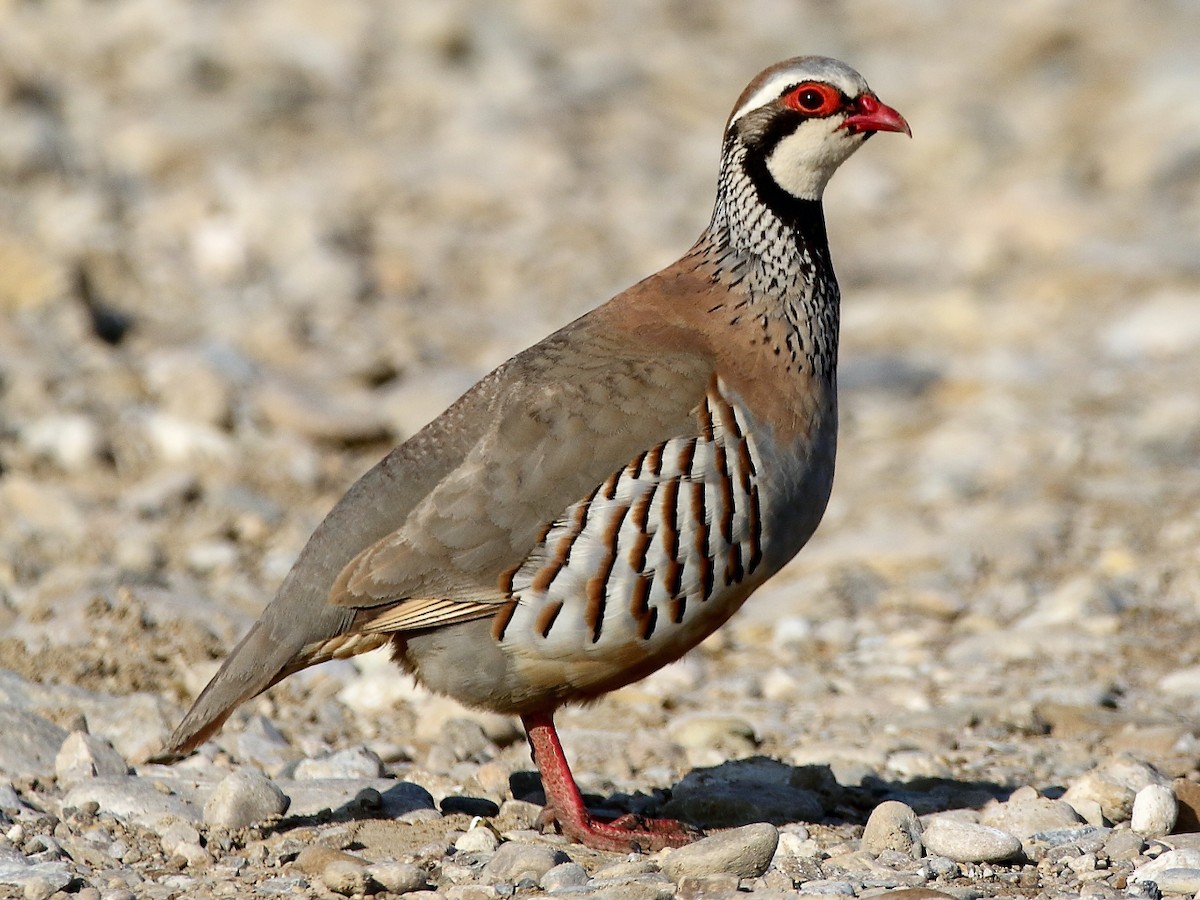
The Red-legged Partridge (Alectoris rufa) is a medium-sized game bird native to southwestern Europe. It is characterized by its distinctive red legs and beak, white throat bordered by a black gorget, and barred flanks. It is a ground-dwelling species, often found in open, dry habitats with scattered scrub and agricultural land.
Dimensioni e longevità
- Lunghezza
- 32-35 cm
- Apertura alare
- 47-50 cm
- Peso
- 390-500 g
- Longevità
- 3-5 years in the wild, up to 10 years in captivity
- Dieta
- Omnivore, primarily herbivorous
Caratteristiche fisiche
- Piumaggio
- Upperparts are olive-brown, breast is grey, and belly is buff. The most striking features are the white throat patch, outlined by a bold black gorget (necklace), and prominent black and chestnut barring on the flanks. The head has a white supercilium and a black line running from the beak through the eye to the gorget. The undertail coverts are rufous.
- Forma del becco
- Short, stout, and conical, bright red.
- Colore degli occhi
- Dark brown, surrounded by a red orbital ring.
- Colore delle zampe
- Bright red.
- Caratteristiche distintive
- Bright red legs and beak, white throat with a distinct black gorget, and bold black and chestnut barring on the flanks. The white supercilium and black eye-stripe are also key.
- Aspetto giovanile
- Juveniles are duller overall, lacking the distinct black gorget and bold flank barring of adults. Their plumage is more mottled brown and grey, and their legs and beak are duller, becoming redder with age.
- Cambiamenti stagionali
- No significant seasonal plumage changes. Plumage remains consistent throughout the year, though wear and tear can make colors appear slightly duller towards the end of the breeding season.
- Dimorfismo sessuale
- Males and females are largely similar in plumage. Males tend to be slightly larger and heavier, and often have a more prominent spur on the tarsus, though this can be variable and is not a definitive identification feature.
Come identificare
- 1
Head Pattern
Look for the bright red beak and legs, the white throat patch clearly outlined by a bold black 'necklace' or gorget, and the white stripe above the eye (supercilium) with a black line running through the eye.
- 2
Flank Barring
Observe the distinctive black and chestnut barring on the sides of the body. This combination of colors is a key identifier.
- 3
Overall Coloration
Note the olive-brown upperparts, grey breast, and buff belly. The contrast between these colors and the bold head and flank markings is characteristic.
- 4
Behavior
If flushed, it will typically run rapidly before taking off in a low, whirring flight for a short distance. Listen for its characteristic 'chuck-a-chuck-a' call.
Habitat e areale
- Biomi
- Mediterranean scrubland, open woodlands, agricultural fields, grasslands, heathlands.
- Areale geografico
- Native to France, Spain, Portugal, and northwestern Italy. Introduced to the United Kingdom (especially England) and other parts of Europe.
- Fascia altitudinale
- Typically found from sea level up to 2,000 meters, though most common in lower to mid-altitudes.
- Ambienti preferiti
- Dry, open landscapes with a mosaic of short vegetation, scattered bushes, hedges, and cultivated fields. Avoids dense forests and very wet areas. Prefers areas with good cover for nesting and roosting, but also open ground for foraging.
Comportamento
- Periodo di attività
- Diurnal, most active during early morning and late afternoon, resting during the hottest parts of the day.
- Abitudini alimentari
- Forages on the ground, primarily consuming seeds, leaves, shoots, roots, and berries. Also eats insects, especially during the breeding season when protein is needed for chicks. Chicks are almost entirely insectivorous initially.
- Comportamento sociale
- Highly social outside the breeding season, forming coveys (flocks) of 5-20 individuals, sometimes larger. During the breeding season, pairs become territorial.
- Tipo di volo
- Reluctant to fly, preferring to run or walk. When flushed, it takes off with a rapid, whirring flight, typically flying low and in a straight line for a short distance before gliding down to cover. Flight is strong but not sustained.
- Migrazione
- Sedentary; it does not migrate. Individuals typically remain within their breeding territories or move short distances to wintering grounds.
- Territorialità
- Pairs establish and defend breeding territories during the spring. Coveys maintain a home range outside the breeding season.
Canto e richiami
- Canto
- The 'song' is a distinctive, often repeated, harsh, chattering call, typically described as 'chuck-a-chuck-a-chuck-a' or 'kerr-ick-kerr-ick'. It can be quite loud and carries well, especially at dawn and dusk.
- Richiamo
- Various calls include a sharp 'whit-whit-whit' alarm call when flushed, and softer clucking or purring sounds within the covey. The most characteristic call is the 'chuck-a-chuck-a' series.
- Quando vocalizza
- Most vocal at dawn and dusk, particularly during the breeding season. Calls can also be heard throughout the day, especially when birds are communicating within a covey or when alarmed.
Riproduzione
- Stagione riproduttiva
- Typically from March to July, with peak egg-laying in April-May.
- Abitudini di nidificazione
- Nests are shallow scrapes on the ground, often concealed under a bush, tussock of grass, or in dense vegetation. Lined with leaves, grass, and feathers.
- Dimensione della covata
- Typically 10-16 eggs, but can range from 8 to 20. Double-brooding is rare but can occur.
- Descrizione dell'uovo
- Eggs are pale buff to yellowish-white, often speckled or spotted with reddish-brown or olive-brown. Oval to pear-shaped.
- Periodo di incubazione
- 23-24 days, primarily by the female.
- Periodo di involo
- Chicks are precocial and leave the nest shortly after hatching (within hours). They can fly short distances at about 10 days old and are fully independent at 60-70 days.
- Cure parentali
- Mainly by the female, though the male often stays nearby and assists in guarding the brood. Both parents may lead the chicks to foraging areas.
Dove trovarlo
Agricultural Land
Look in fields of cereals, vineyards, olive groves, and fallow land, especially those bordered by hedges or scrub.
Heathlands and Scrublands
Open areas with scattered bushes, gorse, and heather provide ideal cover and foraging opportunities.
Dry Grasslands
Areas with short, dry grasses and some taller vegetation for concealment are often frequented.
Roadsides and Field Edges
Often seen foraging along the edges of roads and fields, especially in early morning or late afternoon.
Consigli sul campo
- Listen for Calls. Their distinctive 'chuck-a-chuck-a' call is often heard at dawn and dusk, and can help locate coveys before they are seen.
- Scan Open Areas. Use binoculars to scan open fields, hillsides, and field edges. They are often well-camouflaged but can be spotted when moving.
- Look for Movement. They are ground-dwelling and often run rather than fly. Look for sudden movements in vegetation or across open ground.
- Be Patient and Quiet. Red-legged Partridges can be wary. Approach quietly and patiently, and avoid sudden movements.
- Check for Droppings and Tracks. Their presence can sometimes be indicated by their droppings or distinctive three-toed tracks on dusty paths or soft ground.
Specie simili
Chukar Partridge
Alectoris chukar
The Chukar has a similar black gorget, but it is typically narrower and less distinct. Its flanks have more uniform black barring without the prominent chestnut. The Chukar also lacks the white supercilium and black eye-stripe of the Red-legged Partridge. Its overall coloration is greyer, and its beak and legs are a duller red.
Barbary Partridge
Alectoris barbara
The Barbary Partridge has a distinctive grey head with a broad chestnut collar and a white throat patch that is not bordered by a black gorget. Its flank barring is also different, typically with broad chestnut bands. It is found in North Africa and Sardinia.
Rock Partridge
Alectoris graeca
The Rock Partridge has a grey breast and a white throat bordered by a black gorget, similar to the Red-legged. However, its flank barring is typically black and white, lacking the chestnut. It also has a more prominent white supercilium that extends further back. Its range is typically higher in mountainous regions.
Fatti rapidi
- Primary Diet:
- Seeds, leaves, insects
- Social Structure:
- Coveys (flocks) outside breeding season, pairs during breeding
- Flight Style:
- Short, whirring bursts, prefers running
- Key ID Feature:
- Red legs/beak, black gorget, barred flanks
- Habitat Preference:
- Dry, open agricultural and scrubland
Curiosità
- The Red-legged Partridge is a popular game bird and is widely bred and released for hunting, particularly in the UK and France.
- Despite its name, the 'Pernice Rossa' is not a true partridge in the same genus as the Grey Partridge (Perdix perdix), but belongs to the 'rock partridge' genus Alectoris.
- They are known for their strong running ability, often outrunning predators rather than flying.
- In some areas, hybridization with the Chukar Partridge (Alectoris chukar) and Rock Partridge (Alectoris graeca) can occur, leading to individuals with mixed features.
Classificazione scientifica
- Regno
- Animalia
- Phylum
- Chordata
- Classe
- Aves
- Ordine
- Galliformes
- Famiglia
- Phasianidae
- Genere
- Alectoris
- Specie
- Alectoris rufa
Esplora Red-legged Partridge
Identifica uccelli ovunque
Gratis su iOS, Android e Web. Identificazione per foto e suono, database completo e la tua lista personale.