
Visto un uccello? Identificalo all'istante con l'app Birdby
Apri l'appInformazioni
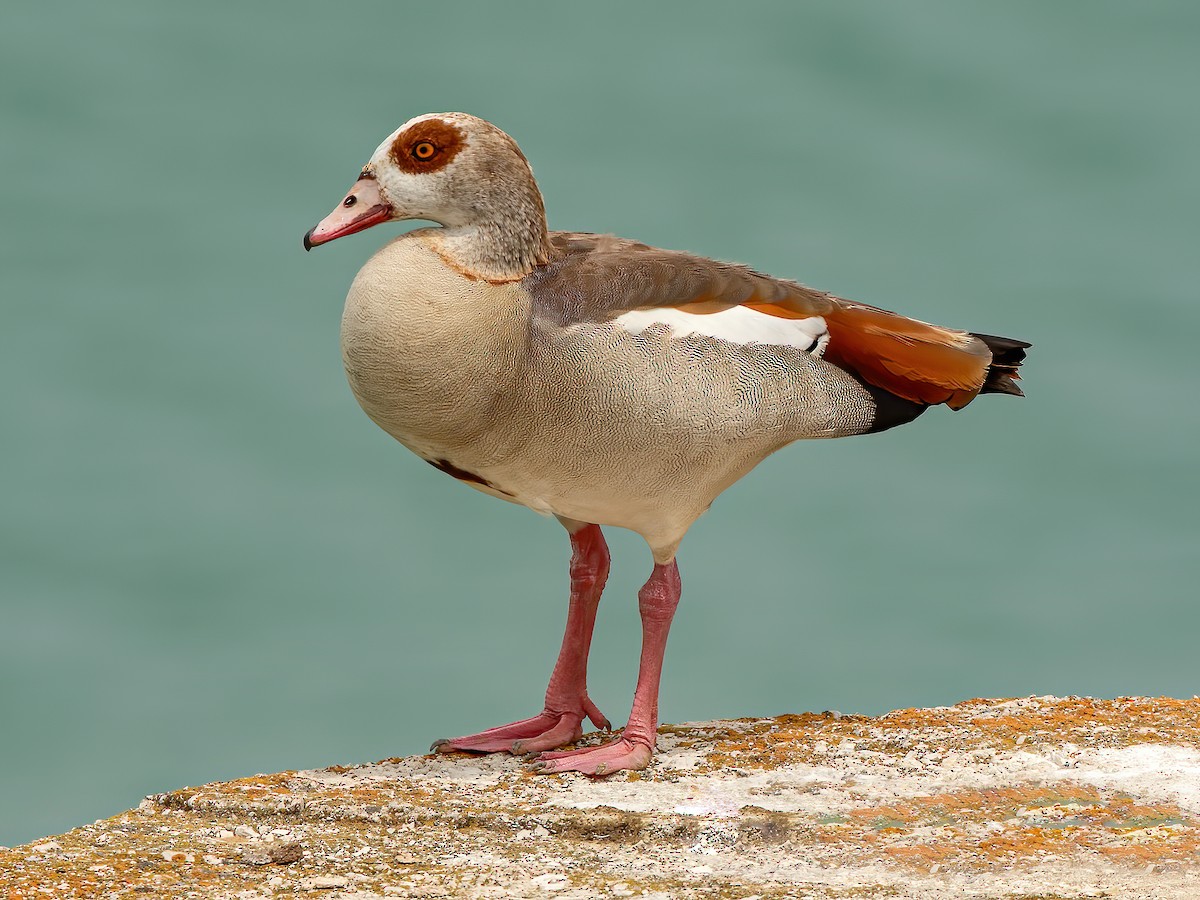
The Egyptian Goose is a distinctive waterfowl species, characterized by its goose-like appearance but taxonomically classified as a shelduck. It is native to Africa but has established feral populations in various parts of Europe and other regions. Known for its striking plumage and often aggressive territorial behavior, it is a common sight in parks, wetlands, and agricultural areas.
Dimensioni e longevità
- Lunghezza
- 63-73 cm
- Apertura alare
- 134-157 cm
- Peso
- 1.5-2.3 kg (male), 1.2-2.0 kg (female)
- Longevità
- Up to 15 years in the wild, longer in captivity
- Dieta
- Herbivore (primarily grazes on grasses, leaves, seeds, and agricultural crops, occasionally consumes small invertebrates)
Caratteristiche fisiche
- Piumaggio
- Overall sandy-brown to grey-brown body plumage. Distinctive dark brown patch around the eye, giving a 'spectacled' appearance. A prominent chestnut-brown patch on the breast. White wing patches (speculum) are visible in flight, bordered by black primaries and green secondaries. The back is darker brown, and the belly is paler. The undertail coverts are buffy-orange.
- Forma del becco
- Pinkish-red bill with a black tip and a black base. Relatively short and stout.
- Colore degli occhi
- Yellowish-orange to orange-brown, surrounded by a dark brown patch.
- Colore delle zampe
- Pinkish-red to orange-red.
- Caratteristiche distintive
- The dark eye-patch, chestnut breast patch, and pinkish legs and bill are key identifiers. In flight, the large white wing patches are very conspicuous.
- Aspetto giovanile
- Juveniles are duller overall, lacking the distinct eye-patch and breast patch. Their plumage is more uniformly grey-brown, and their legs and bill are duller, often greyish-pink, gradually acquiring adult coloration.
- Cambiamenti stagionali
- No significant seasonal plumage changes. Plumage remains consistent throughout the year.
- Dimorfismo sessuale
- Males and females are largely similar in plumage. Males tend to be slightly larger and have a more prominent, often raspier call. During breeding season, males may appear slightly more robust.
Come identificare
- 1
Plumage
Look for the sandy-brown body, dark eye-patch, and chestnut breast patch. The white wing patches are diagnostic in flight.
- 2
Bill and Legs
Note the pinkish-red bill with a black tip and pinkish-red legs. This coloration is unique among similar waterfowl.
- 3
Vocalization
Listen for the harsh, rasping calls of the male and the louder, more raucous 'honk-honk' of the female, especially when disturbed.
- 4
Behavior
Observe its territorial nature, often chasing other birds. It frequently grazes on land, much like a goose.
Habitat e areale
- Biomi
- Wetlands, grasslands, agricultural lands, urban parks, rivers, lakes, reservoirs, estuaries.
- Areale geografico
- Native to sub-Saharan Africa and the Nile Valley. Introduced and established feral populations in Western Europe (especially UK, Netherlands, Belgium, France, Germany), parts of North America, and other regions.
- Fascia altitudinale
- Typically found from sea level up to 1,800 meters, occasionally higher.
- Ambienti preferiti
- Prefers open water bodies with adjacent grassy areas for grazing and nesting. Adaptable to human-modified landscapes, including urban and suburban parks with ponds and lakes.
Comportamento
- Periodo di attività
- Diurnal, active during daylight hours.
- Abitudini alimentari
- Primarily a grazer, feeding on short grasses, clover, and other herbaceous vegetation. Also consumes seeds, grains (especially from agricultural fields), leaves, and aquatic plants. Occasionally supplements its diet with small invertebrates like insects and worms.
- Comportamento sociale
- Highly territorial, especially during the breeding season, often aggressively defending nesting sites and young. Outside of breeding, they can form small to large flocks, particularly during molting or in wintering areas. Pairs typically remain together year-round.
- Tipo di volo
- Strong, direct flight with powerful wing beats. White wing patches are very prominent in flight. Can be quite agile in the air despite its size.
- Migrazione
- Generally resident in its native African range, with some local movements in response to water availability. Feral European populations are largely resident, though some individuals may undertake short-distance dispersal.
- Territorialità
- Highly territorial, particularly during nesting. Pairs will aggressively chase away other waterfowl, including larger geese and ducks, from their chosen nesting and feeding areas. This can lead to conflicts with native species in introduced ranges.
Canto e richiami
- Canto
- Not a true songbird. Vocalizations are primarily calls.
- Richiamo
- Males produce a harsh, rasping 'hark-hark-hark' or 'honk-honk' sound, often described as a 'hissing' or 'snorting' call, especially when agitated or displaying. Females have a louder, more raucous, and repetitive 'honk-honk-honk' or 'ga-ga-ga' call, particularly when in flight or alarmed. They also produce softer conversational calls.
- Quando vocalizza
- Vocalize throughout the day, especially when alarmed, during territorial disputes, or in flight. Females are particularly vocal during courtship and when leading young.
Riproduzione
- Stagione riproduttiva
- Highly variable depending on geographic location and rainfall. In Africa, often coincides with the dry season (July-March). In Europe, typically February-June, but can breed almost year-round if conditions are favorable.
- Abitudini di nidificazione
- Nests are typically placed in concealed locations, often in tree hollows, abandoned raptor nests, dense vegetation, or even on buildings and cliffs. They do not build elaborate nests, often using existing depressions or lining a scrape with down and vegetation.
- Dimensione della covata
- 5-12 eggs, typically 6-10.
- Descrizione dell'uovo
- Creamy white to pale buff, smooth, and unspotted. Oval to sub-elliptical shape.
- Periodo di incubazione
- 28-30 days.
- Periodo di involo
- 70-75 days. Young are precocial and leave the nest shortly after hatching, but remain with parents for an extended period.
- Cure parentali
- Both parents participate in incubation (though primarily the female) and vigorously defend the goslings. Goslings are led to water and feeding areas by both adults.
Dove trovarlo
Urban Parks and Gardens
Common in parks with ponds, lakes, and grassy areas, especially in areas where they have been introduced.
Wetlands and Rivers
Found along slow-moving rivers, lakes, reservoirs, and marshes, particularly those with open banks for grazing.
Agricultural Land
Often seen in fields adjacent to water bodies, grazing on crops or stubble.
Consigli sul campo
- Look for pairs or small family groups. While they can form larger flocks, especially outside the breeding season, pairs are often seen together, sometimes with their goslings.
- Listen for their distinctive calls. Their loud, often harsh vocalizations are a good way to locate them, even before you see them.
- Observe their grazing behavior. They spend a significant amount of time grazing on land, similar to true geese, which can help distinguish them from dabbling ducks.
- Check for white wing patches in flight. If a bird takes flight, the large white patches on its wings are an unmistakable field mark.
Specie simili
Ruddy Shelduck
Tadorna ferruginea
The Ruddy Shelduck is more uniformly orange-brown, lacking the distinct eye-patch and breast patch of the Egyptian Goose. Males have a narrow black collar during breeding season. Its bill and legs are darker, more greyish-black, compared to the pinkish-red of the Egyptian Goose. In flight, the Ruddy Shelduck shows white forewings and black flight feathers, but lacks the large white speculum of the Egyptian Goose.
Common Shelduck
Tadorna tadorna
The Common Shelduck is strikingly patterned with black, white, and chestnut. It has a dark green head, a broad chestnut breast band, and a bright red bill with a knob (more prominent in males). Its overall body plumage is white with black markings, very different from the sandy-brown of the Egyptian Goose.
Fatti rapidi
- Native Range:
- Sub-Saharan Africa and Nile Valley
- Introduced Range:
- Western Europe, parts of North America
- Diet Type:
- Herbivore (grazer)
- Social Structure:
- Monogamous pairs, territorial during breeding
- Conservation Status:
- Least Concern (globally)
Curiosità
- Despite its common name, the Egyptian Goose is not a true goose but belongs to the shelduck subfamily (Tadorninae), which are intermediate between geese and ducks.
- Ancient Egyptians considered the Egyptian Goose sacred and it frequently appears in their art and hieroglyphs.
- They are highly adaptable and have successfully established feral populations in many parts of the world, sometimes becoming a nuisance due to their aggressive nature and impact on native waterfowl.
- Egyptian Geese are known for their unusual nesting sites, often choosing tree hollows or even old raptor nests high above the ground, despite being primarily ground-dwelling birds.
Classificazione scientifica
- Regno
- Animalia
- Phylum
- Chordata
- Classe
- Aves
- Ordine
- Anseriformes
- Famiglia
- Anatidae
- Genere
- Alopochen
- Specie
- Alopochen aegyptiaca
Esplora Oca egiziana
Identifica uccelli ovunque
Gratis su iOS, Android e Web. Identificazione per foto e suono, database completo e la tua lista personale.