
Visto un uccello? Identificalo all'istante con l'app Birdby
Apri l'appInformazioni
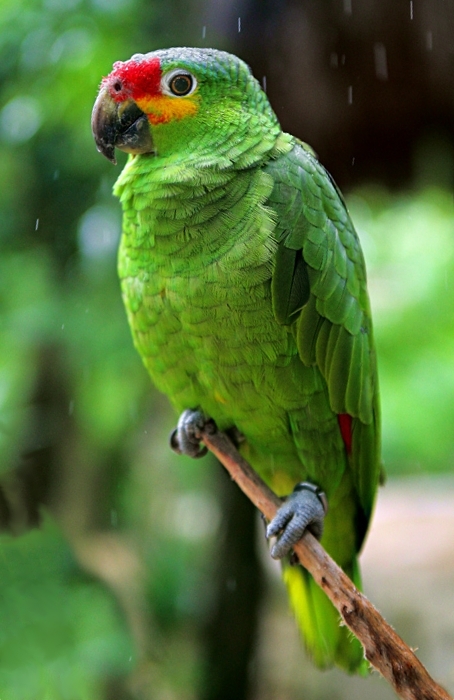
The Red-lored Amazon is a medium-sized parrot characterized by its vibrant green plumage, distinctive red forehead, and yellow cheeks. It is known for its intelligence, vocalizations, and social behavior, often found in tropical and subtropical forests.
Dimensioni e longevità
- Lunghezza
- 32-35 cm (12.5-14 in)
- Apertura alare
- 58-66 cm (23-26 in)
- Peso
- 310-480 g (10.9-16.9 oz)
- Longevità
- Up to 50-60 years in captivity, likely shorter in the wild (20-30 years estimated)
- Dieta
- Herbivore (frugivore, granivore, florivore)
Caratteristiche fisiche
- Piumaggio
- Predominantly bright green plumage. The forehead is bright red, extending to the lores (area between the eye and bill). The cheeks and ear coverts are yellow, often with some orange or red flecking. The crown is typically blue-violet, fading into green on the nape. The primary coverts are red, and the outer webs of the secondary flight feathers are blue-violet. The tail is green with red at the base of the outer feathers and a yellowish-green tip.
- Forma del becco
- Strong, hooked beak, horn-colored with a darker tip.
- Colore degli occhi
- Orange-red iris with a pale periophthalmic ring.
- Colore delle zampe
- Greyish-pink to grey.
- Caratteristiche distintive
- The combination of a red forehead, yellow cheeks, and blue-violet crown is highly distinctive. The red patch on the bend of the wing is also a key field mark.
- Aspetto giovanile
- Juveniles resemble adults but have less extensive and duller red on the forehead, paler yellow on the cheeks, and a brownish-grey iris. The blue-violet on the crown may be less pronounced.
- Cambiamenti stagionali
- No significant seasonal changes in plumage.
- Dimorfismo sessuale
- No significant sexual dimorphism in plumage; males and females look alike. DNA sexing is required for definitive identification.
Come identificare
- 1
Forehead Color
Look for the distinct bright red patch on the forehead, extending to the lores.
- 2
Cheek Color
Observe the prominent yellow cheeks and ear coverts.
- 3
Crown Color
Note the blue-violet wash on the crown, contrasting with the red forehead and green nape.
- 4
Wing Patch
Identify the red patch on the bend of the wing (carpal joint), visible in flight and at rest.
- 5
Vocalizations
Listen for its loud, raucous calls, including rolling 'kree-ah' sounds and various squawks and whistles, especially when flying or in flocks.
- 6
Flight Pattern
Observe its strong, direct flight with rapid wing beats, often in pairs or small groups.
Habitat e areale
- Biomi
- Tropical and subtropical moist broadleaf forests, semi-deciduous forests, gallery forests, forest edges, and sometimes cultivated areas with scattered trees.
- Areale geografico
- Native to Central America, from eastern Mexico south through Belize, Guatemala, Honduras, Nicaragua, Costa Rica, and Panama. Also found in western Colombia and northwestern Ecuador.
- Fascia altitudinale
- Typically found from sea level up to 1,200 meters (3,900 feet), occasionally higher.
- Ambienti preferiti
- Prefers mature forests with tall trees for nesting and roosting, often near water sources. Adapts to disturbed habitats and agricultural lands if sufficient trees remain.
Comportamento
- Periodo di attività
- Diurnal. Most active during early morning and late afternoon, foraging and vocalizing.
- Abitudini alimentari
- Feeds primarily on fruits, seeds, nuts, berries, and flowers. They use their strong beaks to crack open hard shells and manipulate food. Often forage in the canopy.
- Comportamento sociale
- Highly social birds, typically seen in pairs or small family groups during the breeding season. Outside of breeding, they form larger flocks, sometimes numbering in the hundreds, especially at communal roosts.
- Tipo di volo
- Strong, direct flight with rapid wing beats. Often flies in pairs or small flocks, especially at dawn and dusk when moving to and from roosting sites. Their flight calls are distinctive.
- Migrazione
- Resident throughout its range; generally non-migratory. May undertake local movements in search of food resources.
- Territorialità
- Breeding pairs are territorial around their nest sites, but flocks are generally tolerant of each other in feeding and roosting areas.
Canto e richiami
- Canto
- Does not have a complex song. Vocalizations are primarily calls.
- Richiamo
- A wide repertoire of loud, raucous, and often screeching calls. Common calls include a rolling 'kree-ah' or 'krah-krah-krah', often interspersed with whistles, squawks, and chattering. They are known for their ability to mimic sounds.
- Quando vocalizza
- Most vocal at dawn and dusk, during flight, and when disturbed or excited. Also vocal during foraging and social interactions.
Riproduzione
- Stagione riproduttiva
- Varies geographically, but generally from February to June in Central America.
- Abitudini di nidificazione
- Nests in tree cavities, typically in tall, mature trees. They do not build a nest structure, but rather lay eggs directly on the wood debris at the bottom of the cavity.
- Dimensione della covata
- 2-4 eggs, most commonly 3.
- Descrizione dell'uovo
- White, elliptical eggs.
- Periodo di incubazione
- Approximately 24-26 days.
- Periodo di involo
- Chicks fledge (leave the nest) around 56-60 days after hatching.
- Cure parentali
- Both parents participate in incubation and feeding of the young. The female primarily incubates, while the male brings food to her and later to the chicks.
Dove trovarlo
Tropical Forests
Primary and secondary tropical moist broadleaf forests are prime locations.
Forest Edges
Often seen at the edges of forests, where they can access both dense cover and open areas for foraging.
Riparian Zones
Areas along rivers and streams with tall trees are favored habitats.
Agricultural Areas
Can be found in cultivated lands with scattered large trees, especially fruit orchards.
Consigli sul campo
- Listen for Calls. Their loud and distinctive calls are often the first indication of their presence, especially at dawn and dusk.
- Scan Tree Canopies. They spend much of their time foraging in the upper canopy of tall trees. Use binoculars to scan for movement and color.
- Visit Roosting Sites. Locate communal roosting sites, often large trees, where many individuals gather before sunset and disperse at sunrise.
- Look for Feeding Activity. Observe fruiting trees; they are often attracted to specific food sources.
- Be Patient and Quiet. Parrots can be wary. Approach quietly and observe from a distance to avoid disturbing them.
Specie simili
Yellow-naped Amazon
Amazona auropalliata
Lacks the red forehead and yellow cheeks of the Red-lored Amazon. Instead, it has a prominent yellow patch on the nape (back of the neck).
Yellow-headed Amazon
Amazona oratrix
Has extensive yellow on the head, often covering the entire head and nape, much more than the yellow cheeks of the Red-lored Amazon. Lacks the red forehead.
White-fronted Amazon
Amazona albifrons
Smaller in size. Has a white forehead, blue crown, and red around the eyes. Lacks the yellow cheeks and extensive red on the forehead of the Red-lored Amazon.
Fatti rapidi
- Status:
- Least Concern
- Diet:
- Fruits, seeds, nuts, flowers
- Habitat:
- Tropical and subtropical forests
- Sociality:
- Social, often in flocks
- Vocalization:
- Loud, raucous calls and screeches
- Nesting:
- Tree cavities
Curiosità
- The Red-lored Amazon is a popular pet bird due to its intelligence and ability to mimic human speech, though this has unfortunately contributed to illegal trapping in some areas.
- They play an important ecological role as seed dispersers for many tropical plants.
- Their strong beaks are incredibly powerful, capable of cracking open very hard nuts and seeds.
- Like many parrots, they often form strong pair bonds that can last for many years.
Classificazione scientifica
- Regno
- Animalia
- Phylum
- Chordata
- Classe
- Aves
- Ordine
- Psittaciformes
- Famiglia
- Psittacidae
- Genere
- Amazona
- Specie
- Amazona autumnalis
Esplora Red-lored Amazon
Identifica uccelli ovunque
Gratis su iOS, Android e Web. Identificazione per foto e suono, database completo e la tua lista personale.