
Visto un uccello? Identificalo all'istante con l'app Birdby
Apri l'appInformazioni
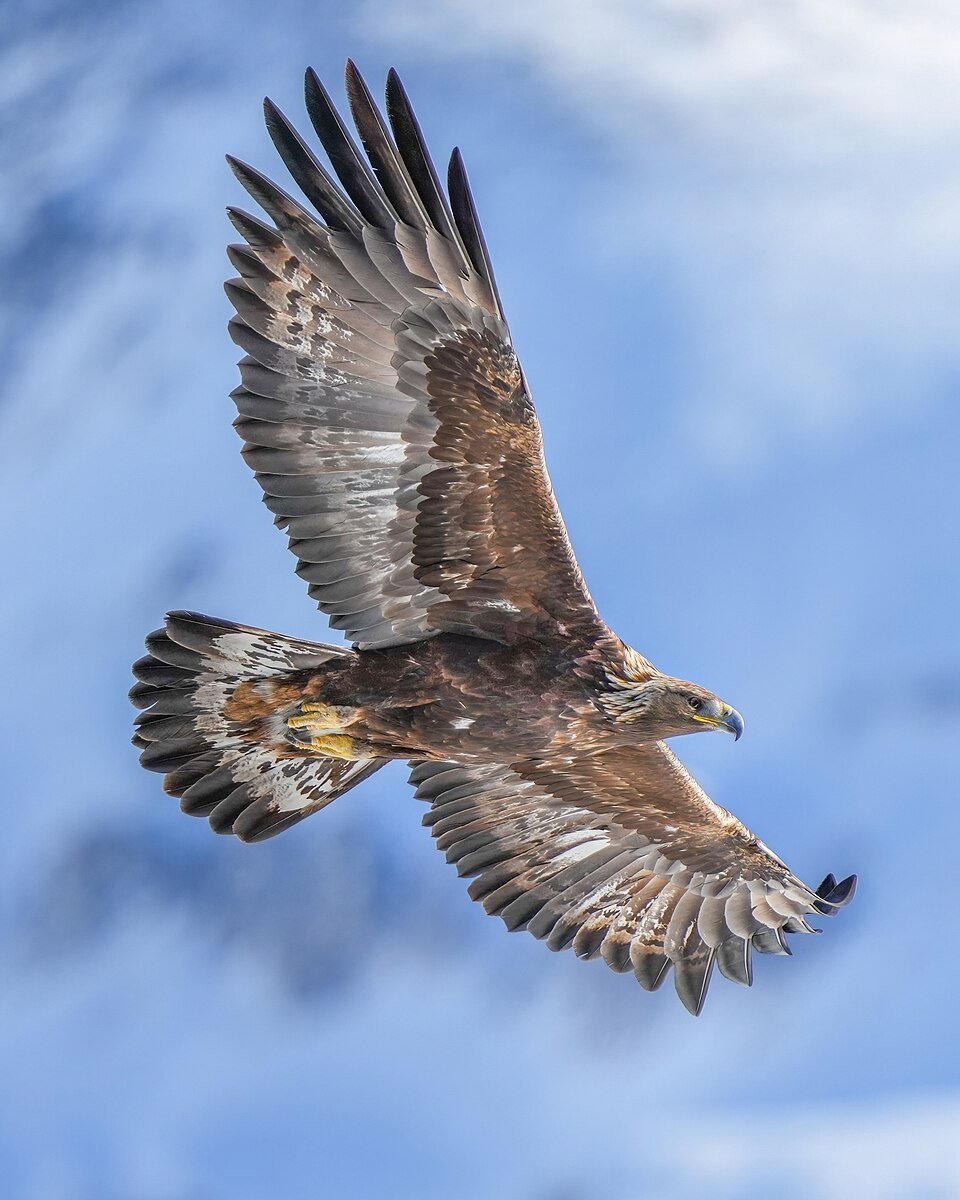
The Golden Eagle is one of the best-known birds of prey in the Northern Hemisphere. It is the most widely distributed species of eagle, characterized by its large size, powerful build, and dark brown plumage with a distinctive golden-brown nape. Renowned for its hunting prowess and majestic flight, it occupies a top position in its ecosystem's food chain.
Dimensioni e longevità
- Lunghezza
- 70-84 cm (28-33 in)
- Apertura alare
- 180-234 cm (71-92 in)
- Peso
- 2.8-6.7 kg (6.2-14.8 lb), females typically larger than males
- Longevità
- Up to 20-25 years in the wild, over 30 years in captivity
- Dieta
- Carnivore, primarily preying on medium-sized mammals (e.g., rabbits, marmots, ground squirrels, foxes, young deer) and birds (e.g., grouse, pheasants, waterfowl). Also consumes carrion, especially in winter.
Caratteristiche fisiche
- Piumaggio
- Adults are uniformly dark brown with a distinctive golden-brown wash on the nape and hindneck, which gives them their common name. The flight feathers are darker, and the tail is dark with indistinct banding. Juveniles have a darker, more uniform brown body, with prominent white patches at the base of the primary flight feathers (carpal patch) and a white tail with a broad, dark terminal band.
- Forma del becco
- Large, powerful, hooked beak, dark grey to black with a yellow cere.
- Colore degli occhi
- Dark brown in adults, lighter brown in juveniles.
- Colore delle zampe
- Yellow, with powerful talons and feathered tarsi (legs covered in feathers down to the toes).
- Caratteristiche distintive
- Large size, golden nape, powerful flight, feathered tarsi, and in juveniles, the prominent white wing patches and white tail base with a dark terminal band.
- Aspetto giovanile
- Juveniles are darker overall, lack the golden nape of adults (or it's much less pronounced), and have striking white patches at the base of the primaries on the underwing and a white tail with a broad, dark terminal band. These white markings gradually diminish over 4-5 years until adult plumage is achieved.
- Cambiamenti stagionali
- No significant seasonal plumage changes. Plumage gradually changes from juvenile to adult over several years.
- Dimorfismo sessuale
- Females are generally larger and heavier than males, but plumage is identical.
Come identificare
- 1
Size and Silhouette
Look for a very large, powerful raptor. In flight, adults hold their wings in a slight dihedral (V-shape) when soaring. Juveniles may hold wings flatter. The head is relatively small compared to the body, and the tail is moderately long.
- 2
Plumage (Adult)
Observe the overall dark brown body with a distinctive golden-brown wash on the nape and hindneck. The flight feathers are dark, and the tail is dark with faint banding.
- 3
Plumage (Juvenile)
Look for prominent white patches at the base of the primary flight feathers on the underwing (carpal patches) and a white tail with a broad, dark terminal band. These are key identification marks for young birds.
- 4
Flight Style
Note the powerful, deep wing beats and long periods of soaring. They are masters of using thermals and updrafts. Their flight is less buoyant than that of a buzzard.
- 5
Habitat
Consider the environment. Golden Eagles prefer open country, mountains, and large wilderness areas, often near cliffs or rocky outcrops.
Habitat e areale
- Biomi
- Mountainous regions, open country, grasslands, tundra, deserts, and coniferous forests, often near cliffs or rocky outcrops for nesting.
- Areale geografico
- Holarctic distribution, found across North America, Eurasia, and parts of North Africa. In North America, from Alaska and Canada south through the western United States and Mexico. In Eurasia, from Western Europe across Russia to China and Japan, and south to parts of the Middle East and North Africa.
- Fascia altitudinale
- Sea level up to 5,000 meters (16,400 ft) in mountainous regions, though typically found at lower elevations in open country.
- Ambienti preferiti
- Prefers open or semi-open landscapes with access to elevated perches and nesting sites, such as cliffs, large trees, or human-made structures like power pylons. Requires extensive hunting territories.
Comportamento
- Periodo di attività
- Diurnal, active during daylight hours.
- Abitudini alimentari
- A highly skilled hunter, often soaring high to spot prey or hunting from a perch. Uses powerful talons to capture prey, which is often killed by crushing. May hunt cooperatively, especially for larger prey. Known to steal prey from other raptors (kleptoparasitism) and occasionally takes carrion.
- Comportamento sociale
- Generally solitary or found in pairs, especially during the breeding season. Pairs maintain large territories year-round. Juveniles may gather in small groups outside the breeding season.
- Tipo di volo
- Powerful and majestic flight, characterized by deep, slow wing beats and long periods of soaring on thermals. Often holds wings in a slight dihedral (V-shape) when soaring. Can achieve high speeds during dives (stoops) when hunting.
- Migrazione
- Resident in many parts of its range, particularly in areas with stable food sources. Northern populations, especially juveniles, may undertake partial or complete migrations to warmer southern areas during winter, often following mountain ranges or coastlines.
- Territorialità
- Highly territorial, especially during the breeding season. Pairs defend large nesting and hunting territories against other Golden Eagles and sometimes other large raptors. Displays include soaring, undulating flight, and mock attacks.
Canto e richiami
- Canto
- Golden Eagles do not have a complex song. Vocalizations are generally limited to calls.
- Richiamo
- Typically silent outside the breeding season. During breeding, they produce a variety of calls, including sharp 'kya-kya-kya' or 'kleek-kleek-kleek' calls, often described as yelps or barks. Also, a softer 'cluck' or 'whistle' may be used between mates or with young. Alarm calls are more intense and rapid.
- Quando vocalizza
- Most vocal during the breeding season, particularly around the nest site, and when interacting with mates or young. Less vocal during migration or outside the breeding period.
Riproduzione
- Stagione riproduttiva
- Varies geographically, typically from late winter to early spring (February-March in temperate regions, later in arctic regions).
- Abitudini di nidificazione
- Builds massive nests (eyries) on cliffs, in large trees, or on human-made structures. Nests are constructed from large sticks and branches, lined with softer materials like grass, moss, and fur. Pairs often have multiple alternate nests within their territory, which they may use in different years. Nests can be used for decades and grow to enormous sizes.
- Dimensione della covata
- 1-4 eggs, most commonly 2.
- Descrizione dell'uovo
- Typically 1-4 (usually 2) eggs, dull white to creamy white, often speckled or blotched with reddish-brown or purple markings. Approximately 74 x 58 mm (2.9 x 2.3 in).
- Periodo di incubazione
- 40-45 days, primarily by the female, with the male providing food.
- Periodo di involo
- 65-75 days after hatching. Young remain dependent on parents for several weeks to months after fledging.
- Cure parentali
- Both parents participate in raising the young. The female primarily incubates and broods, while the male provides most of the food during the early nestling stage. Both parents hunt and feed the young as they grow. Often, only one or two chicks survive, with siblicide (older/stronger chick killing younger/weaker chick) being common.
Dove trovarlo
Mountainous Regions
High-altitude areas with cliffs and open valleys are prime habitats for nesting and hunting.
Open Grasslands and Prairies
Especially in western North America, these areas provide abundant prey like ground squirrels and rabbits.
Remote Wilderness Areas
Undisturbed areas with minimal human presence are preferred for breeding and hunting.
Coastal Cliffs
In some regions, they can be found nesting on sea cliffs and hunting over coastal areas.
Consigli sul campo
- Scan the Skies. Golden Eagles spend a lot of time soaring high on thermals. Use binoculars or a spotting scope to scan the sky, especially during midday when thermals are strongest.
- Look for Perches. Check prominent perches like cliff edges, large dead trees, or power poles in suitable habitats. They often use these to survey their territory.
- Observe Flight Patterns. Learn to recognize their characteristic flight profile: powerful, deep wing beats and soaring with wings held in a slight dihedral.
- Visit Known Territories. Research local birding hotspots or protected areas known to host Golden Eagles. Local birding groups or park rangers can often provide information on active nests or reliable viewing spots.
- Patience is Key. Golden Eagles are often elusive and cover vast territories. Be patient and spend extended periods observing. Early morning or late afternoon can be good for seeing them actively hunting.
Specie simili
Immature Bald Eagle
Haliaeetus leucocephalus
Immature Bald Eagles can be confused with Golden Eagles due to their dark plumage. However, Bald Eagles typically have a larger, more prominent head and beak, and their flight profile shows wings held flat or slightly bowed, not in a dihedral. The white on the underwing of an immature Bald Eagle is often more mottled and extends further along the wing, lacking the distinct white carpal patches of juvenile Golden Eagles. Bald Eagles also prefer habitats closer to large bodies of water.
Common Buzzard (Eurasian)
Buteo buteo
Much smaller than a Golden Eagle. While also a soaring raptor, the Common Buzzard has a shorter tail, broader wings relative to its body, and a more compact appearance. Its plumage is highly variable but generally lighter and more mottled than a Golden Eagle. Flight is less powerful, with more frequent wing beats.
Rough-legged Buzzard (Eurasian) / Rough-legged Hawk (North American)
Buteo lagopus
Significantly smaller. Distinguished by its feathered tarsi (like the Golden Eagle, but smaller scale), a dark belly patch, and a white tail with a broad dark subterminal band. Often hovers, a behavior rarely seen in Golden Eagles.
Fatti rapidi
- Top Predator:
- Occupies the apex predator role in many of its ecosystems.
- Monogamous:
- Pairs typically mate for life and maintain territories for many years.
- Powerful Hunter:
- Capable of taking down prey much larger than itself, including young deer and domestic livestock.
- Feathered Legs:
- Tarsi are feathered down to the toes, a distinguishing feature among many raptors.
- Cultural Significance:
- Highly revered in many cultures, particularly among indigenous peoples of North America and Central Asia.
Curiosità
- Golden Eagles have been recorded diving at speeds over 320 km/h (200 mph) during hunting stoops, making them one of the fastest animals on Earth.
- Their eyesight is estimated to be 4-8 times better than that of humans, allowing them to spot prey from extreme distances.
- In some parts of Central Asia, Golden Eagles are traditionally trained for hunting, a practice known as 'eagle hunting' or 'berkutchi'.
- Golden Eagle nests (eyries) can be enormous, sometimes weighing over a ton and measuring several meters across and deep, built up over decades of use.
- Despite their fearsome reputation, Golden Eagles are generally shy of humans and prefer remote, undisturbed habitats.
Classificazione scientifica
- Regno
- Animalia
- Phylum
- Chordata
- Classe
- Aves
- Ordine
- Accipitriformes
- Famiglia
- Accipitridae
- Genere
- Aquila
- Specie
- Aquila chrysaetos
Esplora Golden Eagle
Identifica uccelli ovunque
Gratis su iOS, Android e Web. Identificazione per foto e suono, database completo e la tua lista personale.