
Visto un uccello? Identificalo all'istante con l'app Birdby
Apri l'appInformazioni
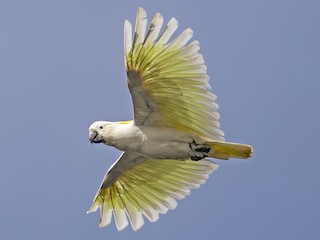
The Sulphur-crested Cockatoo is a large, conspicuous white parrot with a prominent yellow erectile crest. Known for its intelligence, longevity, and loud vocalizations, it is a common sight across much of eastern and northern Australia, as well as New Guinea and surrounding islands. It is highly adaptable and thrives in both natural and urban environments.
Dimensioni e longevità
- Lunghezza
- 44-55 cm
- Apertura alare
- 80-100 cm
- Peso
- 700-1200 g
- Longevità
- 20-40 years in the wild, up to 80 years in captivity
- Dieta
- Herbivore (granivore, frugivore, folivore)
Caratteristiche fisiche
- Piumaggio
- Predominantly white plumage with a distinctive, large, forward-curving erectile crest of bright sulphur-yellow feathers. The underside of the wings and tail feathers show a pale yellow wash, particularly noticeable in flight. The beak is dark grey to black, and the legs are dark grey.
- Forma del becco
- Large, powerful, and sharply hooked dark grey to black beak, adapted for cracking hard nuts and seeds.
- Colore degli occhi
- Males typically have dark brown to black eyes, while females often have reddish-brown eyes. This is a key sexual dimorphism.
- Colore delle zampe
- Dark grey
- Caratteristiche distintive
- The most distinguishing feature is the prominent, erectile sulphur-yellow crest. The overall large size, white plumage, and loud calls are also characteristic.
- Aspetto giovanile
- Juveniles resemble adults but may have a slightly duller yellow crest and sometimes a paler iris color that darkens with age. Their calls may also be less developed.
- Cambiamenti stagionali
- No significant seasonal changes in plumage. The crest may be raised or lowered depending on the bird's mood or level of excitement.
- Dimorfismo sessuale
- Subtle, primarily in eye color: males have dark brown/black irises, females have reddish-brown irises. This difference is more pronounced in adults.
Come identificare
- 1
Crest
Look for the prominent, bright sulphur-yellow crest that can be raised or lowered. This is the most definitive field mark.
- 2
Plumage Color
Observe the overall pure white body plumage. Note the pale yellow wash on the underside of the wings and tail, visible in flight.
- 3
Size and Shape
Identify its large size and robust build, typical of a cockatoo, with a strong, hooked beak.
- 4
Vocalizations
Listen for its very loud, harsh, screeching calls, which are highly characteristic and often heard before the bird is seen.
- 5
Eye Color (for sexing)
If close enough, observe eye color: dark brown/black for males, reddish-brown for females.
Habitat e areale
- Biomi
- Tropical and subtropical forests, woodlands, open country, agricultural areas, urban parks, and suburban gardens.
- Areale geografico
- Native to eastern and northern Australia, New Guinea, and some Indonesian islands (e.g., Aru Islands, Seram). Introduced populations exist in various parts of the world, including New Zealand and Singapore.
- Fascia altitudinale
- Sea level up to approximately 1500 meters.
- Ambienti preferiti
- Prefers areas with tall trees for roosting and nesting, often near water sources. Highly adaptable to human-modified landscapes.
Comportamento
- Periodo di attività
- Diurnal, most active during early morning and late afternoon.
- Abitudini alimentari
- Feeds primarily on seeds, nuts, fruits, berries, flowers, and roots. They forage on the ground and in trees, often in large, noisy flocks. They are known to be destructive to crops and garden plants in some areas.
- Comportamento sociale
- Highly social birds, typically found in pairs or small family groups, but often congregating in large, noisy flocks, especially when feeding or roosting. They are intelligent and curious.
- Tipo di volo
- Strong, direct flight with powerful, shallow wing beats. Often flies in noisy flocks, especially at dawn and dusk when moving to and from roosting sites.
- Migrazione
- Resident throughout their range; no significant migratory patterns. They may undertake local movements in search of food or water.
- Territorialità
- Pairs defend their nest hollows during the breeding season, but feeding and roosting areas are often shared communally.
Canto e richiami
- Canto
- Does not have a melodic 'song' in the traditional sense. Its vocalizations are primarily loud, harsh, and raucous calls.
- Richiamo
- A variety of very loud, piercing, screeching, and squawking calls. Common calls include a harsh 'kaa-ark' or 'scree-ah' often repeated, and a series of high-pitched whistles and growls. They are known for their ability to mimic sounds.
- Quando vocalizza
- Most vocal at dawn and dusk, and when disturbed or excited. Calls are used for communication within flocks, alarm calls, and territorial displays.
Riproduzione
- Stagione riproduttiva
- Typically August to January in the southern parts of its range, and May to September in the northern parts, varying with rainfall and food availability.
- Abitudini di nidificazione
- Nests in tree hollows, usually high up in large, old eucalypts or other suitable trees. Both parents prepare the nest by lining it with wood chips.
- Dimensione della covata
- 1-3 eggs, most commonly 2.
- Descrizione dell'uovo
- Usually 2-3 white, oval eggs.
- Periodo di incubazione
- Approximately 25-30 days, shared by both parents.
- Periodo di involo
- Chicks fledge around 60-70 days after hatching. They remain dependent on their parents for several weeks to months after fledging.
- Cure parentali
- Both parents share incubation duties and care for the young. Young birds often stay with their parents for an extended period, sometimes joining larger family groups.
Dove trovarlo
Urban Parks and Gardens
Common in many Australian cities and towns, often seen feeding on lawns or roosting in large trees.
Eucalypt Woodlands and Forests
Found throughout native eucalypt habitats, especially near watercourses.
Agricultural Areas
Often seen foraging in cultivated fields, sometimes causing damage to crops.
Coastal Areas
Present in coastal forests and mangroves in parts of its range.
Consigli sul campo
- Listen for their calls. Their loud, raucous screeches often give away their presence long before they are seen. They are particularly vocal at dawn and dusk.
- Look for feeding flocks. They often feed in large, noisy flocks on the ground or in trees. Look for disturbed foliage or discarded seed husks.
- Check large trees. They prefer large, old trees for roosting and nesting. Scan tree canopies, especially at the edges of forests or in parks.
- Observe their crest. The crest is a good indicator of their mood; it will be raised when excited, alarmed, or displaying.
Specie simili
Major Mitchell's Cockatoo
Lophochroa leadbeateri
Major Mitchell's Cockatoo has a pinkish-white body, a more elaborate red and yellow crest with white tips, and a pink wash on its underparts. It is generally smaller and found in more arid regions.
Little Corella
Cacatua sanguinea
The Little Corella is significantly smaller, has a shorter, less prominent crest, and a pale blue eye-ring. Its beak is also smaller and paler. It lacks the yellow wash under the wings and tail.
Long-billed Corella
Cacatua tenuirostris
The Long-billed Corella has a distinctive elongated upper mandible, a pinkish-red band across its forehead, and a pink wash on its breast. Its crest is also less prominent and less yellow than the Sulphur-crested Cockatoo.
Fatti rapidi
- Crest Color:
- Sulphur-yellow
- Primary Plumage:
- White
- Vocalization:
- Loud, harsh screeches and squawks
- Sociality:
- Highly social, often in large flocks
- Diet:
- Seeds, nuts, fruits, roots
Curiosità
- Sulphur-crested Cockatoos are highly intelligent and can be taught to mimic human speech and perform tricks. Their problem-solving abilities are well-documented.
- They are known to use tools in the wild, such as using small sticks to extract seeds from cones.
- These cockatoos can live for an exceptionally long time, with some individuals in captivity reaching over 80 years of age.
- Their powerful beaks are strong enough to cause significant damage to wooden structures, electrical wiring, and crops, making them a pest in some areas.
- The position of their crest can indicate their mood: a raised crest often signifies excitement or alarm, while a flattened crest can indicate relaxation or submission.
Classificazione scientifica
- Regno
- Animalia
- Phylum
- Chordata
- Classe
- Aves
- Ordine
- Psittaciformes
- Famiglia
- Cacatuidae
- Genere
- Cacatua
- Specie
- Cacatua galerita
Esplora Sulphur-crested Cockatoo
Identifica uccelli ovunque
Gratis su iOS, Android e Web. Identificazione per foto e suono, database completo e la tua lista personale.