
Visto un uccello? Identificalo all'istante con l'app Birdby
Apri l'appInformazioni
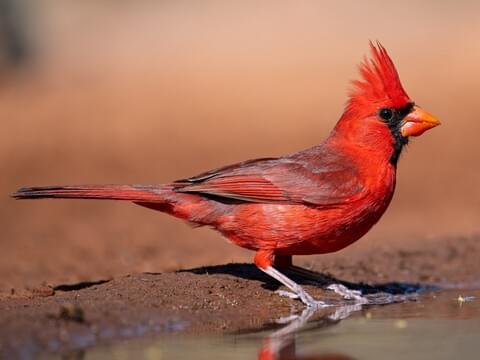
The Northern Cardinal is a medium-sized, seed-eating passerine bird in the family Cardinalidae. It is known for its vibrant red plumage in males and distinctive crest. It is a common and popular bird across eastern North America, often found in suburban areas, gardens, and woodlands.
Dimensioni e longevità
- Lunghezza
- 21-23 cm (8.3-9.1 in)
- Apertura alare
- 25-31 cm (9.8-12.2 in)
- Peso
- 33.6-65 g (1.18-2.29 oz)
- Longevità
- Up to 15 years in the wild, typically 3-5 years
- Dieta
- Omnivore, primarily granivorous (seeds), but also consumes fruits, insects, and berries.
Caratteristiche fisiche
- Piumaggio
- Males are brilliant crimson red over their entire body, with a black mask around the bill. Females are duller, a reddish-brown or olive-brown with red accents on the wings, tail, and crest. Both sexes have a prominent crest.
- Forma del becco
- Conical, stout, and bright orange-red in both sexes, adapted for cracking seeds.
- Colore degli occhi
- Dark brown.
- Colore delle zampe
- Dark pinkish-brown to dark gray.
- Caratteristiche distintive
- Prominent pointed crest on the head, thick conical bill, and a black mask around the bill (more pronounced in males).
- Aspetto giovanile
- Juveniles resemble adult females but are duller, with a grayish-brown body, a shorter, less prominent crest, and a dark gray or blackish bill that gradually turns orange-red.
- Cambiamenti stagionali
- No significant seasonal plumage changes; they retain their coloration year-round.
- Dimorfismo sessuale
- Highly sexually dimorphic. Males are almost entirely bright red, while females are reddish-brown with red highlights.
Come identificare
- 1
Coloration (Male)
Look for the unmistakable brilliant crimson red plumage covering the entire body, including the crest and tail.
- 2
Coloration (Female)
Observe the reddish-brown or olive-brown body with red highlights on the crest, wings, and tail. The overall impression is less vibrant than the male.
- 3
Crest
Both sexes possess a prominent, pointed crest on their head, which can be raised or lowered depending on the bird's mood.
- 4
Bill
Note the thick, conical, bright orange-red bill, perfectly adapted for cracking seeds. Juveniles have a darker bill.
- 5
Facial Mask
Identify the black mask around the bill, more extensive and darker in males, less so in females.
- 6
Song/Calls
Listen for the distinctive clear, whistled 'cheer-cheer-cheer' song or the sharp 'chip' alarm call.
- 7
Behavior
Observe them foraging on the ground or visiting bird feeders. Their presence in dense shrubbery is also a good indicator.
Habitat e areale
- Biomi
- Forest edges, suburban gardens, parks, shrublands, wetlands, and dense thickets.
- Areale geografico
- Southeastern Canada, eastern and central United States, and south through Mexico to northern Guatemala and Belize.
- Fascia altitudinale
- Sea level up to approximately 2,000 meters (6,500 feet).
- Ambienti preferiti
- Dense shrubbery for nesting and cover, open areas for foraging, and access to water sources. They thrive in areas with a mix of open space and dense vegetation.
Comportamento
- Periodo di attività
- Diurnal. Most active during early morning and late afternoon.
- Abitudini alimentari
- Forages on the ground or in low vegetation, often scratching through leaf litter. They use their strong bills to crack open seeds. They are frequent visitors to bird feeders, especially for sunflower seeds.
- Comportamento sociale
- Typically solitary or found in pairs during the breeding season. In winter, they may form small, loose flocks, sometimes mixed with other species. Males can be territorial, especially during breeding.
- Tipo di volo
- Undulating flight pattern, characterized by short bursts of flapping followed by glides.
- Migrazione
- Non-migratory (resident) throughout most of its range. Some northern populations may make short-distance movements south during harsh winters, but generally, they remain in their breeding territories year-round.
- Territorialità
- Males are highly territorial during the breeding season, defending their nesting area with songs and aggressive displays. Females also sing to defend territories and communicate with their mates.
Canto e richiami
- Canto
- A series of clear, whistled notes, often described as 'cheer-cheer-cheer', 'birdie-birdie-birdie', or 'what-cheer, what-cheer, what-cheer'. Both sexes sing, though the female's song is often softer and more complex.
- Richiamo
- A sharp, metallic 'chip' note, used as an alarm call or contact call. Also a softer 'tew-tew-tew' call.
- Quando vocalizza
- Sings year-round, but most frequently and intensely during the breeding season (spring and summer). Males often sing from high perches. Females also sing, often while on the nest or to communicate with their mate.
Riproduzione
- Stagione riproduttiva
- Typically from March to September, with peak activity from April to July. Can raise 2-4 broods per year.
- Abitudini di nidificazione
- Nests are built by the female, usually in dense shrubs, small trees, or vines, 1-3 meters (3-10 feet) above the ground. The nest is a cup-shaped structure made of twigs, bark strips, leaves, and grass, lined with fine grasses or hair.
- Dimensione della covata
- 2-5 eggs, most commonly 3-4.
- Descrizione dell'uovo
- 2-5 eggs (typically 3-4), whitish, grayish, or pale blue, with irregular spots and blotches of brown, purple, or gray, concentrated at the larger end. Average size is 26 x 19 mm.
- Periodo di incubazione
- 11-13 days, primarily by the female.
- Periodo di involo
- 9-11 days after hatching. Young are fed by both parents for several weeks after leaving the nest.
- Cure parentali
- Both parents feed the nestlings and fledglings. The male often continues to feed the fledglings from the first brood while the female begins incubating the next clutch.
Dove trovarlo
Suburban Gardens and Parks
Often found in backyards, parks, and urban green spaces, especially those with dense shrubs and feeders.
Forest Edges and Woodlands
Common along the edges of deciduous and mixed forests, where open areas meet dense cover.
Shrublands and Thickets
They prefer areas with dense undergrowth for nesting and cover from predators.
Riparian Zones
Can be found near streams and rivers, where vegetation is often lush.
Consigli sul campo
- Listen for their song. Their loud, clear whistle is often heard before they are seen, especially in spring and summer.
- Look in dense vegetation. Cardinals prefer to stay hidden in shrubs and thickets, so scan these areas carefully.
- Check bird feeders. They are frequent visitors to feeders, particularly for black oil sunflower seeds. Early morning and late afternoon are good times.
- Be patient and still. Cardinals can be shy. Remaining quiet and still will increase your chances of a sighting.
- Look for movement in leaf litter. They often forage on the ground, scratching through leaves for seeds and insects.
Specie simili
Pyrrhuloxia
Cardinalis sinuatus
The Pyrrhuloxia has a gray body with red accents, a yellow, parrot-like bill, and a shorter, more rounded crest. Its range is primarily southwestern US and Mexico, overlapping only slightly with the Northern Cardinal.
Summer Tanager
Piranga rubra
Male Summer Tanagers are entirely red, but lack the crest and black mask of the Northern Cardinal. Their bill is paler and less conical. Female Summer Tanagers are yellowish-orange, lacking the reddish-brown tones and crest of female cardinals.
Hepatic Tanager
Piranga flava
Male Hepatic Tanagers are brick-red with a gray cheek and lack a crest and black mask. Their bill is also paler. Females are yellowish-orange with a gray cheek.
Fatti rapidi
- Symbolism:
- State bird of seven U.S. states, symbolizing vibrancy and spirit.
- Dietary Preference:
- Seeds (especially sunflower), fruits, insects.
- Nesting Height:
- Typically 1-3 meters (3-10 feet) above ground.
- Vocalization:
- Both sexes sing, a rarity among North American passerines.
- Winter Presence:
- Non-migratory, providing a splash of color in winter landscapes.
Curiosità
- The Northern Cardinal is the state bird of more U.S. states (seven) than any other bird species.
- Female cardinals are one of the few female North American songbirds that sing, often from the nest to communicate with their mate or to signal territory boundaries.
- Their bright red color comes from carotenoid pigments obtained through their diet, particularly from fruits and seeds.
- Cardinals are known to be aggressive towards their own reflection, often pecking at windows or car mirrors, mistaking their reflection for a rival.
- They are one of the most easily recognized and beloved backyard birds in North America.
Classificazione scientifica
- Regno
- Animalia
- Phylum
- Chordata
- Classe
- Aves
- Ordine
- Passeriformes
- Famiglia
- Cardinalidae
- Genere
- Cardinalis
- Specie
- Cardinalis cardinalis
Esplora Northern Cardinal
Identifica uccelli ovunque
Gratis su iOS, Android e Web. Identificazione per foto e suono, database completo e la tua lista personale.