
Visto un uccello? Identificalo all'istante con l'app Birdby
Apri l'appInformazioni
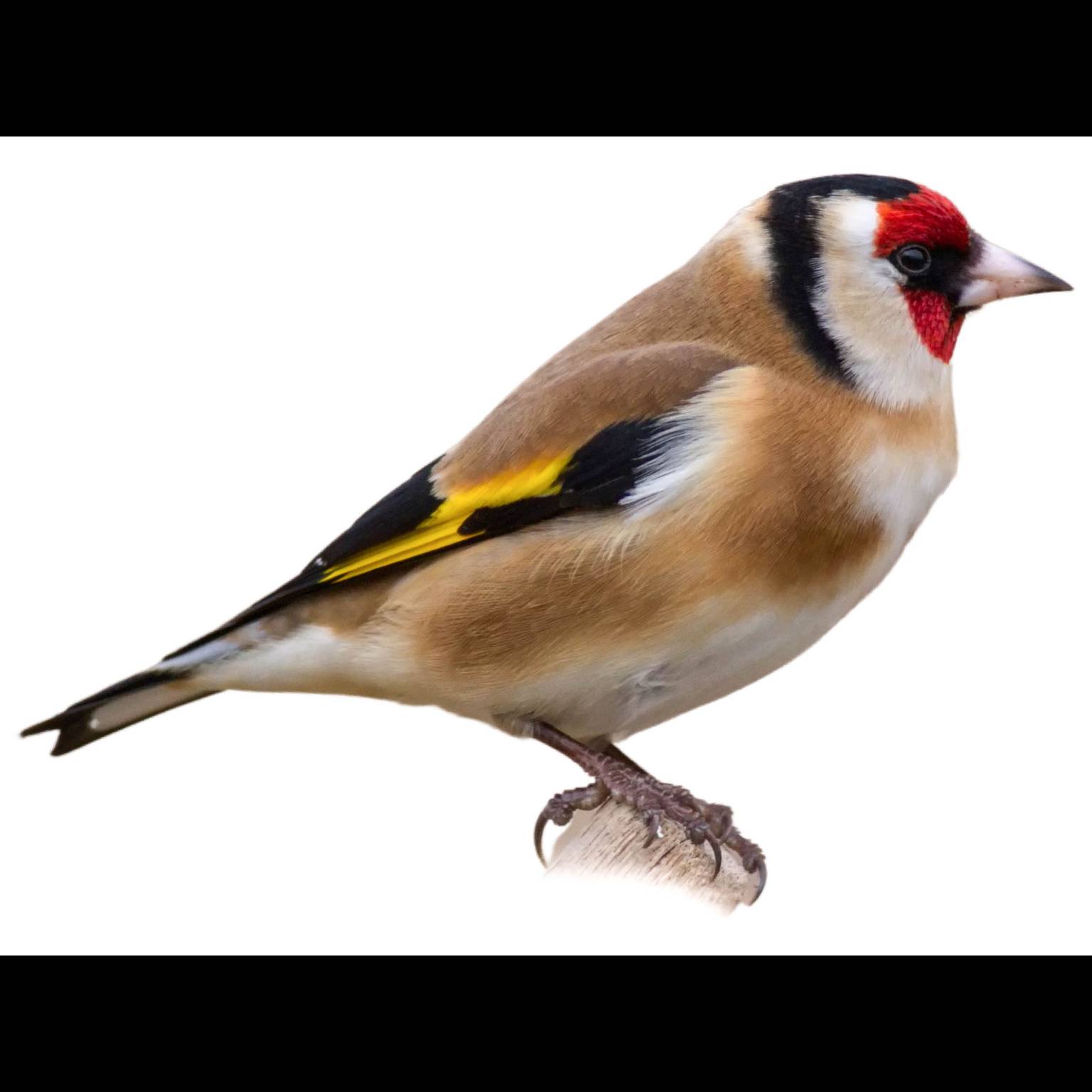
The European Goldfinch, often referred to as 'Cardellino' in Italian, is a small, highly distinctive passerine bird known for its vibrant plumage, particularly the striking red face, black and white head pattern, and bright yellow wing patches. It is a common and widespread species across Europe, North Africa, and western Asia, frequently found in open woodlands, gardens, parks, and cultivated areas. Its diet primarily consists of small seeds, especially those of thistles and teasels, which it extracts with its specialized, pointed beak. Goldfinches are highly social birds, often seen in flocks outside the breeding season, and are admired for their melodious, twittering song.
Dimensioni e longevità
- Lunghezza
- 12-13.5 cm
- Apertura alare
- 21-25 cm
- Peso
- 11-20 g
- Longevità
- 2-6 years (up to 10 years in captivity)
- Dieta
- Granivore (primarily seeds, especially thistle and teasel; occasionally insects for nestlings)
Caratteristiche fisiche
- Piumaggio
- Adults have a striking red face, bordered by a white band, which is then bordered by a black band extending to the nape. The crown is black. The back and flanks are warm brown, contrasting with a white belly and rump. The wings are black with a prominent, broad yellow bar, and white tips to the primary feathers. The tail is black with white tips on the outer feathers.
- Forma del becco
- Conical, pointed, and pale horn-colored, adapted for extracting small seeds from seedheads.
- Colore degli occhi
- Dark brown.
- Colore delle zampe
- Pale pinkish-brown to flesh-colored.
- Caratteristiche distintive
- The combination of the bright red face, black and white head pattern, and the broad yellow wing bar on black wings is unmistakable. Its undulating flight pattern is also characteristic.
- Aspetto giovanile
- Juveniles lack the distinctive red, black, and white head pattern of adults. Their head and body are streaky brown, with a paler, streaked underside. They retain the black wings with the prominent yellow bar, which is a key identification feature even in young birds. They gradually acquire adult plumage through their first autumn molt.
- Cambiamenti stagionali
- There are no significant seasonal plumage changes in adults. The plumage may appear slightly duller due to wear by late summer, but the core pattern remains consistent.
- Dimorfismo sessuale
- Males and females are very similar in plumage. The red mask of the male typically extends slightly further behind the eye than in the female, but this can be subtle and is not always a reliable field mark. Males tend to have slightly larger and more robust bills.
Come identificare
- 1
Head Pattern
Look for the unmistakable bright red face, bordered by white, then black, with a black crown. This is the most distinctive feature of an adult Goldfinch.
- 2
Wing Markings
Observe the wings, which are black with a prominent, broad, bright yellow bar. This yellow patch is visible both at rest and in flight and is present in juveniles as well.
- 3
Flight Pattern
Watch for its characteristic undulating or 'bouncing' flight, where it alternates between rapid wing beats and short glides with closed wings.
- 4
Call and Song
Listen for its distinctive, liquid, twittering song and its metallic 'tswit' or 'stic-lit' call, often given in flight.
- 5
Feeding Behavior
Look for birds feeding on thistle or teasel heads, often clinging acrobatically to extract seeds with their fine bills.
Habitat e areale
- Biomi
- Temperate forests, grasslands, shrublands, cultivated lands, urban and suburban areas.
- Areale geografico
- Widespread across Europe, North Africa, and western Asia, extending eastward to central Asia. Introduced populations exist in Australia, New Zealand, and Uruguay.
- Fascia altitudinale
- From sea level up to 2,000 meters, occasionally higher in some parts of its range.
- Ambienti preferiti
- Open deciduous woodlands, orchards, parks, gardens, hedgerows, cultivated fields, and wasteland with thistles and teasels. They prefer areas with scattered trees and shrubs for nesting and foraging.
Comportamento
- Periodo di attività
- Diurnal.
- Abitudini alimentari
- Primarily granivorous, specializing in small seeds, particularly those of thistles (Carduus, Cirsium) and teasels (Dipsacus), from which it derives its scientific name 'Carduelis'. It uses its fine, pointed beak to extract seeds from complex seedheads. It also feeds on seeds of dandelions, burdock, birch, alder, and various composites. During the breeding season, nestlings are fed a proportion of insects, such as aphids and small caterpillars.
- Comportamento sociale
- Highly social outside the breeding season, forming flocks that can number in the hundreds, especially during autumn and winter. These flocks often forage together. During the breeding season, they become more territorial and are typically seen in pairs or small family groups.
- Tipo di volo
- Distinctive undulating or 'bouncing' flight, characterized by a series of rapid wing beats followed by a short glide with wings closed, creating an up-and-down trajectory.
- Migrazione
- Partially migratory. Northern and eastern populations are largely migratory, moving south and west for the winter. Southern and western European populations are generally resident or undertake short-distance movements. Migratory movements are often irruptive, depending on food availability.
- Territorialità
- Males establish and defend small breeding territories during the nesting season, primarily through song and display. Outside of breeding, they are not territorial.
Canto e richiami
- Canto
- A rapid, liquid, and melodious series of high-pitched, twittering, trilling, and tinkling notes, often described as 'tswit-tswit-tswit-tsee-tsee-tsee'. It is highly distinctive and often given from a prominent perch or in flight.
- Richiamo
- The most common call is a distinctive, metallic 'tswit' or 'stic-lit', often given in flight or when foraging. Other calls include a soft 'chup' and a more agitated 'churr'.
- Quando vocalizza
- Most vocal during the breeding season (spring and early summer), but calls can be heard year-round, especially when flocks are foraging.
Riproduzione
- Stagione riproduttiva
- April to August, typically two broods per year.
- Abitudini di nidificazione
- Nests are typically built in the fork of a tree branch, often high up, in deciduous trees or large shrubs. The nest is a neat, compact cup made of moss, lichen, grass, and plant down, bound together with spider silk, and lined with fine plant material, wool, and feathers. Both sexes contribute to nest building, though the female does most of the work.
- Dimensione della covata
- 3-7 eggs (average 4-6)
- Descrizione dell'uovo
- 3-7 eggs, typically 4-6. Eggs are pale bluish-white, often with fine reddish-brown spots and streaks, particularly at the broader end.
- Periodo di incubazione
- 11-14 days, primarily by the female.
- Periodo di involo
- 13-18 days after hatching. Young are fed by both parents.
- Cure parentali
- Both parents feed the nestlings. The female incubates, and the male brings food to the female on the nest. After fledging, the young are still fed by the parents for a period before becoming independent.
Dove trovarlo
Gardens and Parks
Often attracted to gardens with seed feeders, especially those offering nyjer (thistle) seeds, and parks with mature trees and shrubs.
Open Woodlands and Orchards
Favors edges of deciduous woodlands, orchards, and areas with scattered trees and open ground.
Wasteland and Cultivated Fields
Frequently found in areas with abundant thistles and teasels, such as neglected fields, roadsides, and wasteland.
Hedgerows
Uses hedgerows for nesting, shelter, and foraging, particularly those with berry-bearing shrubs.
Consigli sul campo
- Listen for their distinctive call. Their 'tswit-tswit' call is often the first indication of their presence, especially when they are flying overhead or foraging in flocks.
- Look for thistle and teasel plants. Goldfinches are highly specialized feeders on these plants. If you find a patch of thistles or teasels, especially in late summer and autumn, you are very likely to find Goldfinches feeding there.
- Check bird feeders. They are frequent visitors to bird feeders, particularly those offering nyjer (thistle) seeds, which are a favorite food source.
- Observe their flight. Their undulating flight pattern is quite unique among small finches and can help confirm identification even at a distance.
- Scan tree tops and prominent perches. Males often sing from the tops of trees or other elevated perches during the breeding season.
Specie simili
Greenfinch
Chloris chloris
Greenfinches are larger and stockier, predominantly green and yellow, lacking the red, black, and white head pattern of the Goldfinch. Their yellow wing patches are less defined and more greenish-yellow.
Siskin
Spinus spinus
Siskins are smaller and more slender, with a streaky yellow-green body, a black cap and bib (male), and yellow wing bars. They lack the prominent red face and extensive black and white head markings of the Goldfinch.
Serin
Serinus serinus
Serins are smaller and more compact, with a streaky yellow-green plumage, a bright yellow rump, and a short, conical bill. They lack the distinctive head pattern and broad yellow wing bar of the Goldfinch.
Fatti rapidi
- Key ID Feature:
- Red face, black and white head, yellow wing bar
- Primary Diet:
- Thistle and teasel seeds
- Social Behavior:
- Highly gregarious outside breeding season
- Flight:
- Undulating, 'bouncing' flight
- Conservation Status:
- Least Concern (population stable/increasing in many areas)
Curiosità
- The European Goldfinch is often depicted in Renaissance art, symbolizing resurrection and salvation due to its association with thorny plants like thistles, which were linked to Christ's crown of thorns.
- Its scientific name 'Carduelis' is derived from the Latin word 'carduus', meaning thistle, reflecting its primary food source.
- Goldfinches have a specialized tongue that helps them extract tiny seeds from complex seedheads, acting almost like a brush.
- Historically, Goldfinches were popular cage birds due to their beautiful song and striking appearance, leading to significant trapping pressure in the past. This practice is now largely illegal in many countries.
- There are several recognized subspecies of Carduelis carduelis, showing slight variations in plumage tone and size across its vast range, such as C. c. carduelis (nominate), C. c. britannica, and C. c. parva.
Classificazione scientifica
- Regno
- Animalia
- Phylum
- Chordata
- Classe
- Aves
- Ordine
- Passeriformes
- Famiglia
- Fringillidae
- Genere
- Carduelis
- Specie
- Carduelis carduelis
Esplora European Goldfinch
Identifica uccelli ovunque
Gratis su iOS, Android e Web. Identificazione per foto e suono, database completo e la tua lista personale.