
Visto un uccello? Identificalo all'istante con l'app Birdby
Apri l'appInformazioni
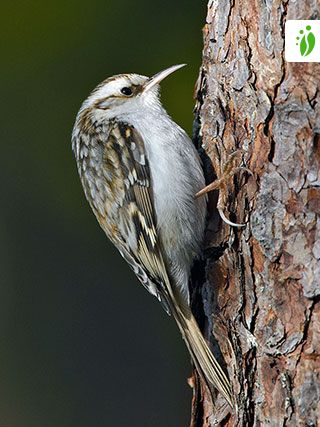
The Eurasian Treecreeper, known in Italian as 'Picchio Muraiolo', is a small passerine bird with a distinctive habit of spiraling up tree trunks in search of insects. Its cryptic plumage provides excellent camouflage against bark.
Dimensioni e longevità
- Lunghezza
- 12-13.5 cm
- Apertura alare
- 17-21 cm
- Peso
- 7-12 g
- Longevità
- 2-3 years (up to 8 years recorded)
- Dieta
- Insectivore
Caratteristiche fisiche
- Piumaggio
- Upperparts are mottled brown and streaked with black, buff, and white, providing excellent camouflage against tree bark. Rump is rufous. Underparts are clean white, contrasting sharply with the upperparts. A prominent white supercilium (eyebrow stripe) is present. Flight feathers are dark with pale barring.
- Forma del becco
- Long, slender, and decurved (downcurved) bill, dark brown to blackish.
- Colore degli occhi
- Dark brown
- Colore delle zampe
- Dark grey to blackish, with long, strong claws adapted for gripping bark.
- Caratteristiche distintive
- Its unique foraging behavior of spiraling up tree trunks, its long decurved bill, and its contrasting white underparts against mottled brown upperparts are key features. The rufous rump is also a good field mark.
- Aspetto giovanile
- Juveniles resemble adults but have a slightly duller, less defined plumage, often with a buffier wash on the underparts and less distinct streaking on the upperparts. The supercilium may be less prominent.
- Cambiamenti stagionali
- No significant seasonal plumage changes. Plumage remains consistent year-round.
- Dimorfismo sessuale
- None; males and females are outwardly identical in plumage and size.
Come identificare
- 1
Foraging Behavior
Look for a small bird spiraling upwards on tree trunks, probing bark crevices with its fine bill. It will typically fly down to the base of another tree to start again.
- 2
Plumage Pattern
Observe the mottled brown and streaked upperparts that blend perfectly with bark, contrasting sharply with clean white underparts. Note the distinct white supercilium.
- 3
Bill Shape
Its long, slender, and distinctly decurved bill is a key identification feature, perfectly adapted for extracting insects from bark.
- 4
Rump Color
A rufous-colored rump is often visible, especially when the bird is moving or flying between trees.
- 5
Vocalizations
Listen for its very thin, high-pitched 'tsee' call or its quiet, accelerating song, which can be easily missed.
Habitat e areale
- Biomi
- Temperate forests, boreal forests, mixed woodlands, parks, and large gardens.
- Areale geografico
- Widespread across the Palearctic region, from Western Europe through Siberia to Japan. Also found in parts of North Africa.
- Fascia altitudinale
- Sea level up to 2,000 meters, occasionally higher in mountainous regions.
- Ambienti preferiti
- Mature deciduous and coniferous forests with abundant large, old trees, especially those with deeply fissured bark where insects can hide. Also found in orchards and wooded parks.
Comportamento
- Periodo di attività
- Diurnal
- Abitudini alimentari
- Primarily insectivorous, feeding on small insects, spiders, insect larvae, and pupae found in bark crevices. It forages by spiraling upwards on tree trunks and large branches, probing with its fine bill. It typically starts near the base of a tree and ascends, then flies to the base of another tree to repeat the process.
- Comportamento sociale
- Generally solitary or found in pairs during the breeding season. Outside of breeding, they may join mixed-species foraging flocks, particularly with tits (Paridae) and kinglets (Regulidae).
- Tipo di volo
- Weak, undulating flight, often described as 'mouse-like' or 'butterfly-like' over short distances between trees. It rarely flies long distances in the open.
- Migrazione
- Mostly resident throughout its range, but northern populations may undertake short-distance altitudinal or partial migrations in harsh winters, moving to lower elevations or more sheltered areas. Some dispersal of juveniles occurs.
- Territorialità
- Territorial during the breeding season, with males defending their nesting and foraging areas through song and displays.
Canto e richiami
- Canto
- A high-pitched, thin, and often rather quiet song, typically a series of 'tsee-tsee-tsee-tiss-tiss-twee' or 'twee-twee-twee-tiddly-twee' notes, often accelerating and rising in pitch towards the end. It can be easily overlooked.
- Richiamo
- A very thin, high-pitched 'tsee' or 'sree' call, often repeated. Also a soft 'sit' or 'tsit' contact call.
- Quando vocalizza
- Most vocal during the breeding season (spring and early summer), but calls can be heard year-round, especially when foraging or in contact with a mate.
Riproduzione
- Stagione riproduttiva
- April to July, typically one or two broods per year.
- Abitudini di nidificazione
- Nests are typically built behind loose bark on tree trunks, in tree crevices, or occasionally in old woodpecker holes or nest boxes. The nest is a cup-shaped structure made of twigs, moss, lichen, and bark strips, lined with feathers, hair, and spider silk.
- Dimensione della covata
- 5-7 eggs
- Descrizione dell'uovo
- 5-7 (occasionally 3-9) eggs, white with fine reddish-brown speckles, particularly at the broader end. Dimensions are approximately 15.5 x 12 mm.
- Periodo di incubazione
- 14-15 days, primarily by the female.
- Periodo di involo
- 15-17 days after hatching. Both parents feed the young.
- Cure parentali
- Both parents participate in feeding the nestlings and fledglings. The female incubates, while the male brings food to her and later to the young.
Dove trovarlo
Mature Woodlands
Deciduous and coniferous forests with a good proportion of old, large trees are prime habitats.
Parks and Gardens
Large parks, arboretums, and gardens with mature trees can host Eurasian Treecreepers, especially in winter.
Orchards
Old orchards with fruit trees can also provide suitable foraging and nesting sites.
Consigli sul campo
- Look Up. Always scan tree trunks from the base upwards. Their camouflage is excellent, so patience is key.
- Listen Carefully. Their calls and songs are high-pitched and can be difficult to hear, especially in windy conditions or noisy environments. Learn their specific 'tsee' call.
- Observe Movement. Their characteristic spiraling movement up tree trunks is often the first clue to their presence, even before you see their plumage details.
- Check Mixed Flocks. In winter, they often join mixed-species foraging flocks with tits and kinglets. If you see such a flock, look closely at the tree trunks.
Specie simili
Short-toed Treecreeper
Certhia brachydactyla
The Short-toed Treecreeper has a slightly shorter hind claw, a less prominent white supercilium (often buffish), and duller, less white underparts (often with a buff wash). Its flank coloration is often more rufous. The most reliable distinction is by song and call: the Short-toed Treecreeper's song is typically faster and more emphatic, and its call is a sharper 'tuit' or 'chwit' compared to the Eurasian Treecreeper's thinner 'tsee'.
Wallcreeper
Tichodroma muraria
Despite the Italian common name 'Picchio Muraiolo' (which literally translates to 'Wallcreeper'), the Eurasian Treecreeper (Certhia familiaris) is a completely different species. The Wallcreeper is a much larger, more colorful bird (grey body, black wings with crimson patches, white wing spots) found in rocky mountainous habitats, not typically on tree trunks. Its foraging style involves creeping on rock faces, not spiraling up trees. The Italian name for Certhia familiaris is actually 'Rampichino comune'.
Fatti rapidi
- Foraging Style:
- Spirals up tree trunks
- Bill Type:
- Long, slender, decurved
- Underparts:
- Clean white
- Rump Color:
- Rufous
- Conservation Status:
- Least Concern
Curiosità
- The Eurasian Treecreeper's scientific name 'Certhia familiaris' means 'creeper of the family', referring to its tree-creeping habits.
- Despite its small size, it can survive very cold winters by finding shelter in tree crevices and maintaining a high metabolic rate.
- It uses its stiff tail feathers as a prop, similar to woodpeckers, to support itself while climbing tree trunks.
- The Italian common name 'Picchio Muraiolo' is a misnomer, as 'Muraiolo' refers to the Wallcreeper (Tichodroma muraria). The correct Italian name for Certhia familiaris is 'Rampichino comune'.
Classificazione scientifica
- Regno
- Animalia
- Phylum
- Chordata
- Classe
- Aves
- Ordine
- Passeriformes
- Famiglia
- Certhiidae
- Genere
- Certhia
- Specie
- Certhia familiaris
Esplora Eurasian Treecreeper
Identifica uccelli ovunque
Gratis su iOS, Android e Web. Identificazione per foto e suono, database completo e la tua lista personale.