
Visto un uccello? Identificalo all'istante con l'app Birdby
Apri l'appInformazioni
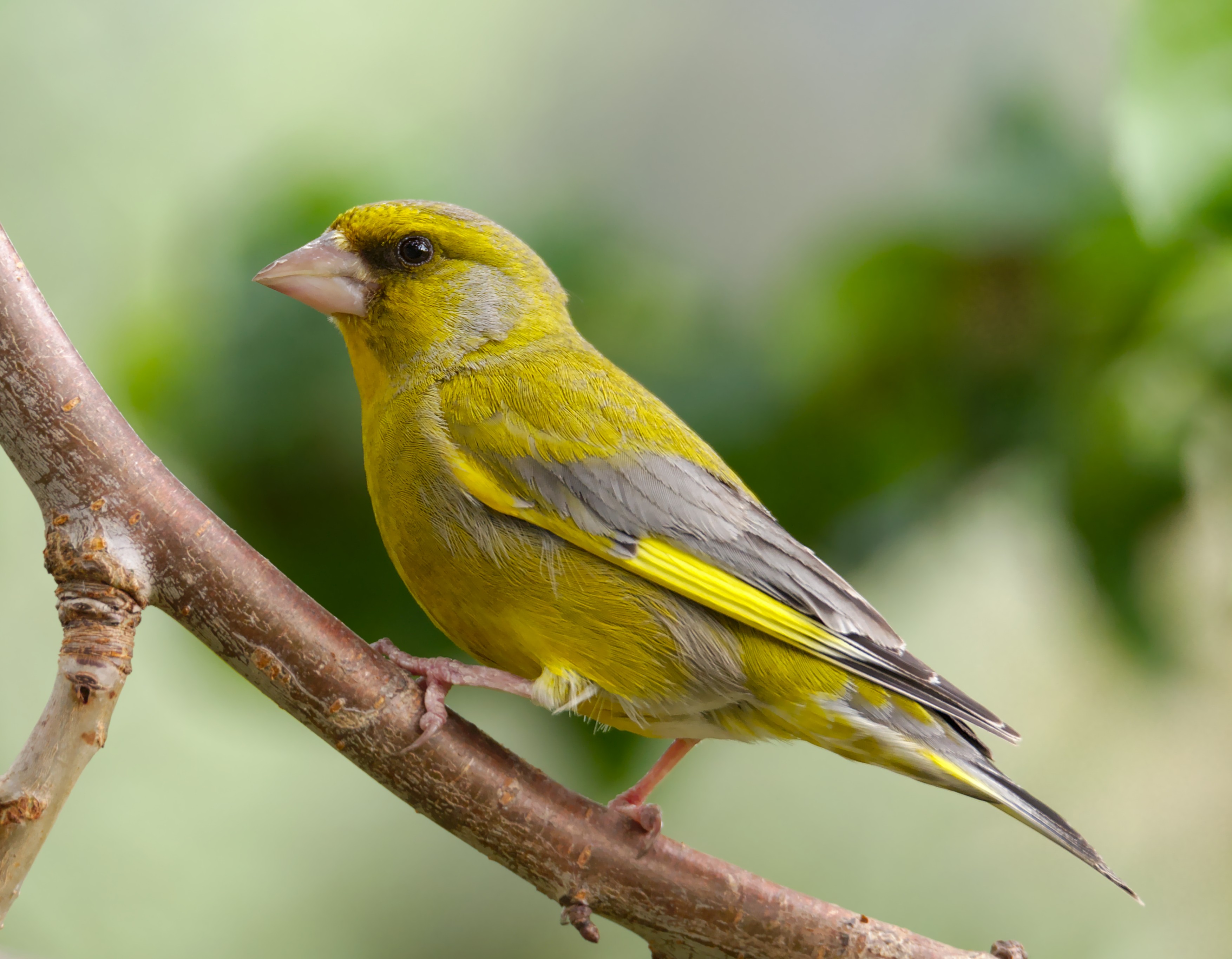
The European Greenfinch, commonly known as Verdone in Italian, is a robust passerine bird belonging to the finch family. It is characterized by its predominantly green plumage, conical bill, and distinctive yellow flashes in its wings and tail, particularly prominent in males. It is a common and widespread species across Europe, North Africa, and parts of Asia, often found in gardens, parks, woodlands, and agricultural areas.
Dimensioni e longevità
- Lunghezza
- 14-16 cm
- Apertura alare
- 25-28 cm
- Peso
- 25-35 g
- Longevità
- 2-5 years (up to 9 years recorded in the wild)
- Dieta
- Granivore (primarily seeds, especially from trees and shrubs, but also buds, berries, and some insects during breeding season)
Caratteristiche fisiche
- Piumaggio
- Males are olive-green overall with bright yellow patches on the primaries and outer tail feathers. The rump is yellowish-green, and the underparts are paler, often with a greyish wash. Females are duller, with a greyer-green plumage and less extensive and less vibrant yellow markings. Juveniles are streaky brown with duller yellow wing patches.
- Forma del becco
- Conical and stout, pale pinkish-horn to greyish-horn in color, adapted for cracking seeds.
- Colore degli occhi
- Dark brown.
- Colore delle zampe
- Pinkish-brown to flesh-colored.
- Caratteristiche distintive
- The combination of olive-green plumage, stout conical bill, and prominent yellow flashes in the wings and tail (especially in flight) are key identification features. The slightly notched tail is also characteristic.
- Aspetto giovanile
- Juveniles are heavily streaked brown on the back, head, and underparts, lacking the uniform green of adults. Their yellow wing and tail patches are duller and less defined.
- Cambiamenti stagionali
- Plumage remains largely consistent throughout the year, though colors may appear slightly brighter after the autumn molt and duller due to wear by late breeding season.
- Dimorfismo sessuale
- Pronounced. Males are brighter and more intensely colored with vivid yellow markings. Females are duller, greyer, and have less extensive yellow.
Come identificare
- 1
Plumage Color
Look for the overall olive-green coloration, especially in males. Females are duller and greyer-green.
- 2
Yellow Wing and Tail Patches
The bright yellow flashes on the primary feathers and outer tail feathers are highly distinctive, particularly noticeable in flight.
- 3
Bill Shape
Note the stout, conical, pale bill, typical of a seed-eating finch.
- 4
Flight Pattern
Observe its characteristic undulating, bouncy flight.
- 5
Vocalizations
Listen for the wheezing 'dzzzzzzzzzzzz' song and the nasal 'tsooeet' call.
Habitat e areale
- Biomi
- Temperate forests, woodlands, scrublands, agricultural land, urban and suburban areas.
- Areale geografico
- Widespread across Europe, North Africa (Morocco, Algeria, Tunisia), and parts of Western Asia (Turkey, Caucasus, Iran). Introduced to Australia, New Zealand, and Uruguay.
- Fascia altitudinale
- Sea level up to 1,500 meters, occasionally higher in some mountainous regions.
- Ambienti preferiti
- Gardens, parks, orchards, hedgerows, woodland edges, coniferous plantations, and areas with scattered trees and shrubs, particularly those producing seeds.
Comportamento
- Periodo di attività
- Diurnal.
- Abitudini alimentari
- Primarily ground feeders, but also feeds in trees and shrubs. Uses its strong bill to crack open seeds. Often seen at bird feeders, especially for sunflower seeds. Also consumes buds, berries, and occasionally insects, particularly when feeding young.
- Comportamento sociale
- Highly gregarious outside the breeding season, forming large flocks, sometimes mixed with other finches. During breeding, pairs are territorial but may nest in loose colonies.
- Tipo di volo
- Undulating, bouncy flight pattern, often described as 'dipping'. The yellow wing patches are very conspicuous in flight.
- Migrazione
- Mostly resident in much of its range, particularly in Western and Southern Europe. Northern and Eastern European populations are partially migratory, moving south and west for the winter. Some altitudinal migration also occurs.
- Territorialità
- Males establish and defend small breeding territories, primarily through song and display. Flocks are non-territorial outside the breeding season.
Canto e richiami
- Canto
- A distinctive, often prolonged, trilling song, typically starting with a series of rapid 'chichichichi' notes, followed by a drawn-out, wheezing 'dzzzzzzzzzzzz' or 'sweeeeeee'. Often delivered from a prominent perch or during a slow, butterfly-like display flight.
- Richiamo
- Common calls include a sharp 'chup' or 'chup-chup' and a characteristic nasal 'tsooeet' or 'dweee' often given in flight or when agitated.
- Quando vocalizza
- Most vocal during the breeding season (spring and early summer), but calls can be heard year-round, especially when in flocks.
Riproduzione
- Stagione riproduttiva
- Typically April to July, often raising 2-3 broods.
- Abitudini di nidificazione
- The nest is a neat, cup-shaped structure built by the female, usually in a bush, hedge, or small tree, often 1-3 meters above the ground. It is constructed from twigs, moss, roots, and lined with finer materials like hair, wool, and feathers.
- Dimensione della covata
- 3-6 eggs (most commonly 4-5).
- Descrizione dell'uovo
- 3-6 eggs, typically pale bluish-white or greenish-white, speckled and streaked with reddish-brown or purplish-grey, particularly at the broader end. Approximately 19 x 14 mm.
- Periodo di incubazione
- 12-14 days, primarily by the female.
- Periodo di involo
- 13-16 days after hatching. Young are fed by both parents.
- Cure parentali
- Both parents feed the nestlings, initially with insects and later with regurgitated seeds. The male often feeds the female during incubation.
Dove trovarlo
Gardens and Parks
Common visitors to bird feeders, especially for sunflower seeds. Look in hedges and shrubs.
Woodland Edges and Hedgerows
Favors areas with dense cover for nesting and foraging.
Agricultural Land
Often found in fields with seed-bearing plants and adjacent hedgerows.
Coniferous Plantations
Utilizes these for nesting and shelter.
Consigli sul campo
- Listen for their song. Their distinctive wheezing song is often the first indication of their presence, especially during spring.
- Check bird feeders. They are frequent visitors to feeders, particularly those offering sunflower seeds or nyjer seeds.
- Look for yellow flashes in flight. The bright yellow patches on their wings and tail are very noticeable when they fly, even at a distance.
- Observe flocks. Outside the breeding season, they often form noisy flocks, making them easier to spot.
Specie simili
Serin
Serinus serinus
The Serin is smaller and more compact, with a much brighter yellow plumage (especially the male), heavily streaked back, and a shorter, more conical bill. Its song is a high-pitched, jingling trill, distinct from the Greenfinch's wheezing notes.
Yellowhammer
Emberiza citrinella
The Yellowhammer is larger, with a longer tail and a more upright posture. Males have a bright yellow head and underparts, with chestnut streaking on the back. Its song is a distinctive 'a little bit of bread and no cheese'.
Chaffinch
Fringilla coelebs
Chaffinches have a more upright stance, a grey-blue cap (male), and prominent white wing bars. They lack the extensive yellow in the wings and tail of the Greenfinch. Their song is a rapid, descending cascade of notes.
Fatti rapidi
- Diet:
- Mainly seeds
- Sociality:
- Gregarious outside breeding season
- Distinguishing Mark:
- Yellow wing and tail flashes
- Song:
- Wheezing trill
- Nest:
- Cup-shaped in bushes/hedges
Curiosità
- The European Greenfinch's scientific name 'Chloris' comes from the Greek word 'chloros', meaning 'green', referring to its plumage color.
- They are known to be quite acrobatic when feeding, sometimes hanging upside down to reach seeds.
- Greenfinches have a specialized tongue that helps them extract seeds from cones and other seed heads.
- In some parts of its range, the Greenfinch population has experienced significant declines due to diseases like Trichomoniasis, highlighting the importance of feeder hygiene.
Classificazione scientifica
- Regno
- Animalia
- Phylum
- Chordata
- Classe
- Aves
- Ordine
- Passeriformes
- Famiglia
- Fringillidae
- Genere
- Chloris
- Specie
- Chloris chloris
Esplora European Greenfinch
Identifica uccelli ovunque
Gratis su iOS, Android e Web. Identificazione per foto e suono, database completo e la tua lista personale.