
Visto un uccello? Identificalo all'istante con l'app Birdby
Apri l'appInformazioni
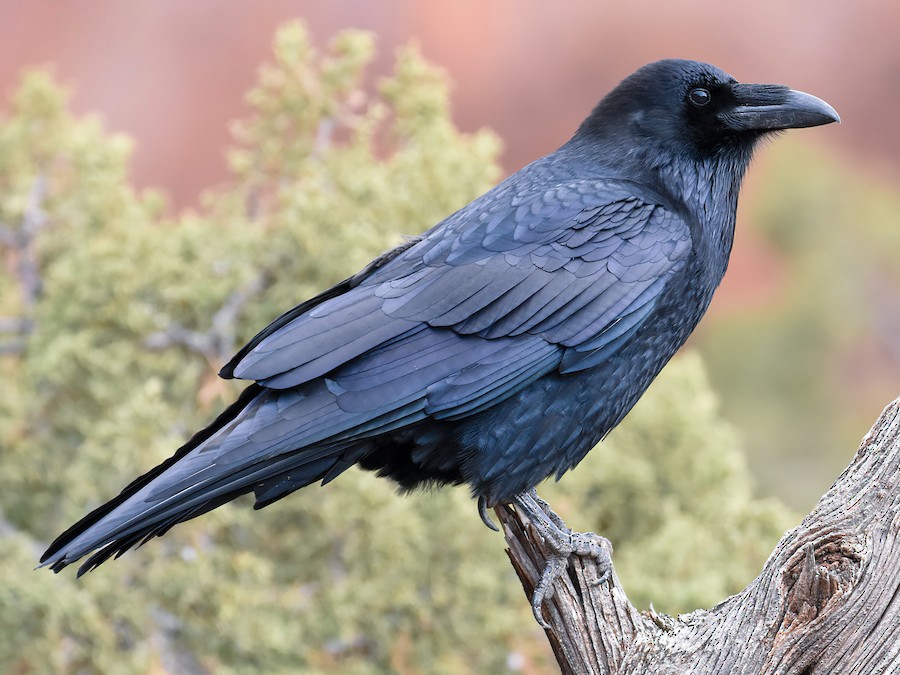
The Common Raven is a large, all-black passerine bird, renowned for its intelligence, adaptability, and complex vocalizations. It is one of the most widespread corvids globally, inhabiting a diverse range of environments.
Dimensioni e longevità
- Lunghezza
- 54-67 cm (21-26 in)
- Apertura alare
- 115-150 cm (45-59 in)
- Peso
- 0.69-2 kg (1.5-4.4 lb)
- Longevità
- 10-15 years in the wild, up to 40 years in captivity
- Dieta
- Omnivore, highly opportunistic, consuming carrion, small mammals, birds, eggs, insects, grains, fruits, and human refuse.
Caratteristiche fisiche
- Piumaggio
- Entirely glossy black plumage with a purplish-blue iridescence, especially visible in good light. The feathers on the throat (hackles) are shaggy and often appear ruffled.
- Forma del becco
- Large, heavy, and slightly decurved black beak. The upper mandible is noticeably thicker and longer than the lower.
- Colore degli occhi
- Dark brown to black in adults; juveniles may have bluish-grey eyes that darken with age.
- Colore delle zampe
- Black
- Caratteristiche distintive
- Large size, shaggy throat feathers, wedge-shaped tail (especially noticeable in flight), and a deep, croaking call. Its flight is powerful and often includes soaring and acrobatic maneuvers.
- Aspetto giovanile
- Juveniles resemble adults but have duller, less glossy black plumage, a less shaggy throat, and often a pinkish gape that darkens with age. Their eyes are typically bluish-grey.
- Cambiamenti stagionali
- No significant seasonal plumage changes. Plumage may appear duller when worn or during molt.
- Dimorfismo sessuale
- Minimal; males are typically slightly larger than females, but this is not reliably discernible in the field.
Come identificare
- 1
Size and Build
Look for a very large, robust, all-black bird. It's noticeably larger than a crow.
- 2
Tail Shape
In flight, observe the tail. A Common Raven has a distinctive wedge-shaped tail, while crows have a fan-shaped or square tail.
- 3
Throat Feathers
When perched or calling, notice the shaggy, bristly feathers on the throat (hackles).
- 4
Beak
The beak is very large, heavy, and slightly decurved, appearing more robust than a crow's.
- 5
Flight Style
Ravens often soar on thermals with minimal wing flapping, sometimes performing aerial displays. Crows tend to flap more continuously.
- 6
Vocalizations
Listen for deep, resonant 'cronk-cronk' or 'kraa-kraa' calls, distinct from the harsher 'caw' of crows.
Habitat e areale
- Biomi
- Highly adaptable, found in a wide range of biomes including forests (coniferous, deciduous, mixed), mountains, deserts, tundra, coastal areas, and increasingly in urban and suburban environments.
- Areale geografico
- Holarctic distribution, found across the Northern Hemisphere including North America, Europe, Asia, and North Africa.
- Fascia altitudinale
- From sea level to high mountain altitudes (over 6,000 meters in some regions).
- Ambienti preferiti
- Prefers open or semi-open landscapes with access to tall structures for nesting (cliffs, large trees, human structures) and foraging opportunities. Often associated with human activity due to food availability.
Comportamento
- Periodo di attività
- Diurnal
- Abitudini alimentari
- Extremely versatile and opportunistic. Scavenges carrion, preys on small vertebrates (rodents, birds, reptiles), raids nests for eggs and young, consumes insects, berries, fruits, and human refuse. Known for caching food.
- Comportamento sociale
- Typically seen in pairs, especially during the breeding season. Outside of breeding, they may form larger communal roosts or gather at abundant food sources. Highly intelligent and known for complex social interactions.
- Tipo di volo
- Powerful, direct flight with deep, deliberate wing beats. Often soars on thermals, sometimes performing aerial acrobatics like rolls and dives. The wedge-shaped tail is a key identification feature in flight.
- Migrazione
- Generally resident throughout its range, though some northern populations may undertake short-distance altitudinal or irruptive movements in response to food availability or harsh weather.
- Territorialità
- Breeding pairs are highly territorial, defending their nesting and foraging areas. Non-breeding birds may range more widely.
Canto e richiami
- Canto
- Ravens do not have a true song in the typical passerine sense. Their vocalizations are highly varied and complex, often described as a 'language' rather than a song.
- Richiamo
- Most characteristic call is a deep, resonant 'kraa-kraa-kraa' or 'cronk-cronk'. They possess an extensive repertoire of calls including gurgles, croaks, rattles, clicks, whistles, and mimicry of other birds and sounds. Calls vary with context (alarm, contact, territorial display).
- Quando vocalizza
- Vocalize throughout the day, particularly active during dawn and dusk, and when communicating with mates or other ravens.
Riproduzione
- Stagione riproduttiva
- Varies geographically, typically late winter to early spring (February-April in many temperate regions).
- Abitudini di nidificazione
- Monogamous pairs build large, bulky nests of sticks, branches, and mud, lined with hair, wool, and other soft materials. Nests are typically placed on cliffs, in tall trees, or on human-made structures like power pylons or bridges.
- Dimensione della covata
- 3-7 eggs (average 4-6)
- Descrizione dell'uovo
- 3-7 eggs, typically 4-6. Eggs are pale bluish-green to olive-green, heavily marked with brown, olive, or purplish spots and blotches, especially at the larger end. Approximately 50 x 33 mm.
- Periodo di incubazione
- 18-21 days, primarily by the female.
- Periodo di involo
- 35-49 days. Young remain dependent on parents for several weeks after fledging.
- Cure parentali
- Both parents participate in feeding and caring for the young. The male often brings food to the incubating female.
Dove trovarlo
Mountainous Regions
Look for them soaring along cliff faces and over valleys.
Forests and Woodlands
Often found in mature forests, especially those with clearings or edges.
Coastal Areas
Common along rocky coastlines, scavenging for food.
Deserts and Arid Lands
Adaptable to harsh environments, often seen near water sources or human settlements.
Urban/Suburban Edges
Increasingly found in areas with human activity, utilizing refuse as a food source.
Consigli sul campo
- Listen for Calls. Their distinctive deep 'cronk' calls are often the first indication of their presence, especially in dense habitats.
- Scan the Sky. Look for large, dark birds soaring high on thermals, often alone or in pairs.
- Check Tall Structures. Ravens often perch on prominent trees, cliffs, power lines, or communication towers.
- Observe Scavenging Sites. They are attracted to carrion, landfills, and other sources of discarded food.
- Patience and Observation. Ravens are intelligent and can be wary. Observe their behavior from a distance to witness their complex interactions.
Specie simili
Carrion Crow
Corvus corone
Common Ravens are significantly larger than Carrion Crows. Ravens have a heavier bill, shaggy throat feathers, and a wedge-shaped tail (crows have a fan-shaped tail). In flight, ravens often soar, while crows typically flap more continuously. Raven calls are deep 'cronks', while crow calls are harsher 'caws'.
Rook
Corvus frugilegus
Rooks are smaller than ravens and have a distinctive pale, bare patch of skin at the base of their bill (adults). Their head is more domed, and their plumage can appear less glossy. Rooks typically have a more pointed, less shaggy throat. Their calls are a higher-pitched 'kaah'.
Chough
Pyrrhocorax pyrrhocorax
Choughs are smaller, have bright red legs and a slender, decurved red bill. Their flight is more buoyant and acrobatic, often near cliffs. Their calls are distinctive 'chee-ow' or 'chuff' sounds.
Fatti rapidi
- Intelligence:
- Among the most intelligent birds, capable of problem-solving, tool use, and mimicry.
- Social Structure:
- Monogamous pairs during breeding, but can form large communal roosts.
- Diet Versatility:
- Highly opportunistic omnivores, adapting their diet to available resources.
- Flight Mastery:
- Known for powerful, soaring flight and aerial acrobatics.
- Vocalization Range:
- Possess a vast repertoire of calls, gurgles, and croaks.
Curiosità
- Ravens are known to play, engaging in activities like sliding down snowbanks or dropping and catching objects in mid-air.
- They can mimic a wide range of sounds, including human speech, other bird calls, and animal noises.
- In many cultures, ravens hold significant symbolic meaning, often associated with wisdom, prophecy, or death.
- Ravens have been observed working cooperatively to hunt or to distract predators from their nests.
- They are one of the few animals that can recognize themselves in a mirror, indicating a high level of self-awareness.
Classificazione scientifica
- Regno
- Animalia
- Phylum
- Chordata
- Classe
- Aves
- Ordine
- Passeriformes
- Famiglia
- Corvidae
- Genere
- Corvus
- Specie
- Corvus corax
Esplora Common Raven
Identifica uccelli ovunque
Gratis su iOS, Android e Web. Identificazione per foto e suono, database completo e la tua lista personale.