
Visto un uccello? Identificalo all'istante con l'app Birdby
Apri l'appInformazioni
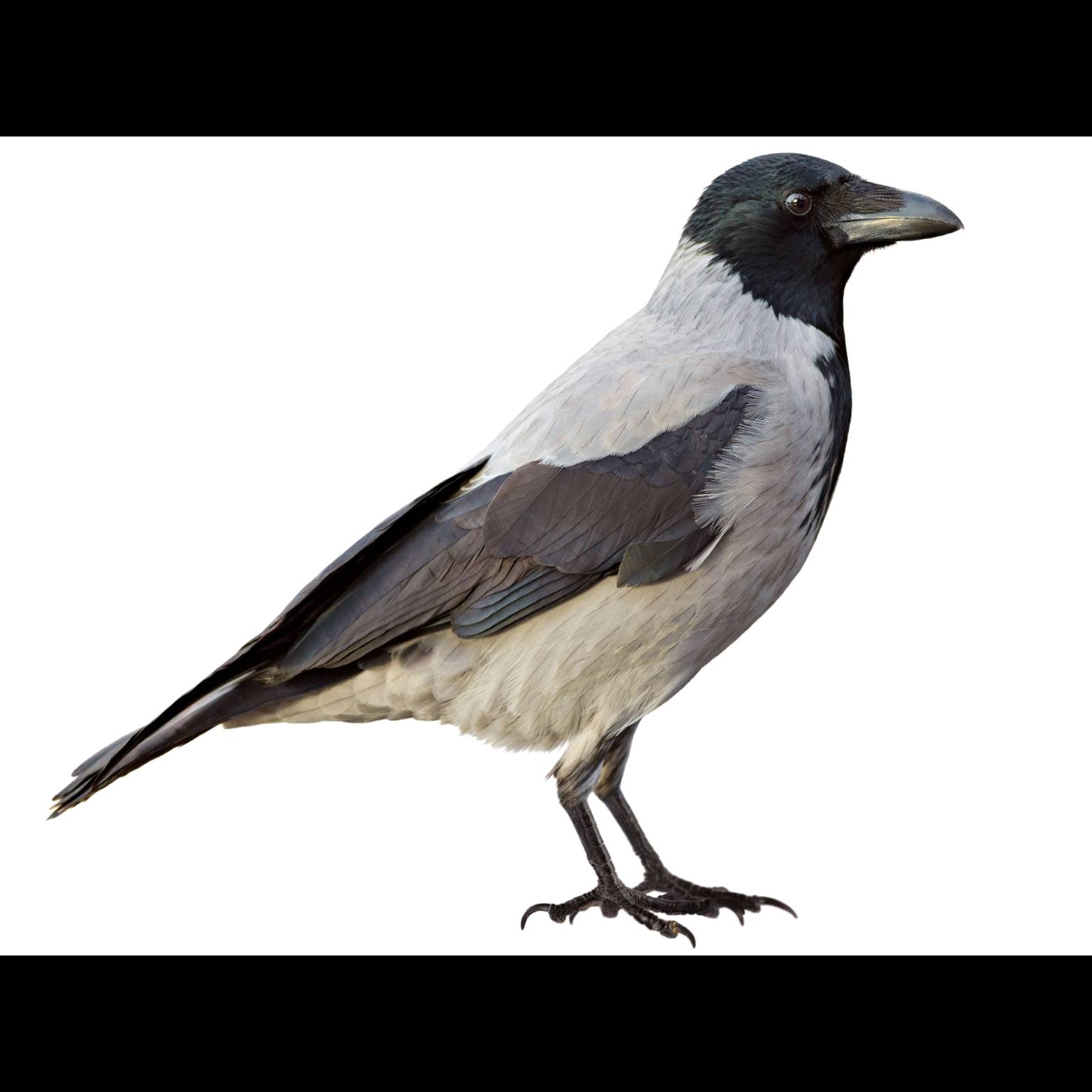
The Hooded Crow, also known as the 'Cornacchia Grigia' in Italian, is a widespread and common passerine bird in the crow family. It is easily recognizable by its distinctive bicolored plumage of ash-grey and glossy black. Highly intelligent and adaptable, it thrives in a variety of habitats, often in close proximity to human settlements.
Dimensioni e longevità
- Lunghezza
- 48-54 cm
- Apertura alare
- 90-100 cm
- Peso
- 370-650 g
- Longevità
- Up to 20 years in the wild, typically 4-7 years
- Dieta
- Omnivore
Caratteristiche fisiche
- Piumaggio
- Adults have a distinctive bicolored plumage: the head, throat, wings, tail, and thighs are glossy black, while the rest of the body (back, belly, and rump) is ash-grey. The black areas often show a purplish-blue sheen in good light.
- Forma del becco
- Strong, stout, and slightly decurved black beak.
- Colore degli occhi
- Dark brown
- Colore delle zampe
- Black
- Caratteristiche distintive
- The striking contrast between the black and grey plumage is the most defining feature. Its overall size is similar to a Carrion Crow, but the grey body immediately distinguishes it.
- Aspetto giovanile
- Juveniles are similar to adults but have duller, less glossy black plumage and a more brownish-grey body. Their eyes are typically bluish-grey, gradually changing to dark brown with age.
- Cambiamenti stagionali
- No significant seasonal plumage changes. The plumage may appear slightly duller when worn before the annual molt.
- Dimorfismo sessuale
- None; males and females are identical in plumage and size.
Come identificare
- 1
Plumage Coloration
Look for the unmistakable bicolored pattern: ash-grey body contrasting sharply with glossy black head, throat, wings, and tail. This is the primary field mark.
- 2
Size and Shape
Medium-large crow, robust build, strong bill. Similar in size and general shape to a Carrion Crow.
- 3
Vocalizations
Listen for its characteristic harsh 'kraa-kraa-kraa' calls, which can be slightly more resonant than a Carrion Crow's.
- 4
Habitat
Observe its environment. While adaptable, they are often found in open areas with scattered trees, agricultural land, and increasingly in urban settings.
- 5
Flight
Note its strong, direct flight with steady wing beats. Look for the grey body against the black wings in flight.
Habitat e areale
- Biomi
- Temperate forests, woodlands, agricultural lands, urban and suburban areas, coastal cliffs, open country with scattered trees.
- Areale geografico
- Widespread across Northern, Eastern, and Southeastern Europe, as well as parts of the Middle East. Its range extends from Ireland and Scotland eastward through Scandinavia, Eastern Europe, and Russia, south to Italy, the Balkans, and Turkey.
- Fascia altitudinale
- Sea level up to 2,000 meters, occasionally higher in mountainous regions.
- Ambienti preferiti
- Highly adaptable, preferring open landscapes with scattered trees for nesting and perching, often near human habitation, cultivated fields, parks, and gardens. Also found along coastlines and river valleys.
Comportamento
- Periodo di attività
- Diurnal
- Abitudini alimentari
- Highly opportunistic omnivores. Diet includes insects, worms, mollusks, small mammals, birds' eggs and nestlings, carrion, seeds, fruits, berries, and human refuse. They are known for caching food and using tools.
- Comportamento sociale
- Often seen in pairs or small family groups during the breeding season. Outside of breeding, they can form large communal roosts, sometimes numbering thousands of individuals, often mixed with other corvids.
- Tipo di volo
- Strong, direct, and purposeful flight with steady wing beats. Often glides for short distances. Can be seen soaring on thermals.
- Migrazione
- Generally resident throughout much of its range. Northern populations (e.g., Scandinavia, Eastern Europe) may undertake short-distance migratory movements southwards during harsh winters, while southern populations are largely sedentary.
- Territorialità
- Breeding pairs are territorial, defending their nesting area. Outside the breeding season, they are more gregarious.
Canto e richiami
- Canto
- Hooded Crows do not have a melodious song. Their vocalizations are primarily calls.
- Richiamo
- The most common call is a harsh, guttural 'kraa-kraa-kraa' or 'karr-karr-karr', similar to the Carrion Crow but often described as slightly more resonant or 'hollow'. They have a wide repertoire of other calls, including alarm calls, contact calls, and various caws that can vary in pitch and intensity depending on the context.
- Quando vocalizza
- Vocalize throughout the day, particularly active in the morning and evening, and during territorial disputes or when mobbing predators.
Riproduzione
- Stagione riproduttiva
- Typically from March to July, with peak activity in April and May.
- Abitudini di nidificazione
- Nests are usually built high in trees (conifers or deciduous), but also on cliffs, pylons, or even buildings. The nest is a bulky structure made of sticks, twigs, and mud, lined with softer materials like wool, hair, grass, and sometimes even wire or plastic.
- Dimensione della covata
- 3-6 eggs, usually 4-5.
- Descrizione dell'uovo
- 3-6 eggs, typically greenish-blue or pale blue with dark brown or olive-green spots and blotches, often concentrated at the broader end. Eggs measure approximately 4.0 x 2.9 cm.
- Periodo di incubazione
- 18-20 days, primarily by the female.
- Periodo di involo
- 32-36 days after hatching. Young remain dependent on parents for several weeks after fledging.
- Cure parentali
- Both parents participate in feeding the young. The male often feeds the female during incubation.
Dove trovarlo
Agricultural Lands
Often seen foraging in fields, especially after plowing or harvesting, looking for insects and seeds.
Urban and Suburban Parks/Gardens
Common in areas with mature trees, where they can find food and nesting sites, often scavenging near human activity.
Coastal Areas
Can be found along shorelines, cliffs, and beaches, scavenging for marine invertebrates and carrion.
Open Woodlands and Forest Edges
Prefers areas with a mix of open ground and trees for nesting and perching.
Consigli sul campo
- Look for the distinctive plumage. The grey body and black extremities are usually visible even from a distance, making it relatively easy to identify.
- Listen for their calls. Their harsh caws are a common sound in their habitat and can help locate them even when hidden.
- Observe their behavior. They are intelligent and often bold, sometimes seen scavenging near human activity or mobbing larger birds of prey.
- Check communal roosts. In winter, look for large gatherings of crows at dusk, often in tall trees or urban areas, where Hooded Crows may mix with other corvids.
Specie simili
Carrion Crow
Corvus corone
The most crucial distinction is plumage: the Carrion Crow is entirely glossy black, lacking any grey on its body. In areas where their ranges overlap (e.g., parts of Central Europe), hybridization can occur, leading to individuals with mixed black and grey plumage.
Rook
Corvus frugilegus
Rooks are entirely black, but adults have a distinctive bare, greyish-white patch of skin at the base of the bill, which is absent in Hooded Crows. Rooks also have a more pointed head and a shaggier 'trousers' of feathers on their legs. Juveniles Rooks lack the bare facial patch, making identification more challenging, but their overall shape and behavior (often in large flocks) can help.
Raven
Corvus corax
Ravens are significantly larger than Hooded Crows, with a much heavier bill and a wedge-shaped tail (Hooded Crows have a fan-shaped tail). Ravens also have shaggy throat feathers (hackles) and a deeper, more resonant 'cronk' call.
Fatti rapidi
- Distinctive Feature:
- Bicolored grey and black plumage
- Diet:
- Highly omnivorous and opportunistic
- Intelligence:
- Known for problem-solving and tool use
- Social Structure:
- Monogamous pairs during breeding, communal roosts in winter
- Conservation Status:
- Least Concern, widespread and common
Curiosità
- The Hooded Crow and Carrion Crow (Corvus corone) were once considered conspecific (Corvus corone) and treated as subspecies, but are now generally recognized as distinct species due to limited interbreeding in their overlap zones and genetic differences. However, some authorities still consider them conspecific.
- Hooded Crows are known for their intelligence and problem-solving abilities, including using tools to access food, such as dropping nuts onto hard surfaces to crack them open.
- They are often seen 'anting,' a behavior where they allow ants to crawl over their feathers, possibly to remove parasites or to apply formic acid as a natural pesticide.
- In some cultures, crows are associated with folklore and mythology, often seen as symbols of wisdom, mystery, or even omens.
Classificazione scientifica
- Regno
- Animalia
- Phylum
- Chordata
- Classe
- Aves
- Ordine
- Passeriformes
- Famiglia
- Corvidae
- Genere
- Corvus
- Specie
- Corvus cornix
Esplora Hooded Crow
Identifica uccelli ovunque
Gratis su iOS, Android e Web. Identificazione per foto e suono, database completo e la tua lista personale.