
Visto un uccello? Identificalo all'istante con l'app Birdby
Apri l'appInformazioni
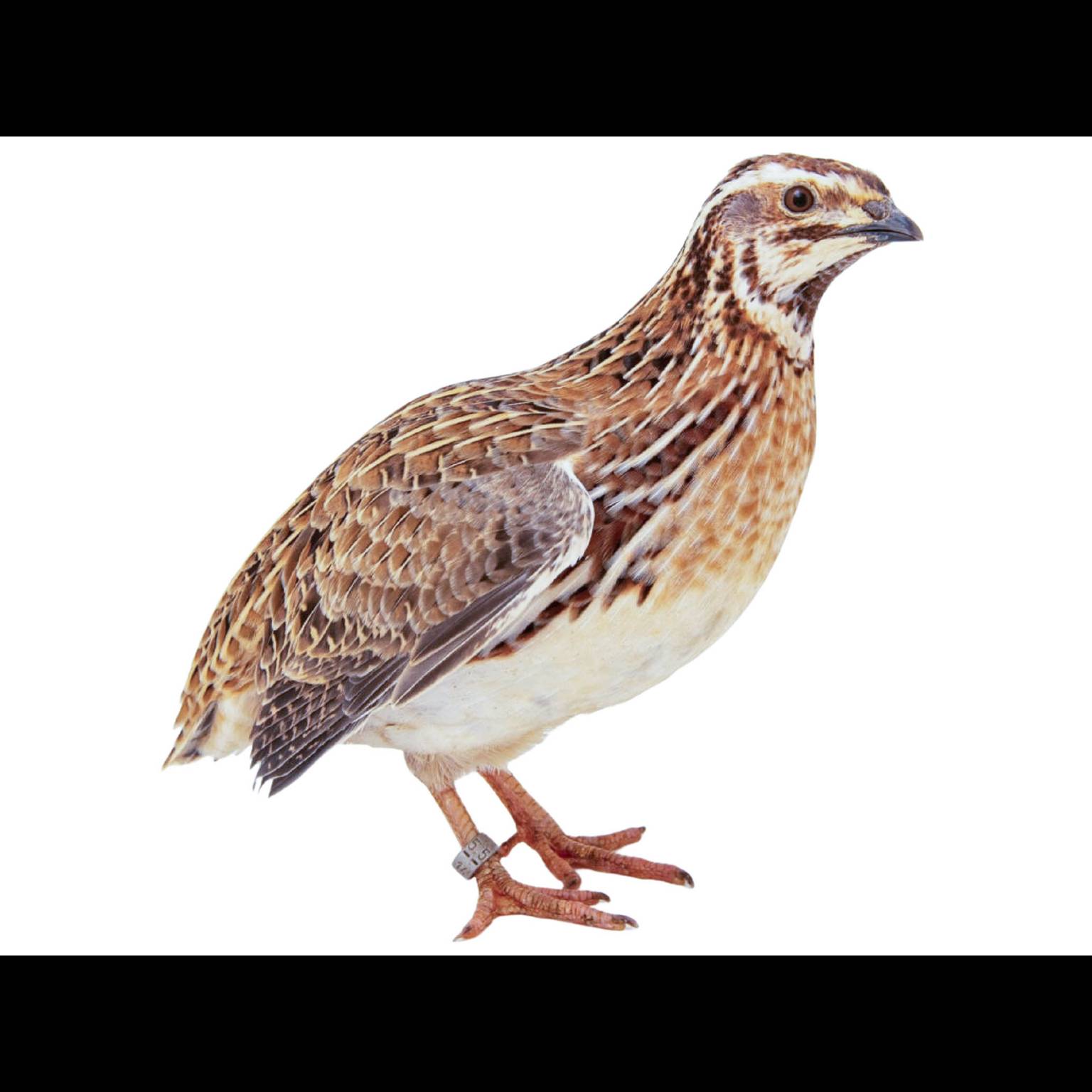
The Common Quail, often referred to simply as Quaglia, is a small, ground-dwelling game bird belonging to the pheasant family. It is known for its cryptic plumage, short tail, and distinctive 'wet-my-lips' call. This migratory species is widespread across Eurasia and Africa, inhabiting open grasslands and agricultural fields. Despite its small size, it undertakes impressive migratory journeys.
Dimensioni e longevità
- Lunghezza
- 16-18 cm
- Apertura alare
- 32-35 cm
- Peso
- 70-150 g (males typically 70-135 g, females 80-150 g)
- Longevità
- 2-3 years in the wild, up to 5 years in captivity
- Dieta
- Omnivore (primarily seeds, grains, and invertebrates)
Caratteristiche fisiche
- Piumaggio
- Overall cryptic brown and buff plumage, heavily streaked and mottled with black and dark brown. Upperparts are streaked with pale buff and dark brown. Underparts are paler, buffish-white, with fine dark streaking on the flanks. The wings are relatively long and pointed for a game bird, aiding in its migratory flights.
- Forma del becco
- Short, conical, and stout, adapted for pecking seeds and insects from the ground. Color is typically dark horn to brownish-grey.
- Colore degli occhi
- Dark brown.
- Colore delle zampe
- Pale flesh to yellowish-brown.
- Caratteristiche distintive
- Small size, short tail, cryptic streaked plumage, and a distinctive head pattern. Males have a more pronounced dark throat patch and facial markings.
- Aspetto giovanile
- Juveniles resemble adult females but are generally duller, with less defined markings and a more uniformly streaked appearance. Their plumage is softer and less compact.
- Cambiamenti stagionali
- No significant seasonal plumage changes. The plumage remains cryptic year-round, providing camouflage in its grassland habitat.
- Dimorfismo sessuale
- Males (cocks) typically have a more distinct black or dark brown anchor-shaped throat patch and dark moustachial stripes, often with a rufous wash on the breast. Females (hens) lack the prominent throat patch, having a paler, often spotted or streaked throat and breast, and generally duller facial markings. Females are also slightly larger on average.
Come identificare
- 1
Size and Shape
Look for a very small, plump, short-tailed game bird that often appears hunched on the ground. Its overall shape is compact.
- 2
Plumage Pattern
Observe the cryptic streaked brown and buff plumage. Look for pale streaks on the upperparts and fine dark streaking on the flanks. The wings are relatively long and pointed.
- 3
Head Markings (Males)
For males, identify the distinctive dark anchor-shaped throat patch and dark moustachial stripes. This is the most reliable field mark for sexing.
- 4
Vocalization
Listen for the male's characteristic 'wet-my-lips' or 'quick-quick-quick' call, especially at dawn and dusk. This is often the easiest way to detect their presence.
- 5
Flight
When flushed, they burst into a rapid, whirring flight, typically flying low and straight for a short distance before dropping back into cover.
Habitat e areale
- Biomi
- Temperate grasslands, steppes, agricultural fields, meadows, open scrubland.
- Areale geografico
- Breeds across much of Europe, Asia (east to Mongolia and northern China), and parts of North Africa. Winters in sub-Saharan Africa and parts of India and Pakistan.
- Fascia altitudinale
- Typically found from sea level up to 2,000 meters, occasionally higher in some mountainous regions during migration.
- Ambienti preferiti
- Prefers areas with dense, tall vegetation for cover, such as cereal crops (wheat, barley), hayfields, alfalfa fields, and natural grasslands. Avoids dense forests and arid deserts.
Comportamento
- Periodo di attività
- Diurnal, but migratory flights often occur at night.
- Abitudini alimentari
- Forages on the ground, often hidden within vegetation. Its diet consists primarily of seeds from grasses and cultivated plants, grains, and a variety of invertebrates such as beetles, ants, grasshoppers, and caterpillars. Chicks are almost exclusively insectivorous in their early stages.
- Comportamento sociale
- Generally solitary or found in small, loose groups outside the breeding season. During migration, they can form larger, more concentrated flocks. Males are polygynous, often mating with multiple females.
- Tipo di volo
- Flies with rapid, whirring wingbeats, typically low to the ground for short distances when flushed. Migratory flights are strong and direct, often undertaken at night.
- Migrazione
- A long-distance migratory species. European populations migrate south to sub-Saharan Africa for the winter, while Asian populations winter in India and Pakistan. Spring migration occurs from March to May, and autumn migration from August to October. They migrate primarily at night.
- Territorialità
- Males establish breeding territories, which they defend through vocalizations and occasional physical displays. Females are less territorial, focusing on nesting and chick-rearing.
Canto e richiami
- Canto
- The male's distinctive advertising call, often described as 'wet-my-lips' or 'quick-quick-quick', is a three-note phrase, loud and far-carrying. It is typically repeated several times, especially at dawn and dusk during the breeding season.
- Richiamo
- Various contact calls, alarm calls, and soft clucking sounds. When flushed, they emit a sharp 'whit-whit-whit' or 'prrrrt' call.
- Quando vocalizza
- Males call most frequently during the breeding season (spring and early summer), primarily at dawn, dusk, and sometimes throughout the night. Calls are less frequent outside the breeding season.
Riproduzione
- Stagione riproduttiva
- April to August, varying geographically.
- Abitudini di nidificazione
- Nests are simple scrapes on the ground, typically well-hidden in dense vegetation, often at the base of a tussock or crop plant. The nest is lined with grass and leaves.
- Dimensione della covata
- 6-12 eggs, sometimes up to 18. Females may lay multiple clutches in a season, especially if the first is lost.
- Descrizione dell'uovo
- Eggs are oval to sub-elliptical, smooth, and glossy. Color ranges from pale buff to olive-brown, often speckled or blotched with darker brown or black. Average size is about 30 x 23 mm.
- Periodo di incubazione
- 16-19 days, primarily by the female.
- Periodo di involo
- Chicks are precocial and leave the nest shortly after hatching (within hours). They can fly short distances at about 11 days old and are fully independent by 30-50 days.
- Cure parentali
- Mainly by the female, who incubates the eggs and cares for the chicks. Males may remain in the vicinity but typically do not participate directly in chick-rearing.
Dove trovarlo
Agricultural Fields
Look in fields of cereal crops (wheat, barley, oats), alfalfa, and hay, especially those with dense undergrowth.
Grasslands and Meadows
Search in open, grassy areas with sufficient cover, including natural steppes and extensive meadows.
Open Scrubland
Occasionally found in areas with scattered low bushes and tall grasses.
Consigli sul campo
- Listen for the Call. The Common Quail is notoriously difficult to see due to its cryptic plumage and secretive nature. Listening for the male's distinctive 'wet-my-lips' call is often the best way to locate them, particularly during the breeding season at dawn or dusk.
- Walk Slowly Through Fields. If you suspect quails are present, slowly walking through suitable habitat may flush them, allowing for a brief view as they fly off.
- Use Binoculars. Even if flushed, their flight is fast. Binoculars will help you get a better look at their plumage and flight pattern.
- Be Patient and Quiet. Quails are shy. Patience and minimal disturbance are key to observing them.
Specie simili
Japanese Quail
Coturnix japonica
Very similar in appearance and often considered conspecific or a subspecies. Males of Japanese Quail typically have a more uniform rufous breast and lack the distinct black throat patch of Common Quail. Their call is also subtly different, often described as 'whir-whit-whit' or 'chir-chir-chir', lacking the clear three-note structure of Common Quail. Hybridization occurs where ranges overlap.
Rain Quail
Coturnix coromandelica
Smaller and darker overall than Common Quail. Males have a prominent black breast band and a white throat with a black central stripe. Found in South Asia.
Harlequin Quail
Coturnix delegorguei
Males have a striking black and white facial pattern and a broad black breast band. Females are similar to Common Quail but often have a more rufous wash and distinct spotting on the underparts. Found in Africa.
Fatti rapidi
- Status:
- Least Concern (IUCN Red List)
- Habitat:
- Grasslands, agricultural fields
- Diet:
- Seeds, grains, insects
- Migration:
- Long-distance migrant
- Call:
- 'Wet-my-lips' (male)
Curiosità
- The Common Quail is the only Old World quail that undertakes long-distance migrations, covering thousands of kilometers between breeding and wintering grounds.
- Despite its small size, it is a popular game bird in many parts of its range, leading to significant hunting pressure.
- The species has been domesticated for egg and meat production, particularly the Japanese Quail (Coturnix japonica), which is often confused with or considered a subspecies of the Common Quail.
- Their cryptic plumage makes them incredibly difficult to spot on the ground, often only revealing themselves when almost stepped upon.
- The male's distinctive call is one of the most characteristic sounds of European and Asian agricultural landscapes in spring and early summer.
Classificazione scientifica
- Regno
- Animalia
- Phylum
- Chordata
- Classe
- Aves
- Ordine
- Galliformes
- Famiglia
- Phasianidae
- Genere
- Coturnix
- Specie
- Coturnix coturnix
Esplora Common Quail
Identifica uccelli ovunque
Gratis su iOS, Android e Web. Identificazione per foto e suono, database completo e la tua lista personale.