
Visto un uccello? Identificalo all'istante con l'app Birdby
Apri l'appInformazioni
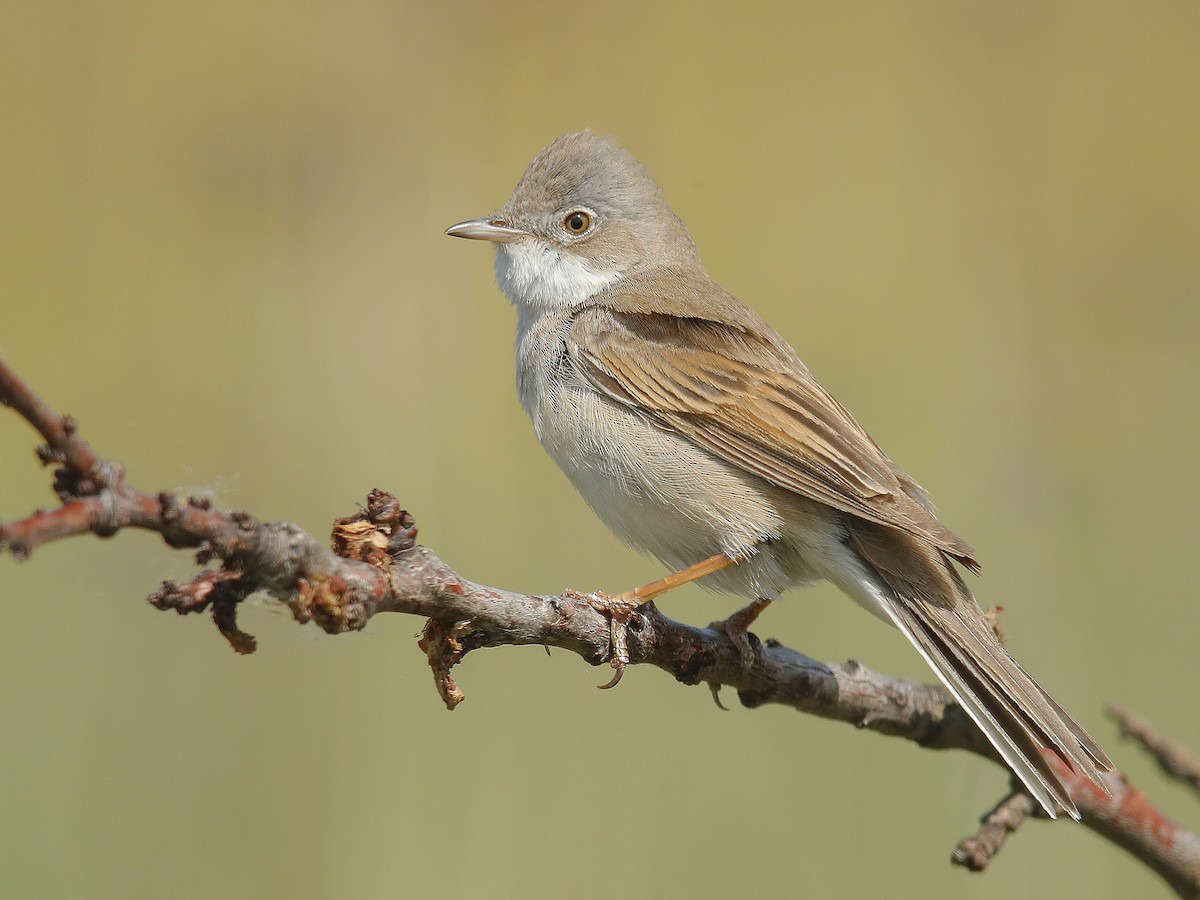
The Common Whitethroat (Curruca communis), known in Italian as Sterpazzola, is a widespread and common passerine bird belonging to the Old World warbler family Sylviidae. It is a migratory species, breeding across most of Europe and western Asia and wintering in sub-Saharan Africa. It is characterized by its distinctive scratchy song and preference for scrubby habitats.
Dimensioni e longevità
- Lunghezza
- 13-15 cm
- Apertura alare
- 18-23 cm
- Peso
- 12-17 g
- Longevità
- 2-5 years (up to 8 years recorded)
- Dieta
- Insectivore (primarily), Frugivore (seasonally)
Caratteristiche fisiche
- Piumaggio
- Adult males have a grey head, white throat, and pale pinkish-buff breast and flanks. The back and wings are brownish with rufous edges to the flight feathers, and the tail is dark with white outer tail feathers. Adult females are duller overall, with a browner head and less distinct pinkish wash on the underparts. Both sexes have a prominent white throat patch.
- Forma del becco
- Small, pointed, and relatively slender, dark grey to blackish.
- Colore degli occhi
- Dark brown, often with a pale orbital ring.
- Colore delle zampe
- Pale brown to greyish-brown.
- Caratteristiche distintive
- The combination of a grey head (males), white throat, rufous wing panel, and white outer tail feathers are key identification features. Its rather long tail is often cocked or fanned.
- Aspetto giovanile
- Juveniles resemble adult females but are generally warmer brown above, with a buffier wash on the underparts and less distinct grey on the head. The rufous wing panel is often more prominent.
- Cambiamenti stagionali
- No significant seasonal plumage changes. Breeding and non-breeding plumages are similar, though fresh autumn plumage may appear slightly richer in tone before wear.
- Dimorfismo sessuale
- Males are more brightly colored with a distinct grey head and pinkish breast. Females are duller, with a browner head and less pronounced pinkish tones on the underparts.
Come identificare
- 1
Plumage (Male)
Look for the distinctive grey head, bright white throat, and pale pinkish-buff breast. The brownish back and wings with rufous edges to the flight feathers are also key.
- 2
Plumage (Female/Juvenile)
Females and juveniles are duller, with a browner head, but still show the white throat and some rufous on the wings. The overall impression is less contrasting than the male.
- 3
Tail
Observe the dark tail with prominent white outer tail feathers, especially noticeable in flight or when the tail is fanned. The tail is often cocked.
- 4
Song
Listen for the characteristic rapid, scratchy, and jumbled warble, often delivered with great enthusiasm from an exposed perch or during a short song-flight.
- 5
Habitat
Check dense, scrubby vegetation, hedgerows, and woodland edges. They are often heard before they are seen, as they tend to stay hidden within the bushes.
Habitat e areale
- Biomi
- Temperate forests, grasslands, shrublands, agricultural lands.
- Areale geografico
- Breeds across Europe (excluding northern Scandinavia and parts of Russia) and western Asia, extending east to central Siberia. Winters in sub-Saharan Africa, from Senegal east to Ethiopia and south to South Africa.
- Fascia altitudinale
- Sea level up to 2,000 meters, occasionally higher in mountainous regions during migration.
- Ambienti preferiti
- Prefers open, bushy habitats such as hedgerows, scrubland, woodland edges, young plantations, clearings, overgrown gardens, and heathland. Requires dense vegetation for nesting and foraging.
Comportamento
- Periodo di attività
- Diurnal.
- Abitudini alimentari
- Primarily insectivorous, feeding on a wide variety of insects and their larvae, including caterpillars, beetles, flies, and aphids. During late summer and autumn, it supplements its diet with berries and small fruits to build up fat reserves for migration.
- Comportamento sociale
- Generally solitary or found in pairs during the breeding season. Migrates in loose flocks, but not typically seen in large aggregations.
- Tipo di volo
- Undulating, rather weak, and often low over vegetation. During display flights, males may sing from an exposed perch before performing a short, fluttering song-flight.
- Migrazione
- Long-distance migratory. Arrives in breeding grounds from late April to May and departs for wintering grounds in sub-Saharan Africa from August to October. Migrates mainly at night.
- Territorialità
- Males establish and defend breeding territories through song and display flights. They can be quite aggressive towards intruders.
Canto e richiami
- Canto
- A distinctive, rapid, scratchy, and rather jumbled warble, often described as 'churr-churr-churr-chiff-chaff-chiff-chaff'. It is delivered with great energy, often from an exposed perch or during a short, undulating song-flight.
- Richiamo
- Common calls include a harsh, scolding 'churr' or 'tack', often given when alarmed or agitated. Also a softer 'tett' or 'whit' call.
- Quando vocalizza
- Most vocal during the breeding season, from April to July, especially in the mornings and evenings. Calls can be heard year-round, particularly alarm calls.
Riproduzione
- Stagione riproduttiva
- May to July, typically two broods per season.
- Abitudini di nidificazione
- Nests are typically built low down in dense scrub, brambles, or thorny bushes, usually less than 1 meter above the ground. The nest is a neat, cup-shaped structure made of grass, stems, roots, and hair, often lined with finer materials.
- Dimensione della covata
- 3-6 eggs
- Descrizione dell'uovo
- 3-6 eggs (typically 4-5), smooth, glossy, white to pale greenish-white, heavily speckled and blotched with olive-brown, grey, and sometimes purplish-grey markings, often concentrated at the broad end.
- Periodo di incubazione
- 11-13 days, primarily by the female, but the male may assist.
- Periodo di involo
- 10-12 days after hatching. Young are fed by both parents.
- Cure parentali
- Both parents participate in incubation (though female more so) and feeding of the nestlings and fledglings.
Dove trovarlo
Hedgerows
Excellent places to find Common Whitethroats, especially those with a mix of thorny bushes and taller vegetation.
Scrubland
Preferred breeding habitat, look for them in areas with dense, low-lying bushes and scattered taller shrubs.
Woodland Edges and Clearings
Areas where forests transition to open land, providing both cover and foraging opportunities.
Overgrown Gardens and Allotments
Can be found in suburban areas with suitable dense vegetation.
Consigli sul campo
- Listen for the song. The Common Whitethroat's distinctive scratchy song is often the first indication of its presence. Learn to recognize it, as the bird itself can be elusive.
- Scan exposed perches. Males often sing from the top of a bush or a prominent branch before dropping back into cover. Look for movement in these areas.
- Be patient. They can be shy and spend much of their time hidden. Find a suitable spot and wait quietly; they may eventually emerge or sing closer.
- Look for movement in dense cover. Even if you can't see the bird clearly, rustling in bushes might indicate its presence as it forages.
Specie simili
Lesser Whitethroat
Curruca curruca
The Lesser Whitethroat has a darker grey head (often appearing capped), darker grey legs, and lacks the rufous wing panel of the Common Whitethroat. Its song is a distinctive, rattling 'rattle-rattle-rattle' followed by a clear, fluty warble, very different from the Common Whitethroat's scratchy song.
Garden Warbler
Sylvia borin
The Garden Warbler is plainer, lacking the grey head and white throat of the Common Whitethroat. It is uniformly brownish-grey above and buffy-white below, with no rufous in the wings or white in the tail. Its song is a rich, melodious, and sustained warble, without the scratchy quality of the Common Whitethroat.
Orphean Warbler
Curruca hortensis
The Orphean Warbler is larger and stouter, with a darker grey head (especially males), a more prominent white eye-ring, and lacks the rufous wing panel. Its song is much richer and more varied, often mimicking other birds.
Fatti rapidi
- Scientific Name:
- Curruca communis
- Family:
- Sylviidae
- Diet:
- Insects, berries
- Habitat:
- Scrubland, hedgerows, woodland edges
- Migration:
- Long-distance migrant to sub-Saharan Africa
- Conservation Status:
- Least Concern
Curiosità
- The Common Whitethroat was formerly placed in the genus Sylvia, but recent phylogenetic studies led to its reclassification into the genus Curruca.
- Despite its commonness, its population experienced significant declines in the late 1960s due to droughts in its African wintering grounds, highlighting the vulnerability of long-distance migrants to climate events.
- Males often perform a 'butterfly flight' display during the breeding season, fluttering above the bushes while singing vigorously to attract a mate.
- They are known to be quite aggressive towards other birds, especially during the breeding season, defending their territories with vigor.
Classificazione scientifica
- Regno
- Animalia
- Phylum
- Chordata
- Classe
- Aves
- Ordine
- Passeriformes
- Famiglia
- Sylviidae
- Genere
- Curruca
- Specie
- communis
Esplora Common Whitethroat
Identifica uccelli ovunque
Gratis su iOS, Android e Web. Identificazione per foto e suono, database completo e la tua lista personale.