
Visto un uccello? Identificalo all'istante con l'app Birdby
Apri l'appInformazioni
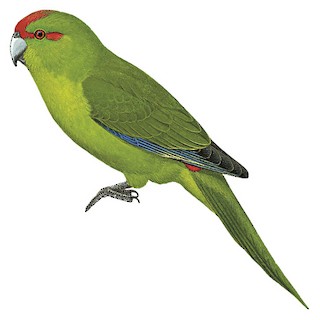
The Red-crowned Parakeet, commonly known as Kakariki Fronte Rossa, is a medium-sized, vibrant green parrot endemic to New Zealand and its outlying islands. Known for its distinctive red forehead and crown, it is an active and inquisitive bird, often seen foraging on the ground or in the canopy.
Dimensioni e longevità
- Lunghezza
- 23-27 cm
- Apertura alare
- 32-38 cm
- Peso
- 50-90 g
- Longevità
- Up to 10 years in the wild, longer in captivity
- Dieta
- Herbivore (primarily granivore and frugivore)
Caratteristiche fisiche
- Piumaggio
- Predominantly bright emerald green plumage. Distinctive crimson-red band across the forehead extending to behind the eye, and a red patch on each side of the rump. Primary flight feathers are violet-blue. Undersides are paler green.
- Forma del becco
- Short, stout, and hooked. The upper mandible is dark grey to black, fading to a paler grey or whitish at the base, while the lower mandible is pale grey to whitish.
- Colore degli occhi
- Reddish-orange to dark red
- Colore delle zampe
- Greyish-pink to dark grey
- Caratteristiche distintive
- The prominent red forehead and crown, combined with the red rump patches, are the most distinctive field marks. Its overall bright green coloration and active foraging behavior also aid identification.
- Aspetto giovanile
- Juveniles resemble adults but have duller plumage, particularly the red markings, which are less intense and extensive. Their beaks are typically paler, and their eyes may be a duller brown-orange.
- Cambiamenti stagionali
- No significant seasonal changes in plumage. The vibrant green and red markings remain consistent year-round.
- Dimorfismo sessuale
- Males are generally slightly larger than females, with a marginally larger head and beak, but plumage is identical. This difference is often subtle and difficult to discern in the field.
Come identificare
- 1
Red Crown and Forehead
Look for the bright crimson-red band extending from the forehead over the crown and behind the eye. This is the most definitive field mark.
- 2
Red Rump Patches
Observe the bird's back and rump; two distinct red patches on either side of the rump are characteristic.
- 3
Overall Green Plumage
The vibrant emerald green body plumage is consistent across adults.
- 4
Violet-blue Primaries
In flight or when wings are spread, look for the violet-blue outer flight feathers.
- 5
Vocalizations
Listen for their characteristic rapid, chattering 'ki-ki-ki-ki' calls, especially when they are active or in flight.
- 6
Behavior
They are often seen foraging on the ground or climbing actively through vegetation, which can help distinguish them from more arboreal species.
Habitat e areale
- Biomi
- Forests (native and exotic), scrubland, open woodlands, coastal areas, and sometimes suburban gardens.
- Areale geografico
- Endemic to New Zealand, including the North, South, Stewart, and Chatham Islands, as well as several smaller offshore islands (e.g., Auckland, Antipodes, Campbell, Kermadec Islands).
- Fascia altitudinale
- Sea level up to approximately 1200 meters, depending on habitat availability.
- Ambienti preferiti
- Prefers mature native forests (Nothofagus, Podocarp-broadleaf), dense scrub, and regenerating bush. Also found in exotic pine plantations and areas with abundant seed-bearing plants.
Comportamento
- Periodo di attività
- Diurnal. Most active during early morning and late afternoon, foraging and vocalizing.
- Abitudini alimentari
- Primarily feeds on seeds, fruits, berries, nuts, flowers, buds, and nectar. They are often seen foraging on the ground for fallen seeds or climbing through vegetation to access food. Occasionally consumes insects and larvae.
- Comportamento sociale
- Typically seen in pairs or small family groups. Outside the breeding season, they may form larger flocks, especially where food is abundant. They are generally quite vocal and active.
- Tipo di volo
- Flight is swift and direct, often undulating, with rapid wing beats. They can be quite agile when navigating through dense forest canopy.
- Migrazione
- Resident throughout its range; does not undertake long-distance migrations. May make local movements in search of food resources.
- Territorialità
- Pairs are territorial during the breeding season, defending their nesting site. Outside of breeding, they are less territorial and may forage in communal areas.
Canto e richiami
- Canto
- Not known for a complex song. Their vocalizations are generally described as chattering or twittering.
- Richiamo
- Common calls include a rapid, chattering 'ki-ki-ki-ki' or 'kaka-kaka-kaka', often given in flight or when alarmed. They also produce softer chirps and whistles during foraging or social interactions.
- Quando vocalizza
- Most vocal during foraging, in flight, and when communicating with flock members, particularly in the morning and evening.
Riproduzione
- Stagione riproduttiva
- Typically October to December, but can extend into March, especially if food is plentiful. May have multiple clutches in a good season.
- Abitudini di nidificazione
- Nests in tree hollows, crevices in rocks, or burrows in the ground (especially on predator-free islands). They do not construct elaborate nests, often laying eggs directly on wood dust or debris.
- Dimensione della covata
- 4-9 eggs, typically 5-7.
- Descrizione dell'uovo
- White, oval-shaped eggs.
- Periodo di incubazione
- Approximately 20-24 days, primarily by the female.
- Periodo di involo
- Chicks fledge around 5-6 weeks after hatching. They remain dependent on parents for a short period after fledging.
- Cure parentali
- Both parents feed the chicks after hatching, though the female does most of the incubation. The male often feeds the female during incubation.
Dove trovarlo
Native Forests
Look in mature Podocarp-broadleaf and Nothofagus forests throughout New Zealand.
Offshore Islands
Many predator-free offshore islands (e.g., Tiritiri Matangi, Kapiti Island) have thriving populations and offer excellent viewing opportunities.
National Parks and Reserves
Found in various national parks and protected areas across the North and South Islands.
Suburban Parks/Gardens
Occasionally seen in well-vegetated suburban areas, especially those bordering native bush.
Consigli sul campo
- Listen for Calls. Their chattering calls are often heard before the bird is seen. Follow the sound to locate them.
- Look for Movement. They are active foragers; watch for movement in the canopy or on the forest floor as they search for food.
- Visit Predator-Free Sanctuaries. These islands and fenced sanctuaries offer the best chances for close-up views due to higher population densities and reduced shyness.
- Early Morning/Late Afternoon. These are typically the most active times for foraging and vocalizing.
Specie simili
Yellow-crowned Parakeet
Cyanoramphus auriceps
The Yellow-crowned Parakeet has a yellow crown and forehead, lacking the extensive red band of the Red-crowned Parakeet. It also has a smaller red patch behind the eye and no red rump patches. Its call is generally higher-pitched and more rapid.
Orange-fronted Parakeet
Cyanoramphus malherbi
The Orange-fronted Parakeet is very similar to the Yellow-crowned Parakeet but has an orange-yellow band on its forehead. It is critically endangered and much rarer. Distinguishing it from the Yellow-crowned can be challenging, but both lack the prominent red crown and rump of the Red-crowned Parakeet.
Fatti rapidi
- Common Name:
- Red-crowned Parakeet (Kakariki Fronte Rossa)
- Scientific Name:
- Cyanoramphus novaezelandiae
- Conservation Status:
- Least Concern
- Diet:
- Seeds, fruits, flowers, insects
- Habitat:
- Forests, scrubland, coastal areas
- Distinguishing Feature:
- Red forehead, crown, and rump patches
Curiosità
- The name 'Kakariki' means 'small parrot' in Māori, and also refers to the color green.
- They are known for their inquisitive nature and can become quite tame in areas with frequent human interaction.
- On some predator-free islands, they have adapted to nesting in burrows in the ground, a behavior less common on the main islands due to predation.
- Their diet includes a wide variety of native and introduced plant species, making them adaptable to different environments.
Classificazione scientifica
- Regno
- Animalia
- Phylum
- Chordata
- Classe
- Aves
- Ordine
- Psittaciformes
- Famiglia
- Psittaculidae
- Genere
- Cyanoramphus
- Specie
- Cyanoramphus novaezelandiae
Esplora Red-crowned Parakeet
Identifica uccelli ovunque
Gratis su iOS, Android e Web. Identificazione per foto e suono, database completo e la tua lista personale.