
Visto un uccello? Identificalo all'istante con l'app Birdby
Apri l'appInformazioni
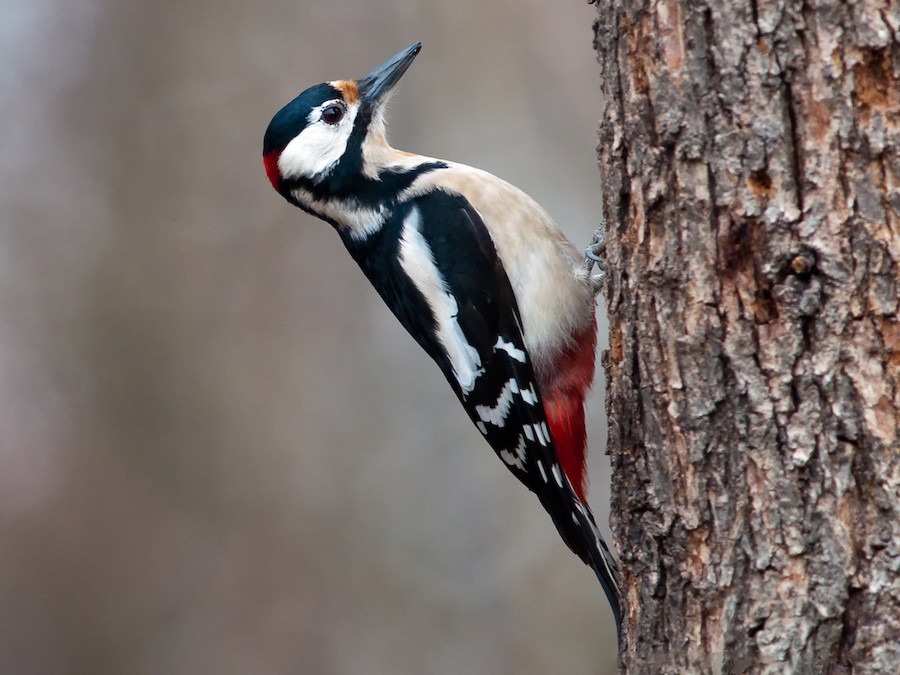
The Great Spotted Woodpecker is a medium-sized woodpecker, widely distributed across Eurasia and North Africa. It is a striking bird with pied black and white plumage and a distinctive red patch under its tail. Known for its drumming on trees, it plays a crucial ecological role in forest ecosystems.
Dimensioni e longevità
- Lunghezza
- 20-24 cm
- Apertura alare
- 34-39 cm
- Peso
- 70-90 g
- Longevità
- Up to 11 years in the wild, typically 2-3 years
- Dieta
- Omnivore, primarily insectivorous, especially wood-boring larvae, but also consumes seeds, nuts, berries, and occasionally bird eggs or nestlings.
Caratteristiche fisiche
- Piumaggio
- Predominantly black and white. Black upperparts with large white oval patches on the shoulders. White underparts, often with a buffy wash on the flanks. A prominent red patch under the tail (vent).
- Forma del becco
- Strong, chisel-shaped, dark grey to black bill, adapted for drilling into wood.
- Colore degli occhi
- Reddish-brown to dark brown
- Colore delle zampe
- Dark grey to black
- Caratteristiche distintive
- Pied black and white plumage, large white shoulder patches, red vent. Males have a red patch on the nape, juveniles have a red crown.
- Aspetto giovanile
- Juveniles of both sexes have a red crown, which extends from the forehead to the nape. This red crown is often brighter and more extensive than the adult male's nape patch. The white shoulder patches may be less distinct, and the overall plumage can appear duller.
- Cambiamenti stagionali
- No significant seasonal plumage changes. Plumage remains consistent throughout the year.
- Dimorfismo sessuale
- Males have a distinct red patch on the nape (back of the head), which is absent in females. Females have an entirely black nape.
Come identificare
- 1
Size and Shape
Medium-sized woodpecker with a sturdy body, short tail, and strong, chisel-like bill. Typical woodpecker posture, often clinging vertically to tree trunks.
- 2
Plumage Pattern
Look for the striking black and white pattern. Key features are the large white oval patches on the black shoulders and the bright red patch under the tail (vent).
- 3
Head Pattern
Observe the head. It has a black cap, white cheeks, and a black malar stripe (mustache stripe) that connects to the black nape. Males have an additional red patch on the nape, while females do not. Juveniles have a full red crown.
- 4
Vocalizations and Drumming
Listen for its sharp 'kik' call. Most distinctively, listen for its loud, rapid, and short drumming bursts on tree trunks, which are a key identification feature, especially during the breeding season.
- 5
Flight
Note its characteristic undulating flight pattern, a series of dips and rises.
Habitat e areale
- Biomi
- Temperate forests, boreal forests, mixed woodlands, parks, gardens, orchards.
- Areale geografico
- Widespread across Europe and Asia, from the British Isles and Scandinavia east to Japan and Kamchatka, and south to North Africa (Morocco, Algeria, Tunisia) and parts of the Middle East.
- Fascia altitudinale
- Sea level up to 2,000 meters, occasionally higher in mountainous regions.
- Ambienti preferiti
- Prefers mature deciduous and coniferous woodlands, especially those with a good supply of dead or decaying wood for foraging and nesting. Also common in suburban parks and large gardens with mature trees.
Comportamento
- Periodo di attività
- Diurnal, active from dawn to dusk.
- Abitudini alimentari
- Forages primarily on tree trunks and branches, using its strong bill to excavate insects from under bark or within wood. Also gleans insects from surfaces, probes crevices, and hammers open cones for seeds. Will visit bird feeders for suet, peanuts, and seeds.
- Comportamento sociale
- Generally solitary or found in pairs during the breeding season. Highly territorial, especially during nesting. Juveniles may form small, loose groups after fledging before dispersing.
- Tipo di volo
- Undulating flight pattern, characterized by a series of rapid wing beats followed by a short glide with wings tucked in, creating a 'dipping' motion.
- Migrazione
- Mostly resident throughout its range. Northern populations may undertake short-distance irruptive movements in years of poor cone crops, but true long-distance migration is rare.
- Territorialità
- Highly territorial, especially during the breeding season. Both sexes defend their nesting and foraging territories through drumming, calls, and aggressive displays.
Canto e richiami
- Canto
- Does not have a complex song. Its primary vocalization is a sharp, explosive 'kik' or 'kix' call, often repeated. The most characteristic 'song' is its drumming.
- Richiamo
- A sharp, single 'kik' or 'kix', often repeated rapidly when agitated or in contact. Also a softer 'chick' or 'chip' call. Alarm calls are harsher and more insistent.
- Quando vocalizza
- Calls are given year-round. Drumming is most frequent during the breeding season (late winter to early summer) as a territorial display and to attract a mate.
Riproduzione
- Stagione riproduttiva
- Typically April to June, with drumming starting in late winter (February-March).
- Abitudini di nidificazione
- Nests in cavities excavated by both sexes in dead or decaying trees, or sometimes in live trees with soft heartwood. The entrance hole is typically circular. Nests are usually 2-10 meters above ground.
- Dimensione della covata
- Typically 4-6 eggs.
- Descrizione dell'uovo
- 3-7 (usually 4-6) pure white, glossy, oval eggs. Approximately 26 x 19 mm.
- Periodo di incubazione
- 10-13 days, shared by both parents.
- Periodo di involo
- 20-24 days after hatching. Young remain dependent on parents for several weeks after fledging.
- Cure parentali
- Both parents incubate the eggs and feed the nestlings. After fledging, both parents continue to feed the young for several weeks, teaching them foraging skills.
Dove trovarlo
Forests and Woodlands
Look in mature deciduous, coniferous, and mixed forests. They prefer areas with older trees and some dead wood.
Parks and Gardens
Common in suburban and urban parks, large gardens, and orchards, especially those with mature trees.
Bird Feeders
Often visit garden bird feeders, particularly for suet and peanuts, especially in winter.
Consigli sul campo
- Listen for Drumming. During late winter and spring, listen for their distinctive, loud, and rapid drumming on tree trunks. This is often the first indication of their presence.
- Look for Foraging Signs. Scan tree trunks for holes or excavated areas where they have been foraging for insects. They often work their way up a tree trunk in a spiral fashion.
- Check Bird Feeders. If you have a suet feeder, keep an eye out, as they are frequent visitors, especially in colder months.
- Patience and Stealth. Woodpeckers can be shy. Move slowly and quietly through wooded areas, and use binoculars to scan tree trunks from a distance.
Specie simili
Syrian Woodpecker
Dendrocopos syriacus
The Syrian Woodpecker lacks the black malar stripe connecting to the nape, giving it a cleaner white face. Its white shoulder patches are also typically larger and more extensive, and the red vent patch is often paler. Its range is more restricted to southeastern Europe and the Middle East.
Middle Spotted Woodpecker
Dendrocopos medius
The Middle Spotted Woodpecker has a red crown (in both sexes, though duller in females) and lacks the black malar stripe, giving it a 'clean' white face. It also lacks the large white shoulder patches of the Great Spotted Woodpecker and has a pinkish-red vent, not bright red. Its drumming is much softer and less frequent, and its calls are different.
Lesser Spotted Woodpecker
Dryobates minor
Significantly smaller (sparrow-sized) than the Great Spotted Woodpecker. It has barred black and white upperparts, not large white shoulder patches. Males have a red crown, females have a white crown. Its drumming is softer and its calls are a distinctive 'pee-pee-pee'.
Fatti rapidi
- Primary Food Source:
- Wood-boring insects and larvae
- Nesting Site:
- Tree cavities excavated by the pair
- Distinguishing Feature (Male):
- Red patch on the nape
- Distinguishing Feature (Juvenile):
- Red crown
- Sound:
- Sharp 'kik' call and loud drumming
Curiosità
- The Great Spotted Woodpecker can drum up to 10-12 times per second, and a single drumming burst can last for several seconds. They use drumming not only for communication but also to locate insects by listening for vibrations.
- Their tongues are incredibly long and barbed, allowing them to extract insects from deep within wood. They can extend their tongue up to 4 cm beyond the tip of their bill.
- To protect their brains from the impact of drumming, woodpeckers have specialized skull structures, including spongy bone and strong neck muscles, which act as shock absorbers.
- They are known to 'farm' sap from trees by drilling rows of small holes, then returning to drink the sap or eat insects attracted to it. This behavior is less common than in sapsuckers but does occur.
- While primarily insectivorous, they are opportunistic feeders and have been observed preying on eggs and nestlings of smaller birds, especially during the breeding season when protein demands are high.
Classificazione scientifica
- Regno
- Animalia
- Phylum
- Chordata
- Classe
- Aves
- Ordine
- Piciformes
- Famiglia
- Picidae
- Genere
- Dendrocopos
- Specie
- Dendrocopos major
Esplora Great Spotted Woodpecker
Identifica uccelli ovunque
Gratis su iOS, Android e Web. Identificazione per foto e suono, database completo e la tua lista personale.