
Visto un uccello? Identificalo all'istante con l'app Birdby
Apri l'appInformazioni
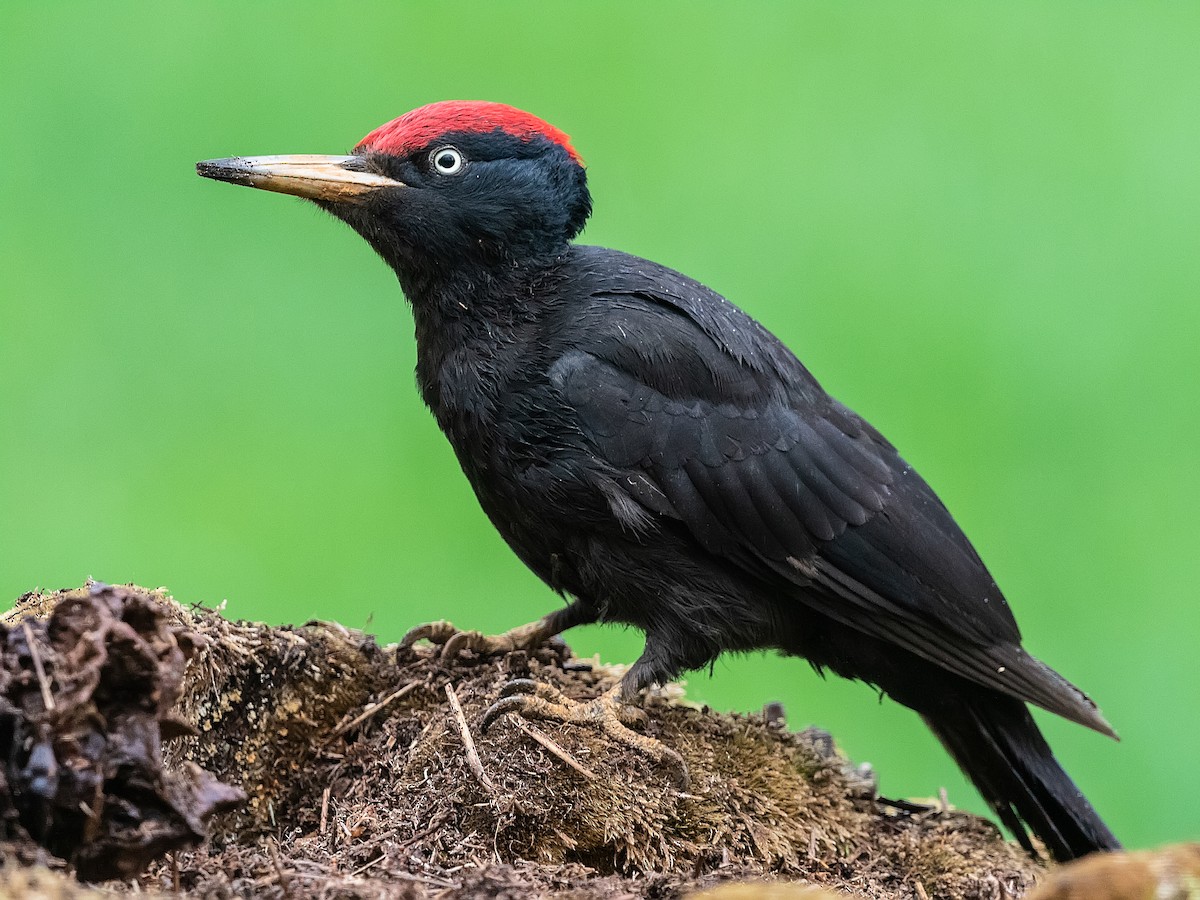
The Black Woodpecker is the largest woodpecker in Europe, Asia, and North Africa, characterized by its striking all-black plumage and a prominent red crown patch in males. It is a powerful excavator, creating large rectangular holes in trees for nesting and foraging, playing a crucial ecological role as a primary cavity nester.
Dimensioni e longevità
- Lunghezza
- 45-55 cm
- Apertura alare
- 64-78 cm
- Peso
- 250-400 g
- Longevità
- Up to 10-12 years in the wild
- Dieta
- Insectivore, primarily feeding on ants and wood-boring beetle larvae.
Caratteristiche fisiche
- Piumaggio
- Adults are entirely glossy black, with a distinctive red crown. The plumage can appear somewhat duller or brownish-black when worn.
- Forma del becco
- Long, chisel-shaped, powerful, and dark grey to black. The tip can appear lighter due to wear.
- Colore degli occhi
- Pale yellow to whitish iris, contrasting with the dark plumage.
- Colore delle zampe
- Dark grey to black, zygodactyl feet (two toes pointing forward, two backward) for gripping tree trunks.
- Caratteristiche distintive
- Large size, all-black body, and the prominent red crown (full in males, patch in females). Its flight is strong and undulating.
- Aspetto giovanile
- Juveniles resemble adults but have duller, more sooty-black plumage. The red on the head is often less extensive and duller, sometimes with an orange-red hue, and the eyes may be darker.
- Cambiamenti stagionali
- No significant seasonal plumage changes. Plumage may appear more worn and less glossy towards the end of the breeding season.
- Dimorfismo sessuale
- Males have a completely red crown extending from the forehead to the nape. Females have a smaller red patch only on the hindcrown/nape, with the rest of the crown being black.
Come identificare
- 1
Size and Color
Look for a very large, entirely black woodpecker. Its size alone distinguishes it from most other European woodpeckers.
- 2
Head Pattern
Observe the red on the head: a full red crown in males, a smaller red patch on the hindcrown in females. This is a key field mark.
- 3
Flight
Note its strong, undulating flight pattern, often with deep wing beats, as it flies between trees or across clearings.
- 4
Vocalizations
Listen for its loud, powerful, and relatively slow drumming, or its distinctive 'klee-eh' or 'kru-kru-kru' calls.
- 5
Foraging Signs
Look for large, rectangular holes in tree trunks, often at the base of trees or in dead wood, which are characteristic foraging signs.
Habitat e areale
- Biomi
- Temperate and boreal forests, mixed forests, coniferous forests, and mature deciduous woodlands.
- Areale geografico
- Widespread across the Palearctic region, from Western Europe (excluding Ireland and most of Great Britain) through Scandinavia, Central and Eastern Europe, Russia, and across Siberia to East Asia (including Japan and parts of China). Also present in parts of Turkey and the Caucasus.
- Fascia altitudinale
- Sea level up to 2,000 meters, occasionally higher in mountainous regions.
- Ambienti preferiti
- Prefers mature, extensive forests with large, old trees (especially conifers like spruce and pine, and deciduous trees like beech and oak) for nesting and foraging. Requires dead or decaying wood for insect prey and suitable trees for excavating nest cavities.
Comportamento
- Periodo di attività
- Diurnal.
- Abitudini alimentari
- Forages by hammering and chiseling into dead or decaying wood, as well as live trees, to extract ants (especially carpenter ants) and wood-boring beetle larvae. Also gleans insects from bark surfaces. Often creates large, rectangular foraging holes.
- Comportamento sociale
- Generally solitary or found in pairs, especially during the breeding season. Highly territorial. Juveniles may remain with parents for a short period after fledging.
- Tipo di volo
- Strong, direct, and undulating flight, with deep wing beats. Often flies at canopy level or across clearings with a characteristic 'dipping' motion.
- Migrazione
- Mostly resident throughout its range, though some northern populations may undertake short-distance altitudinal or irruptive movements in harsh winters or in search of food.
- Territorialità
- Highly territorial, especially around nesting and foraging sites. Pairs defend a large territory, often indicated by drumming and vocalizations.
Canto e richiami
- Canto
- The 'song' is a loud, far-carrying, and distinctive drumming, a rapid series of powerful blows on a resonant tree trunk. It typically lasts 2-3 seconds and is used for territorial display and attracting a mate. The drumming is slower and more powerful than that of smaller woodpeckers.
- Richiamo
- Common calls include a loud, ringing 'klee-eh' or 'kru-kru-kru' series, often given in flight or when agitated. Also a sharp 'kwick' or 'kyaak' call. Alarm calls are harsher and more rapid.
- Quando vocalizza
- Most vocal during the breeding season (late winter to early summer), with drumming and calls used for territorial defense and communication. Calls can be heard year-round.
Riproduzione
- Stagione riproduttiva
- Typically March to July, with egg-laying occurring from April to May.
- Abitudini di nidificazione
- Excavates a new nest cavity each year, usually in a large, old, often decaying tree (both deciduous and coniferous). The entrance hole is typically oval or rectangular, and the cavity can be quite deep. Both sexes participate in excavation, which can take 2-4 weeks.
- Dimensione della covata
- 3-6 eggs
- Descrizione dell'uovo
- 3-6 (usually 4-5) pure white, glossy, oval eggs.
- Periodo di incubazione
- 12-14 days, shared by both parents.
- Periodo di involo
- 24-31 days after hatching. Young remain in the nest until fully feathered and capable of flight.
- Cure parentali
- Both parents share incubation duties and feed the nestlings. After fledging, the young are fed by parents for several weeks and learn foraging techniques.
Dove trovarlo
Mature Forests
Extensive, old-growth forests with a mix of coniferous and deciduous trees are prime habitats. Look for areas with standing deadwood.
Mountainous Regions
Often found in montane forests, where large trees are abundant.
Forest Edges and Clearings
While preferring dense forest, they may be seen flying across clearings or at forest edges, especially when moving between foraging areas.
Consigli sul campo
- Listen for Drumming. Their powerful drumming carries a long distance and is often the first indication of their presence. It's slower and more resonant than smaller woodpeckers.
- Look for Foraging Holes. Scan tree trunks, especially older or dead trees, for large, rectangular excavations. These are unmistakable signs of Black Woodpecker activity.
- Be Patient and Quiet. Black Woodpeckers can be shy. Move slowly and quietly through suitable habitat, and use binoculars to scan tree trunks and branches.
- Early Morning/Late Afternoon. They are often most active during these times, especially during the breeding season.
Specie simili
Green Woodpecker
Picus viridis
The Green Woodpecker is largely green with a red crown and black 'moustache' stripe. It is smaller and primarily forages on the ground for ants, unlike the arboreal Black Woodpecker. The Black Woodpecker is entirely black with a red crown.
Great Spotted Woodpecker
Dendrocopos major
Much smaller than the Black Woodpecker. It has a pied black and white plumage with red undertail coverts and a red patch on the nape (male) or crown (juvenile). The Black Woodpecker is uniformly black.
Pileated Woodpecker
Dryocopus pileatus
Found in North America. While also large and mostly black with a red crest, the Pileated Woodpecker has prominent white stripes on its face and neck, and white underwings, which are absent in the Eurasian Black Woodpecker.
Fatti rapidi
- Size:
- Largest European woodpecker
- Color:
- All black with red crown
- Diet:
- Mainly ants and beetle larvae
- Nesting:
- Excavates large cavities in old trees
- Sound:
- Loud, powerful drumming and 'klee-eh' calls
Curiosità
- The Black Woodpecker is a 'keystone species' in many forest ecosystems. The large cavities it excavates are subsequently used by numerous other species, including owls, ducks, bats, and martens, which cannot create their own large holes.
- Its powerful beak can deliver blows with a force equivalent to 1,000 times the force of gravity, yet its brain is protected by specialized bone and muscle structures.
- Unlike many woodpeckers that primarily feed on insects under the bark, the Black Woodpecker specializes in excavating deep into the heartwood to find carpenter ants and their larvae, which form a significant part of its diet.
- The species' scientific name, Dryocopus martius, translates roughly to 'tree-hewing warrior', reflecting its powerful excavating abilities.
Classificazione scientifica
- Regno
- Animalia
- Phylum
- Chordata
- Classe
- Aves
- Ordine
- Piciformes
- Famiglia
- Picidae
- Genere
- Dryocopus
- Specie
- Dryocopus martius
Esplora Black Woodpecker
Identifica uccelli ovunque
Gratis su iOS, Android e Web. Identificazione per foto e suono, database completo e la tua lista personale.