
Visto un uccello? Identificalo all'istante con l'app Birdby
Apri l'appInformazioni
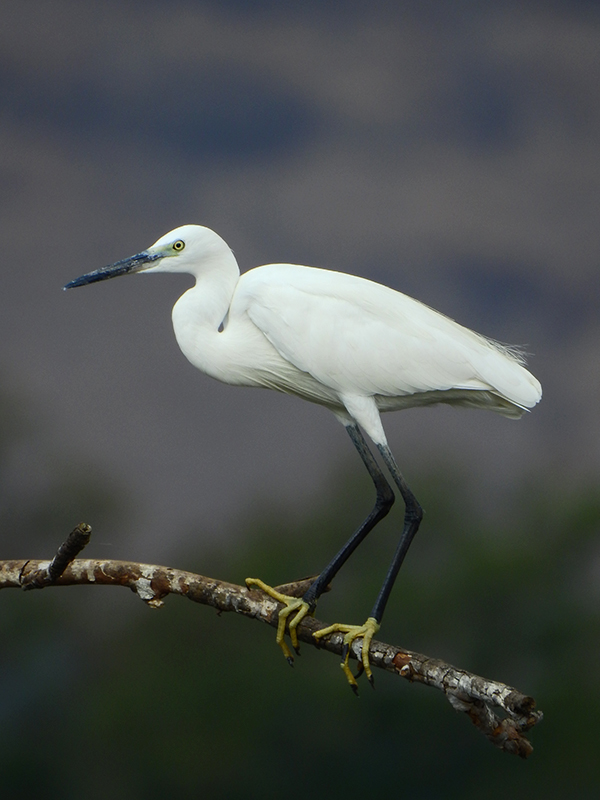
The Little Egret is a small, white heron with a slender black bill, black legs, and striking yellow feet. It is a widespread species, found in warm temperate and tropical regions of Europe, Africa, Asia, and Australia. Known for its elegant appearance and active foraging style in shallow waters.
Dimensioni e longevità
- Lunghezza
- 55-65 cm (22-26 in)
- Apertura alare
- 88-106 cm (35-42 in)
- Peso
- 350-550 g (12-19 oz)
- Longevità
- Up to 10-15 years in the wild
- Dieta
- Carnivore (primarily fish, amphibians, insects, crustaceans)
Caratteristiche fisiche
- Piumaggio
- Entirely pure white plumage. In breeding season, it develops two long, delicate nuchal plumes (aigrettes) extending from the back of the head, and lacy scapular plumes on its back.
- Forma del becco
- Slender, pointed, and entirely black.
- Colore degli occhi
- Iris is pale yellow.
- Colore delle zampe
- Black legs with conspicuously bright yellow feet. The yellow coloration on the feet can extend slightly up the lower tarsus in some individuals, especially during breeding.
- Caratteristiche distintive
- Combination of all-white plumage, black bill, black legs, and bright yellow feet. The nuchal plumes and lacy scapular plumes during breeding are also highly distinctive.
- Aspetto giovanile
- Juveniles resemble non-breeding adults but may have duller, greenish-yellow feet and sometimes a slightly duller bill. They lack the ornamental plumes of breeding adults.
- Cambiamenti stagionali
- During the breeding season (typically spring and early summer), adults develop two long, slender nuchal plumes (up to 20 cm long) and numerous lacy scapular plumes on their back and breast. The yellow on the feet may become more intense. Outside the breeding season, these plumes are absent, and the plumage is plain white.
- Dimorfismo sessuale
- Males and females are morphologically similar in plumage and size. Males may be slightly larger on average, but this is not a reliable field mark.
Come identificare
- 1
Size and Shape
Medium-sized, slender white heron with a relatively long neck and legs.
- 2
Plumage
Pure white body plumage at all times. Look for ornamental plumes during breeding season.
- 3
Bill Color
Always black, slender, and pointed.
- 4
Leg and Foot Color
Black legs with distinctive bright yellow feet. This is a crucial field mark.
- 5
Breeding Plumes
In breeding season, look for two long, thin nuchal plumes extending from the back of the head and lacy scapular plumes on the back.
- 6
Foraging Behavior
Active and agile foraging, often running, foot-stirring, or wing-flicking in shallow water.
Habitat e areale
- Biomi
- Wetlands, coastal areas, estuaries, rivers, lakes, marshes, rice paddies, mangroves.
- Areale geografico
- Widespread across the Old World: Southern Europe, Africa, Asia (from the Middle East to Southeast Asia and Australia). Also a relatively recent colonizer in the New World (Caribbean, parts of South America, and increasingly North America).
- Fascia altitudinale
- Primarily lowlands, typically from sea level up to a few hundred meters, rarely higher.
- Ambienti preferiti
- Shallow freshwater and saltwater habitats with abundant small prey, often with emergent vegetation for cover and nesting. Tolerant of both natural and artificial wetlands.
Comportamento
- Periodo di attività
- Diurnal, most active during daylight hours, particularly in the morning and late afternoon.
- Abitudini alimentari
- Highly active and agile hunter. Employs various foraging techniques including 'foot-stirring' (shuffling feet to disturb prey), 'wing-flicking' (flashing wings to startle prey), 'running and chasing', and 'standing and waiting'. Primarily feeds on small fish, frogs, tadpoles, aquatic insects, crustaceans, and occasionally small reptiles or mammals.
- Comportamento sociale
- Often solitary when foraging, but highly gregarious when roosting and nesting. Forms large communal roosts and breeds in colonies (heronries), often alongside other heron species.
- Tipo di volo
- Graceful and direct flight with slow, deliberate wingbeats. Neck is typically retracted into an 'S' shape, and legs trail behind the body, extending beyond the tail.
- Migrazione
- Northern populations are migratory, moving south to warmer regions for winter (e.g., European birds winter in Africa). Southern populations are largely resident or undertake local dispersive movements. Migration occurs mainly at night.
- Territorialità
- Defends a small feeding territory when foraging, but highly colonial during breeding, with nests built in close proximity within the heronry.
Canto e richiami
- Canto
- Not known for a complex song. Vocalizations are generally harsh and guttural.
- Richiamo
- Common calls include a harsh, croaking 'kraaah' or 'arrk', especially when disturbed or in flight. Also emits a variety of squawks and gurgles at the nest site, particularly during interactions between adults or with chicks.
- Quando vocalizza
- Most vocal during breeding season at the colony, or when alarmed. Generally silent when foraging.
Riproduzione
- Stagione riproduttiva
- Varies geographically, typically spring and early summer (e.g., March-July in Europe, year-round in tropical regions).
- Abitudini di nidificazione
- Nests colonially in heronries, often with other species of herons and egrets. Nests are typically platforms of sticks and reeds, built in trees, bushes, or reedbeds, usually over water or on islands, providing protection from predators.
- Dimensione della covata
- 3-5 eggs, occasionally 2-6.
- Descrizione dell'uovo
- Pale blue-green, unspotted, oval-shaped eggs.
- Periodo di incubazione
- 21-25 days, incubated by both parents.
- Periodo di involo
- Chicks fledge (become capable of flight) at around 30-35 days old, but remain dependent on parents for feeding for several more weeks.
- Cure parentali
- Both parents share incubation duties and care for the young, bringing food to the nest.
Dove trovarlo
Coastal Lagoons and Estuaries
Excellent places to find them, especially where mudflats and shallow waters are present.
Freshwater Marshes and Lakes
Look along the edges of reedbeds and open water, particularly in areas with emergent vegetation.
Rice Paddies and Irrigated Fields
Common in agricultural areas with flooded fields, especially in Asia.
Mangrove Swamps
Found in coastal tropical and subtropical regions, often roosting and nesting in mangroves.
Consigli sul campo
- Look for movement. Their active foraging style makes them relatively easy to spot as they dart and shuffle through shallow water.
- Scan for yellow feet. The bright yellow feet against black legs are a very distinctive feature, even from a distance, especially when wading.
- Visit heronries. During breeding season, locate known heronries where they nest communally, often with other heron species.
- Check at dawn and dusk. While diurnal, they are often seen flying to and from communal roosts at the beginning and end of the day.
Specie simili
Great Egret
Ardea alba
Significantly larger (90-100 cm length) with a yellow bill (black only during breeding) and black feet. Lacks the nuchal plumes of the Little Egret. Forages more slowly and deliberately.
Snowy Egret
Egretta thula
Found in the Americas. Very similar in size and appearance, also with black bill, black legs, and yellow feet. The key difference is the presence of curly, recurved plumes on the head, neck, and back of the Snowy Egret during breeding, compared to the two straight nuchal plumes of the Little Egret. Also, the lores (area between eye and bill) of the Snowy Egret turn red during breeding, while the Little Egret's lores turn blue-grey or greenish-yellow.
Cattle Egret
Bubulcus ibis
Smaller and stockier. Has a yellow bill (orange-red during breeding) and duller, yellowish-green legs and feet. Develops buffy-orange plumes on head, neck, and back during breeding. Often found in drier habitats, associating with livestock.
Fatti rapidi
- Key ID Feature:
- Black bill, black legs, yellow feet
- Plumage:
- All white
- Foraging Style:
- Active, foot-stirring, wing-flicking
- Sociality:
- Colonial breeder and rooster
- Migration:
- Partial migrant in northern ranges
Curiosità
- The Little Egret was heavily hunted in the late 19th and early 20th centuries for its breeding plumes ('aigrettes'), which were highly prized for women's hats. This led to significant population declines and was a major catalyst for the early conservation movement.
- It is a relatively recent colonizer of the New World, first breeding in Barbados in 1954 and subsequently expanding its range into other Caribbean islands and parts of South and North America.
- The 'foot-stirring' foraging technique is quite unique, where the egret shuffles its feet on the bottom to flush out hidden prey.
- Despite its name, the Little Egret is not always the smallest egret in its range; the Cattle Egret is often smaller.
Classificazione scientifica
- Regno
- Animalia
- Phylum
- Chordata
- Classe
- Aves
- Ordine
- Pelecaniformes
- Famiglia
- Ardeidae
- Genere
- Egretta
- Specie
- Egretta garzetta
Esplora Little Egret
Identifica uccelli ovunque
Gratis su iOS, Android e Web. Identificazione per foto e suono, database completo e la tua lista personale.