
Visto un uccello? Identificalo all'istante con l'app Birdby
Apri l'appInformazioni
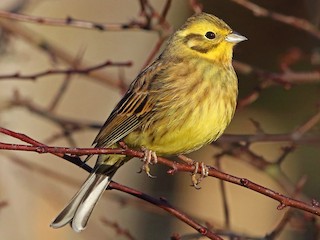
The Yellowhammer is a medium-sized passerine bird in the bunting family Emberizidae. It is a distinctive and widespread species across much of Europe and Asia, known for the bright yellow plumage of the male, especially during the breeding season. It is typically found in open countryside with scattered trees and hedgerows, often perching conspicuously to sing its characteristic song.
Dimensioni e longevità
- Lunghezza
- 16-17 cm
- Apertura alare
- 23-29.5 cm
- Peso
- 20-36 g
- Longevità
- Typically 2-3 years in the wild, with records up to 10 years.
- Dieta
- Omnivore, primarily seeds (especially cereals and grasses) outside the breeding season, supplemented with invertebrates (insects, spiders) during breeding to feed young.
Caratteristiche fisiche
- Piumaggio
- Adult males in breeding plumage are striking with a bright yellow head and underparts, streaked brown back, rufous rump, and dark brown wings with two pale wing-bars. Females are duller, with less yellow and more streaking. Juveniles resemble females but are even more heavily streaked and duller.
- Forma del becco
- Conical, stout, and relatively short, adapted for seed-eating. Dark grey to blackish.
- Colore degli occhi
- Dark brown.
- Colore delle zampe
- Pinkish-brown to flesh-colored.
- Caratteristiche distintive
- Bright yellow head and underparts (male), rufous rump (visible in flight), and distinctive 'little bit of bread and no cheese' song.
- Aspetto giovanile
- Duller and more heavily streaked than adult females, with less yellow overall. The streaking extends further down the flanks and breast.
- Cambiamenti stagionali
- Males are brightest in breeding plumage (spring/summer), becoming slightly duller in non-breeding plumage (autumn/winter) with some brown streaking on the crown and cheeks. Females show less seasonal variation but may appear slightly brighter in spring.
- Dimorfismo sessuale
- Pronounced. Males are much brighter yellow, especially on the head and underparts, with more defined streaking. Females are duller, with greenish-yellow on the head and breast, and heavier streaking on the flanks and breast.
Come identificare
- 1
Male Plumage
Look for the bright yellow head and underparts, especially prominent during the breeding season. Note the rufous rump (often visible in flight) and streaked brown back.
- 2
Female Plumage
Females are duller, with greenish-yellow on the head and breast, and more extensive streaking on the flanks. Still retain some yellow, particularly on the face and belly.
- 3
Song
Listen for the characteristic 'a little bit of bread and no cheese' song, a series of short notes followed by a drawn-out final note. This is often the easiest way to identify them.
- 4
Habitat
Check open countryside with hedgerows, scattered trees, and agricultural fields. They often perch conspicuously on wires, bushes, or tree tops.
- 5
Flight
Observe their undulating flight pattern, typical of buntings.
Habitat e areale
- Biomi
- Temperate grasslands, agricultural land, open woodlands, heathland, scrubland.
- Areale geografico
- Widespread across most of Europe and temperate Asia, from Ireland and Portugal in the west to Siberia and Mongolia in the east. Introduced to New Zealand.
- Fascia altitudinale
- Typically found from sea level up to 1,000 meters, occasionally higher in mountainous regions.
- Ambienti preferiti
- Prefers open, cultivated land with hedgerows, scattered bushes, and trees, often near human habitation. Avoids dense forests and treeless plains.
Comportamento
- Periodo di attività
- Diurnal.
- Abitudini alimentari
- Forages primarily on the ground, picking up seeds and invertebrates. Will also feed on seed heads of plants. During winter, often forms flocks and feeds in stubble fields or around farm buildings.
- Comportamento sociale
- Solitary or in pairs during the breeding season. Forms flocks, sometimes mixed with other finches and buntings, outside the breeding season, especially in winter.
- Tipo di volo
- Undulating flight, typical of buntings, with short bursts of wing beats followed by glides. Often flies low over hedges.
- Migrazione
- Mostly resident in western and southern parts of its range. Northern and eastern populations are migratory, moving south and west for the winter. Partial migrant in central Europe.
- Territorialità
- Males are territorial during the breeding season, defending their nesting area with song and displays.
Canto e richiami
- Canto
- A distinctive, rhythmic song often described as 'a little bit of bread and no cheese' or 'ti-ti-ti-ti-ti-tiiiiii'. It consists of a series of short, rapid notes followed by a drawn-out final note. Sung from a prominent perch.
- Richiamo
- Common calls include a sharp 'chip' or 'tsip', and a softer 'twick' or 'tseep'. Alarm call is a more emphatic 'chitt'.
- Quando vocalizza
- Males sing frequently from early spring through late summer, primarily in the morning and evening, but also throughout the day.
Riproduzione
- Stagione riproduttiva
- April to August, typically producing 2-3 broods per year.
- Abitudini di nidificazione
- The nest is a cup-shaped structure built by the female, usually on or very close to the ground, well-hidden in dense vegetation, often at the base of a bush or in a tussock of grass. Made of grass, moss, and roots, lined with finer materials like hair.
- Dimensione della covata
- 3-5 eggs.
- Descrizione dell'uovo
- 3-5 eggs, typically pale purplish-white to greyish-white, with characteristic dark, hair-like scrawls and spots, often concentrated at the broad end.
- Periodo di incubazione
- 12-14 days, primarily by the female.
- Periodo di involo
- 11-13 days after hatching, young leave the nest.
- Cure parentali
- Both parents feed the nestlings and fledglings, though the female does most of the incubation.
Dove trovarlo
Agricultural Land
Look in fields with hedgerows, especially those growing cereals or oilseed rape. Stubble fields are good in winter.
Open Woodlands & Woodland Edges
Found in areas where woodlands meet open fields, or in open, sparse woodland with good undergrowth.
Heathland & Scrubland
Areas with scattered gorse, heather, and small bushes provide ideal habitat.
Gardens & Parks (rural)
May visit larger, rural gardens, especially those with seed feeders or adjacent to suitable habitat.
Consigli sul campo
- Listen for the song. The distinctive song is often heard before the bird is seen. Once heard, scan prominent perches like fence posts, power lines, or bush tops.
- Look for movement on the ground. Yellowhammers often feed on the ground, so watch for movement in grassy areas, under hedges, or in stubble fields.
- Visit early morning or late afternoon. These are often the most active times for singing and feeding.
- Use binoculars. Their bright yellow plumage can be striking, but binoculars will help confirm identification and observe details like the rufous rump.
Specie simili
Cirl Bunting
Emberiza cirlus
The Cirl Bunting male has a distinctive black throat and eye-stripe, and a greenish-grey head with yellow supercilium and moustachial stripe, lacking the extensive bright yellow head of the Yellowhammer. The song is a monotonous, rapid trill, very different from the Yellowhammer's.
Pine Bunting
Emberiza leucocephalos
Males of the Pine Bunting have a white crown and cheeks, with chestnut on the head and breast, and a white collar, contrasting with the Yellowhammer's all-yellow head. Females are harder to distinguish but generally lack the strong yellow tones of female Yellowhammers.
Corn Bunting
Emberiza calandra
The Corn Bunting is larger and plumper, entirely streaky brown with no yellow plumage. Its song is a jangling, metallic 'squeaky gate' sound, distinctly different from the Yellowhammer.
Fatti rapidi
- Distinctive Song:
- 'A little bit of bread and no cheese'
- Male Plumage:
- Bright yellow head and underparts
- Habitat Preference:
- Open countryside with hedgerows and scattered trees
- Diet:
- Seeds (winter), insects (breeding)
- Nesting:
- Ground-nesting, well-hidden
Curiosità
- The Yellowhammer's song is one of the most easily recognizable bird songs in Europe and has been immortalized in various folk songs and poems.
- Despite its 'Least Concern' conservation status globally, Yellowhammer populations have declined significantly in some parts of its range, particularly in Western Europe, due to agricultural intensification and habitat loss.
- In New Zealand, where it was introduced, the Yellowhammer is considered a common and widespread species, often found in similar habitats to its native range.
- The 'hair-like' markings on its eggs are a distinctive feature among buntings, making their eggs relatively easy to identify.
Classificazione scientifica
- Regno
- Animalia
- Phylum
- Chordata
- Classe
- Aves
- Ordine
- Passeriformes
- Famiglia
- Emberizidae
- Genere
- Emberiza
- Specie
- Emberiza citrinella
Esplora Yellowhammer
Identifica uccelli ovunque
Gratis su iOS, Android e Web. Identificazione per foto e suono, database completo e la tua lista personale.