
Visto un uccello? Identificalo all'istante con l'app Birdby
Apri l'appInformazioni
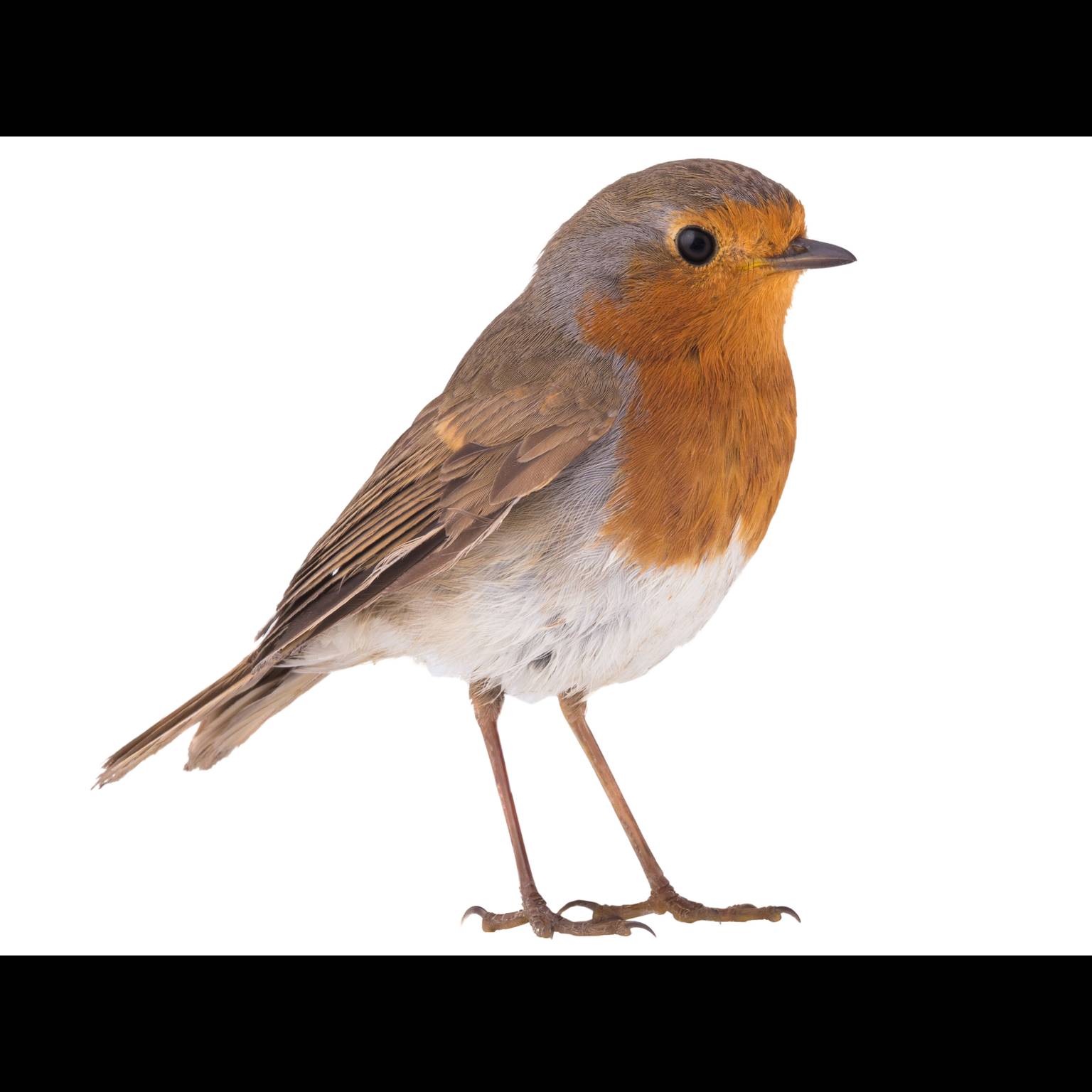
The European Robin, known as 'Pettirosso Europeo' in Italian, is a small insectivorous passerine bird, well-known for its distinctive orange-red breast and face, bordered with grey on the sides of the neck and chest. It is a familiar garden bird across much of its range and is often associated with winter and Christmas in many European cultures. Despite its seemingly 'cute' appearance, it is highly territorial and can be quite aggressive towards other robins.
Dimensioni e longevità
- Lunghezza
- 12.5-14 cm
- Apertura alare
- 20-22 cm
- Peso
- 16-22 g
- Longevità
- 1-2 years (up to 5 years in optimal conditions, maximum recorded 19 years)
- Dieta
- Omnivore (primarily insectivore)
Caratteristiche fisiche
- Piumaggio
- Adults have a bright orange-red breast, throat, and face, bordered by a narrow grey band on the sides of the neck and chest. The upperparts are olive-brown, and the belly is whitish. The flanks are buffy-brown. The wings and tail are dark brown. Juveniles are mottled brown with dark spots, lacking the orange-red plumage, which develops gradually over their first few months.
- Forma del becco
- Small, slender, pointed, and dark brown to black.
- Colore degli occhi
- Dark brown.
- Colore delle zampe
- Pale brown to pinkish-brown.
- Caratteristiche distintive
- The most distinctive feature is the vivid orange-red breast and face. Its upright posture and frequent tail flicking are also characteristic.
- Aspetto giovanile
- Juveniles are entirely mottled brown, with dark spots on a paler background, particularly on the head and upperparts. They lack any orange-red plumage. The orange-red breast begins to appear during their post-juvenile moult, typically from late summer to autumn.
- Cambiamenti stagionali
- No significant seasonal plumage changes. The plumage remains consistent throughout the year, though it may appear slightly duller when worn before the annual moult.
- Dimorfismo sessuale
- None. Males and females are virtually identical in plumage and size, making them indistinguishable in the field without genetic testing or behavioral observation during breeding.
Come identificare
- 1
Plumage
Look for the unmistakable bright orange-red breast, throat, and face, contrasting with olive-brown upperparts and a whitish belly. This is the primary identification mark for adults.
- 2
Size and Shape
A small, plump bird with a relatively large head and eyes, and a short tail. It often holds itself in an upright posture.
- 3
Behavior
Observe its foraging style: hopping on the ground, often with a characteristic tail flick. Its bold and confiding nature, especially in gardens, is also a good clue.
- 4
Song and Calls
Listen for its distinctive, warbling, melancholic song, particularly at dawn and dusk. The sharp 'tic-tic-tic' alarm call is also very characteristic.
- 5
Juveniles
If you see a small, mottled brown bird with dark spots, especially in late summer, it could be a juvenile European Robin before it develops its red breast.
Habitat e areale
- Biomi
- Temperate forests, woodlands, parks, gardens, hedgerows, scrubland, and urban areas.
- Areale geografico
- Widespread across Europe, western Siberia, North Africa, and parts of the Middle East. Its range extends from Ireland and Great Britain in the west, across continental Europe to the Ural Mountains, and south to the Atlas Mountains and the Canary Islands.
- Fascia altitudinale
- Sea level up to 2,500 meters, though typically found at lower to mid-elevations.
- Ambienti preferiti
- Prefers areas with dense undergrowth for foraging and nesting, such as woodland edges, clearings, mature gardens, and parks. It is highly adaptable to human-modified landscapes.
Comportamento
- Periodo di attività
- Diurnal. Known for singing at dawn and dusk, and sometimes at night under artificial light.
- Abitudini alimentari
- Primarily insectivorous, feeding on insects (beetles, ants, caterpillars), spiders, worms, and other invertebrates. In autumn and winter, they supplement their diet with berries and seeds. They often forage on the ground, hopping and running, and are known to follow large animals or humans to catch disturbed prey. They also visit bird feeders.
- Comportamento sociale
- Highly territorial, especially males, during the breeding season and often throughout the year. They are largely solitary outside of the breeding season, though they may tolerate other robins at rich food sources. Pairs form for breeding.
- Tipo di volo
- Short, undulating flights between perches, often low to the ground. When alarmed, flight can be more direct and rapid.
- Migrazione
- Northern and eastern populations are migratory, moving south and west for the winter. Western and southern European populations are largely resident, though some individuals may undertake short-distance movements. British and Irish robins are mostly resident.
- Territorialità
- Extremely territorial. Both sexes defend territories vigorously, especially during the breeding season. Males use their song and display of their red breast to warn off rivals. Fights can occur and may sometimes be fatal.
Canto e richiami
- Canto
- A beautiful, warbling, and melancholic song, often described as a 'liquid' or 'trickling' melody. It consists of a series of high-pitched, clear, and varied notes, often starting with a few hesitant notes before flowing into a more complex, rapid, and varied sequence. Sung from a prominent perch.
- Richiamo
- Common calls include a sharp, ticking 'tic-tic-tic' or 'tsip' call, often given when alarmed or agitated. Also a thin, high-pitched 'seee' call.
- Quando vocalizza
- Sings throughout the year, though most intensely during the breeding season (spring and early summer). Also known for singing in autumn and winter, and sometimes at night, especially in urban areas under streetlights.
Riproduzione
- Stagione riproduttiva
- Typically from March to August, with two to three broods per year.
- Abitudini di nidificazione
- Nests are usually built close to the ground, often in hollows, banks, tree stumps, ivy, or even in man-made objects like sheds, flowerpots, or old kettles. The nest is a cup-shaped structure made of moss, leaves, and grass, lined with fine roots, hair, and feathers.
- Dimensione della covata
- 5-7 eggs.
- Descrizione dell'uovo
- Eggs are typically 5-7, smooth, glossy, and white to pale buff, often speckled or mottled with reddish-brown, particularly at the broader end. Average size is about 20 x 15 mm.
- Periodo di incubazione
- 13-14 days, primarily by the female.
- Periodo di involo
- 12-15 days after hatching. Young leave the nest before they can fly strongly.
- Cure parentali
- Both parents feed the nestlings and fledglings, though the female does most of the incubation. The male often feeds the female during incubation.
Dove trovarlo
Gardens and Parks
One of the most common and easily observed birds in European gardens, parks, and urban green spaces, especially where there is some shrubbery and leaf litter.
Woodlands and Forests
Common in deciduous and mixed woodlands, particularly at the edges and in clearings with dense undergrowth.
Hedgerows and Scrubland
Favors areas with dense vegetation for cover and foraging, such as hedgerows, thickets, and scrubby areas.
Consigli sul campo
- Listen for their song. Their distinctive song is often the first indication of their presence, even when hidden in dense foliage. They sing year-round.
- Look on the ground. Robins spend a lot of time foraging on the ground for invertebrates. Watch for their characteristic hopping and tail-flicking movements.
- Be patient and still. They are often quite confiding and will approach humans, especially if they associate them with disturbed soil (e.g., gardening) or food. Remaining still can encourage them to come closer.
- Check bird feeders. In winter, they are frequent visitors to bird feeders, especially for mealworms, suet, and seeds.
Specie simili
Rufous-tailed Robin
Luscinia sibilans
The Rufous-tailed Robin has a less extensive orange-red patch, typically confined to the throat and upper breast, and lacks the grey border. Its upperparts are more rufous, and it has a distinct pale supercilium (eyebrow stripe).
Japanese Robin
Larvivora akahige
The Japanese Robin has a more restricted orange-red throat and breast, with a black band separating it from the white belly. Its upperparts are darker, and it has a more prominent white supercilium.
American Robin
Turdus migratorius
Despite the shared common name, the American Robin is a much larger thrush species (family Turdidae) with a brick-red breast and grey upperparts. It lacks the distinct orange-red face and grey border of the European Robin. They are not closely related.
Fatti rapidi
- Iconic Status:
- Often considered the national bird of the United Kingdom.
- Territoriality:
- Known for fierce territorial defense, even against their own reflection.
- Winter Singer:
- One of the few European passerines that sings regularly throughout the winter months.
- Christmas Symbol:
- Strongly associated with Christmas in many European countries, often depicted on cards.
Curiosità
- The European Robin's scientific name, 'Erithacus rubecula', literally means 'red robin'.
- Despite its common name, the American Robin (Turdus migratorius) is a thrush and not closely related to the European Robin. Early European settlers in America named the new bird after the familiar European Robin due to its reddish breast.
- Robins are known to become quite tame and will often approach gardeners, hoping to catch worms and insects disturbed by digging.
- Male and female robins look identical, which is unusual for many bird species where males are often more brightly colored.
- They have excellent low-light vision, which allows them to forage and sing in dim conditions, such as dawn, dusk, and even under artificial light at night.
Classificazione scientifica
- Regno
- Animalia
- Phylum
- Chordata
- Classe
- Aves
- Ordine
- Passeriformes
- Famiglia
- Muscicapidae
- Genere
- Erithacus
- Specie
- Erithacus rubecula
Esplora European Robin
Identifica uccelli ovunque
Gratis su iOS, Android e Web. Identificazione per foto e suono, database completo e la tua lista personale.