
Visto un uccello? Identificalo all'istante con l'app Birdby
Apri l'appInformazioni
The Common Kestrel, known as 'Gheppio' in Italian, is a small to medium-sized raptor widely distributed across Europe, Asia, and Africa. It is renowned for its distinctive hovering flight, a behavior known as 'kestrel-hovering' or 'wind-hovering', which it uses to locate prey. This species is highly adaptable, thriving in a variety of open and semi-open habitats, often in close proximity to human settlements.
Dimensioni e longevità
- Lunghezza
- 32-39 cm
- Apertura alare
- 65-82 cm
- Peso
- 136-252 g (male), 154-314 g (female)
- Longevità
- Up to 16 years in the wild, typically 3-4 years
- Dieta
- Carnivore, primarily feeding on small mammals (voles, mice), large insects (grasshoppers, beetles), small birds, and reptiles.
Caratteristiche fisiche
- Piumaggio
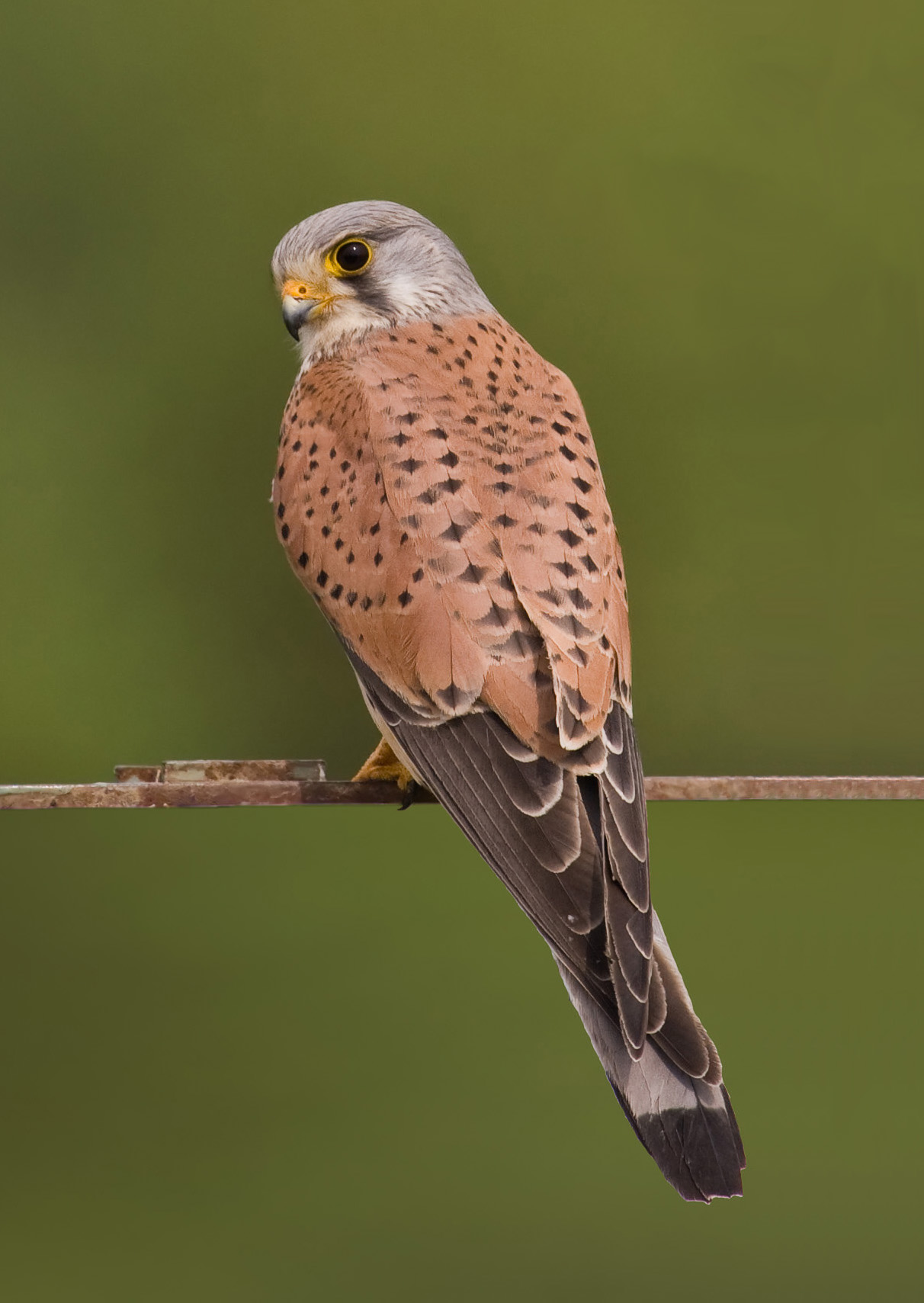
- Adult males have a rufous-brown back and wing-coverts with black spots, a grey head and rump, and a grey tail with a broad black subterminal band and a narrow white tip. Underparts are buff with black streaks. Adult females and juveniles are generally browner overall, with a rufous-brown head and tail, both barred with black. The tail also has a broad black subterminal band. Underparts are more heavily streaked than males.
- Forma del becco
- Short, sharply hooked, dark grey to black with a yellow cere.
- Colore degli occhi
- Dark brown
- Colore delle zampe
- Bright yellow
- Caratteristiche distintive
- Long, pointed wings and a relatively long tail. The most distinctive feature is its hovering flight, often with the tail fanned, while scanning the ground for prey.
- Aspetto giovanile
- Similar to adult females, with a rufous-brown head and barred tail. Plumage is generally duller and more heavily streaked than adult males. The cere and eye-ring are often duller yellow than adults.
- Cambiamenti stagionali
- No significant seasonal plumage changes. Plumage wear can make colors appear duller towards the end of the breeding season.
- Dimorfismo sessuale
- Pronounced. Males have a grey head and tail, and fewer spots on the back. Females have a rufous-brown head and barred rufous-brown tail. Females are also typically larger and heavier than males.
Come identificare
- 1
Hovering Flight
Look for a raptor holding itself almost stationary in the air, facing into the wind, with rapid wing beats and a fanned tail. This is the most characteristic identification feature.
- 2
Plumage (Adult Male)
Note the grey head and tail (with a black subterminal band), rufous-brown back with black spots, and buff underparts with streaking. The dark 'moustache' stripe is also a key feature.
- 3
Plumage (Adult Female/Juvenile)
Observe the overall browner appearance, rufous-brown head and tail (both barred), and heavier streaking on the underparts compared to the male.
- 4
Size and Shape
A relatively small, slender falcon with long, pointed wings and a long tail. Compare its size to a pigeon for scale.
- 5
Call
Listen for the distinctive, high-pitched 'kee-kee-kee-kee' call, especially when the bird is agitated or around its nesting site.
Habitat e areale
- Biomi
- Grasslands, heathlands, agricultural areas, open woodlands, urban and suburban environments, coastal cliffs.
- Areale geografico
- Widespread across Europe, Asia, and Africa. Extends from the British Isles and Iberia eastward across Eurasia to Japan, and south through Africa.
- Fascia altitudinale
- Sea level up to 4,500 meters in some parts of its range, though typically found at lower to mid-elevations.
- Ambienti preferiti
- Open country with scattered trees, hedgerows, or structures for perching and nesting. Often found near human habitation, including towns and cities, where buildings provide nesting sites.
Comportamento
- Periodo di attività
- Diurnal, most active during daylight hours, particularly morning and late afternoon.
- Abitudini alimentari
- Primarily a diurnal hunter. It employs a characteristic hovering flight (kestrel-hovering) at heights of 10-40 meters, facing into the wind, to spot prey. Once prey is located, it drops rapidly, often in a series of short dives, to capture it. Also hunts from perches, scanning the ground. Prey is typically swallowed whole or torn into pieces.
- Comportamento sociale
- Generally solitary outside the breeding season. During breeding, pairs are monogamous and territorial. May form loose aggregations at rich feeding grounds or during migration.
- Tipo di volo
- Distinctive hovering flight, often appearing almost stationary in the air, with rapid wing beats and fanned tail. When not hovering, flight is direct and purposeful, with shallow, rapid wing beats. Glides on slightly bowed wings.
- Migrazione
- Partial migrant. Northern and eastern populations are migratory, moving south to warmer regions in winter (e.g., southern Europe, Africa, South Asia). Western and southern European populations are largely resident or undertake short-distance movements. African populations are generally resident.
- Territorialità
- Highly territorial during the breeding season, defending nesting and hunting areas from conspecifics and other raptors.
Canto e richiami
- Canto
- Does not have a complex song. Vocalizations are primarily calls.
- Richiamo
- Most common call is a rapid, high-pitched 'kee-kee-kee-kee' or 'klee-klee-klee-klee', often given when alarmed, excited, or during territorial disputes. Also a softer 'kew-kew-kew' during courtship or when approaching the nest.
- Quando vocalizza
- Calls are most frequently heard during the breeding season, especially around the nest, and when birds are alarmed or interacting.
Riproduzione
- Stagione riproduttiva
- Typically April to July, varying geographically.
- Abitudini di nidificazione
- Does not build its own nest. Utilizes old nests of other birds (e.g., crows, magpies), tree cavities, rock crevices, ledges on cliffs or buildings, and sometimes nest boxes. Nests are often unlined or sparsely lined with twigs, moss, or feathers.
- Dimensione della covata
- 3-7 eggs, most commonly 4-6.
- Descrizione dell'uovo
- 3-7 eggs (typically 4-6), oval to rounded, pale buff to reddish-brown, heavily speckled, blotched, or streaked with darker reddish-brown or purplish-brown markings. Size: approximately 35-42 mm x 29-33 mm.
- Periodo di incubazione
- 27-29 days, primarily by the female, with the male providing food.
- Periodo di involo
- 27-32 days after hatching. Young remain dependent on parents for several weeks after fledging.
- Cure parentali
- Both parents participate in raising the young. The female incubates and broods, while the male provides most of the food during incubation and early chick-rearing. Both parents hunt for the older chicks.
Dove trovarlo
Open Countryside
Look in agricultural fields, meadows, heathlands, and grasslands where small mammals and insects are abundant.
Urban and Suburban Areas
Often seen perching on tall buildings, church steeples, or telephone poles, especially in areas with nearby open spaces for hunting.
Roadsides
Frequently seen hovering or perching on wires and posts along roads, taking advantage of roadside verges for hunting.
Coastal Cliffs and Quarries
Nests in crevices and ledges, and hunts over adjacent open areas.
Consigli sul campo
- Scan the Sky. Look for the characteristic hovering flight, often at a moderate height, as they scan the ground for prey.
- Check Perches. Kestrels often perch on prominent vantage points like telephone poles, tall trees, buildings, or fence posts to survey their hunting grounds.
- Listen for Calls. Their distinctive 'kee-kee-kee' call can often draw attention to their presence, especially during the breeding season.
- Observe Behavior. Watch for sudden dives or rapid descents, indicating they have spotted prey. They are often quite tolerant of human presence.
Specie simili
Lesser Kestrel
Falco naumanni
Lesser Kestrels are slightly smaller, lack the dark 'moustache' stripe of the Common Kestrel, and males have unspotted rufous backs and unbarred grey tails. Their call is also distinct, a softer 'chew-chew-chew' rather than the Common Kestrel's sharp 'kee-kee-kee'. They often nest colonially.
Red-footed Falcon
Falco vespertinus
Red-footed Falcons are more slender, males are uniformly dark grey with red legs and cere, and females have a rufous head and underparts. They have a more buoyant, tern-like flight and rarely hover as extensively as Common Kestrels. Their primary diet is large insects.
Merlin
Falco columbarius
Merlins are smaller, stockier, and have shorter tails. Males are slate-grey above with rufous underparts, while females are brownish. They fly with rapid, powerful wing beats and rarely hover. Merlins are primarily bird hunters.
Fatti rapidi
- Primary Hunting Method:
- Hovering flight
- Dietary Staple:
- Small mammals (voles, mice)
- Nesting Preference:
- Uses existing nests or cavities
- Sexual Dimorphism:
- Males have grey head/tail, females are browner and barred
- Conservation Status:
- Least Concern (stable population)
Curiosità
- Common Kestrels can see ultraviolet light, which helps them detect the urine trails of voles, making their prey visible even when hidden in vegetation.
- The 'kestrel-hovering' flight is incredibly energy-efficient for hunting, allowing them to remain stationary over a target area without expending much energy in forward flight.
- Despite being a raptor, the Common Kestrel is one of the most common birds of prey in many parts of its range, adapting well to human-modified landscapes.
- They are known to cache food, especially during periods of abundant prey, storing it for later consumption.
Classificazione scientifica
- Regno
- Animalia
- Phylum
- Chordata
- Classe
- Aves
- Ordine
- Falconiformes
- Famiglia
- Falconidae
- Genere
- Falco
- Specie
- Falco tinnunculus
Esplora Common Kestrel
Identifica uccelli ovunque
Gratis su iOS, Android e Web. Identificazione per foto e suono, database completo e la tua lista personale.