
Visto un uccello? Identificalo all'istante con l'app Birdby
Apri l'appInformazioni
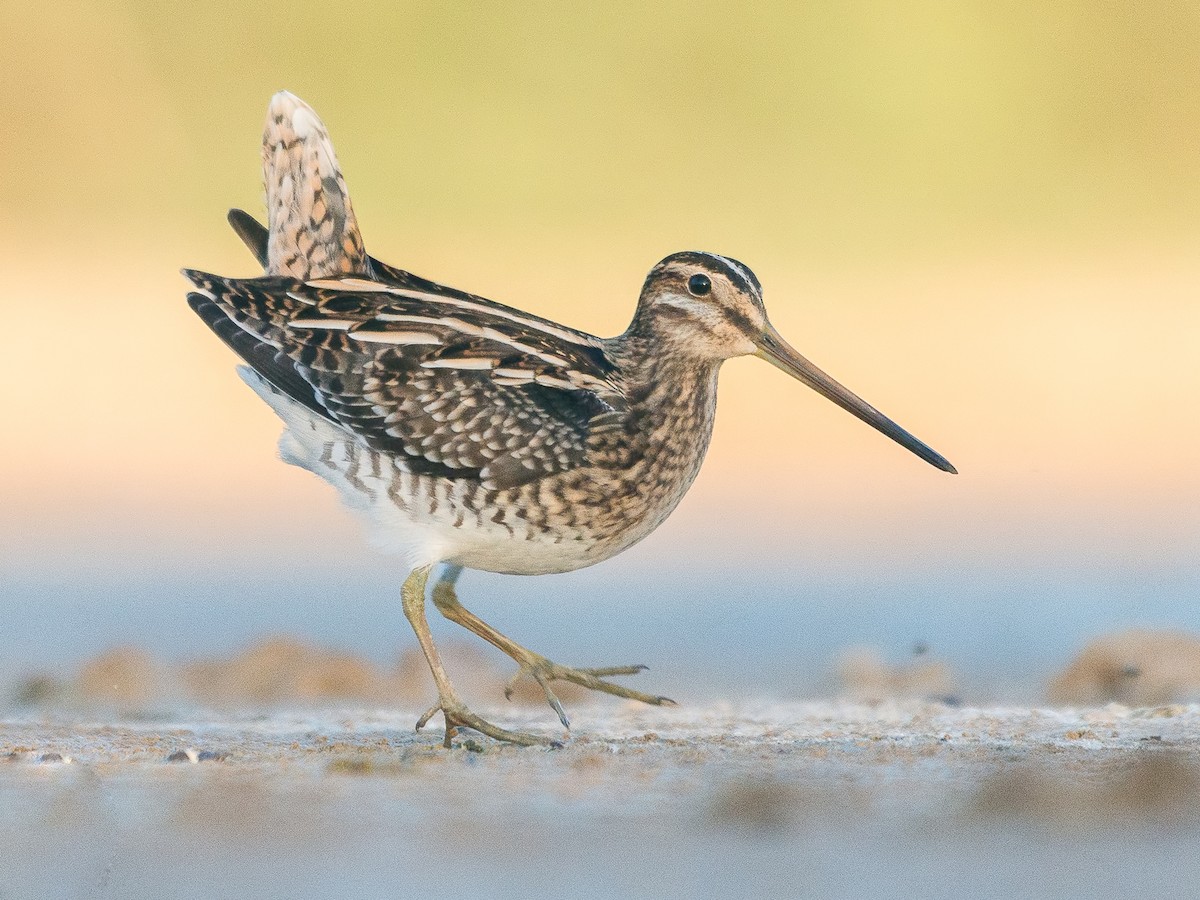
The Common Snipe, known as Beccaccino in Italian, is a medium-sized, cryptically plumaged wading bird with a remarkably long, straight bill. It is renowned for its elusive nature, camouflaged appearance, and distinctive 'drumming' display flight.
Dimensioni e longevità
- Lunghezza
- 23-28 cm (9.1-11.0 in)
- Apertura alare
- 39-45 cm (15.4-17.7 in)
- Peso
- 80-140 g (2.8-4.9 oz), occasionally up to 180 g
- Longevità
- Typically 2-5 years in the wild, with records up to 10-12 years.
- Dieta
- Carnivore (primarily invertebrates)
Caratteristiche fisiche
- Piumaggio
- Upperparts are mottled and streaked with dark brown, black, and rufous, providing excellent camouflage. The underparts are whitish with streaking on the flanks. Distinctive pale buffy-white stripes run along the crown, supercilium (above the eye), and malar (below the eye). The back has two prominent buffy-white stripes formed by the scapular feathers. The tail is short, wedge-shaped, and dark with rufous-orange sides and white tips, particularly visible in flight.
- Forma del becco
- Extremely long (6-7 cm), straight, slender, and dark-tipped bill, brownish at the base. The tip is flexible and sensitive, used for probing.
- Colore degli occhi
- Dark brown.
- Colore delle zampe
- Greenish-grey to yellowish-green.
- Caratteristiche distintive
- Long bill, cryptic plumage with strong longitudinal stripes on the head and back, short tail, and characteristic zig-zag flight when flushed.
- Aspetto giovanile
- Juveniles resemble adults but have narrower, less distinct buffy stripes on the back and scapulars. Their plumage can appear slightly duller and less sharply defined.
- Cambiamenti stagionali
- No significant seasonal plumage changes. Breeding and non-breeding plumages are essentially the same.
- Dimorfismo sessuale
- Males and females are virtually identical in plumage and size. There is no reliable visual distinction in the field.
Come identificare
- 1
Long Bill
Look for the exceptionally long, straight, and slender bill, which is a key feature of all snipes.
- 2
Cryptic Plumage
Observe the intricate pattern of dark brown, black, and rufous mottling on the upperparts, providing superb camouflage against wetland vegetation.
- 3
Head Stripes
Note the distinct pale buffy-white stripes on the head: one down the center of the crown, and prominent supercilium (above the eye) and malar (below the eye) stripes.
- 4
Back Stripes
Identify the two prominent buffy-white stripes running down the back, formed by the scapular feathers, which are often visible even when the bird is standing.
- 5
Flight Pattern (when flushed)
When disturbed, the Common Snipe takes off with an explosive, erratic, zig-zag flight, often accompanied by a harsh 'scaap' call. This is a very reliable field mark.
- 6
Drumming Display
During the breeding season, listen for the distinctive 'drumming' or 'bleating' sound produced by the male's tail feathers during its aerial display dives.
Habitat e areale
- Biomi
- Wetlands, marshes, bogs, wet meadows, tundra, and damp grasslands.
- Areale geografico
- Widespread breeding range across the Palearctic and Nearctic regions. Winters in southern Europe, Africa, South Asia, and Central and South America.
- Fascia altitudinale
- Primarily lowlands, but can be found at higher elevations in suitable wetland habitats, up to 2,000 meters (6,500 ft) in some parts of its range.
- Ambienti preferiti
- Requires soft, muddy ground for probing, dense vegetation for cover, and open areas for display flights. Often found near shallow water bodies, ditches, and flooded fields.
Comportamento
- Periodo di attività
- Primarily crepuscular and nocturnal, especially during migration and foraging. Can be active during the day, particularly when breeding or disturbed.
- Abitudini alimentari
- Forages by probing its long bill deep into soft mud and soil, using its sensitive tip to detect invertebrates. Diet consists mainly of insect larvae (especially craneflies, beetles), earthworms, leeches, mollusks, and occasionally seeds or plant matter.
- Comportamento sociale
- Generally solitary or found in loose aggregations, especially during migration or in wintering grounds. During the breeding season, males are territorial.
- Tipo di volo
- When flushed, it takes off with a characteristic explosive, zig-zag flight, often accompanied by a harsh 'scaap' call, before settling into a more direct flight path. During display, males perform spectacular aerial maneuvers, including high-altitude circles and dives.
- Migrazione
- Mostly migratory, with northern populations moving south for the winter. Some southern populations may be resident. Migration occurs primarily at night, often in small flocks.
- Territorialità
- Males establish and defend breeding territories, primarily through aerial displays and vocalizations.
Canto e richiami
- Canto
- The most famous 'song' is the 'drumming' or 'bleating' sound produced by vibrating outer tail feathers during a male's display flight. This sound is a low, pulsating 'hoo-hoo-hoo-hoo' or 'whu-whu-whu-whu', often described as sounding like a goat or lamb. It is produced during steep dives.
- Richiamo
- A harsh, explosive 'scaap' or 'ketch' call is given when flushed from cover. Also produces a 'chip-per, chip-per' call from the ground or in flight.
- Quando vocalizza
- Calls are given year-round, especially when disturbed. Drumming is primarily heard during the breeding season (spring and early summer), mostly at dawn, dusk, and sometimes at night.
Riproduzione
- Stagione riproduttiva
- April to July, varying geographically.
- Abitudini di nidificazione
- Nests are shallow scrapes on the ground, typically well-hidden in dense vegetation (e.g., tussocks of grass, sedges) in wet meadows or bogs. Lined with grass and leaves.
- Dimensione della covata
- Usually 4 eggs.
- Descrizione dell'uovo
- Typically 4 eggs, olive-buff to greenish-brown, heavily blotched and spotted with dark brown or black, especially at the broader end. Pyriform (pear-shaped).
- Periodo di incubazione
- 18-21 days, primarily by the female.
- Periodo di involo
- Chicks are precocial and leave the nest shortly after hatching. They are able to feed themselves within a few days and fledge (become capable of sustained flight) at around 19-20 days.
- Cure parentali
- Mainly by the female, though the male may assist in guarding the brood. Females often lead the first brood away while the male may take over care of a second brood if one is laid.
Dove trovarlo
Wetlands and Marshes
Look in areas with shallow water, muddy edges, and dense emergent vegetation such as reeds, sedges, and rushes.
Wet Meadows and Bogs
Explore damp grasslands, bogs, and peatlands, especially those with tussocks of grass that provide cover.
Flooded Fields and Ditches
During migration and winter, they can be found in flooded agricultural fields, along ditches, and at the edges of ponds.
Consigli sul campo
- Be Patient and Observant. Common Snipes are incredibly well-camouflaged and often remain motionless. Scan suitable habitats slowly and carefully.
- Listen for Calls. Their 'scaap' call when flushed is often the first indication of their presence. During breeding season, listen for the male's drumming display.
- Look for Movement. They often feed with a characteristic 'sewing machine' motion of their head as they probe the mud. Look for subtle movements in dense vegetation.
- Approach Carefully. They are easily flushed. If you hear a 'scaap' and see a zig-zag flight, try to mark where it landed, as they often don't fly far.
- Use Optics. Binoculars are essential for spotting these cryptic birds and observing their detailed plumage patterns.
Specie simili
Great Snipe
Gallinago media
Larger and stockier than Common Snipe. Has more white in the tail (outer tail feathers are almost entirely white). Less streaking on the flanks. Flight is heavier and more direct, rarely zig-zagging when flushed. Lacks the drumming display.
Jack Snipe
Lymnocryptes minimus
Significantly smaller than Common Snipe. Shorter bill. Lacks the prominent pale crown stripe and supercilium; instead, it has a dark crown with two yellowish stripes on either side. The back has a metallic green and purple sheen. When flushed, it flies low and slowly, often for a short distance, before dropping back into cover. Does not zig-zag like the Common Snipe.
Pintail Snipe
Gallinago stenura
Very similar to Common Snipe, but typically found in Asia. Distinguished by having more than 12 tail feathers (Common Snipe has 14-16, but the outer ones are very narrow and stiff, like pins, hence 'pintail'). Field identification is extremely difficult and often requires close views or in-hand examination.
Fatti rapidi
- Bill Length:
- Approximately 1/4 of its total body length
- Flight Speed:
- Can reach speeds of up to 100 km/h (60 mph) during escape flights
- Drumming Sound:
- Produced by specialized outer tail feathers vibrating in the airflow during display dives
- Diet Specialization:
- Highly adapted for probing soft substrates for hidden invertebrates
- Camouflage:
- One of the most cryptically plumaged birds, making it extremely difficult to spot on the ground
Curiosità
- The term 'sniper' originated from hunters who found it extremely challenging to hunt the elusive Common Snipe due to its erratic flight and camouflage.
- The Common Snipe's brain is unique among birds, with the eyes positioned so far back that it has a 360-degree field of vision, allowing it to see predators from all directions while probing for food.
- Its long bill has a flexible, sensitive tip that can open independently of the rest of the bill, allowing it to grasp prey underground without having to extract its entire bill.
- The 'drumming' sound is a form of mechanical sound production, not vocalization, and is a key part of the male's courtship display.
Classificazione scientifica
- Regno
- Animalia
- Phylum
- Chordata
- Classe
- Aves
- Ordine
- Charadriiformes
- Famiglia
- Scolopacidae
- Genere
- Gallinago
- Specie
- Gallinago gallinago
Esplora Common Snipe
Identifica uccelli ovunque
Gratis su iOS, Android e Web. Identificazione per foto e suono, database completo e la tua lista personale.