
Visto un uccello? Identificalo all'istante con l'app Birdby
Apri l'appInformazioni
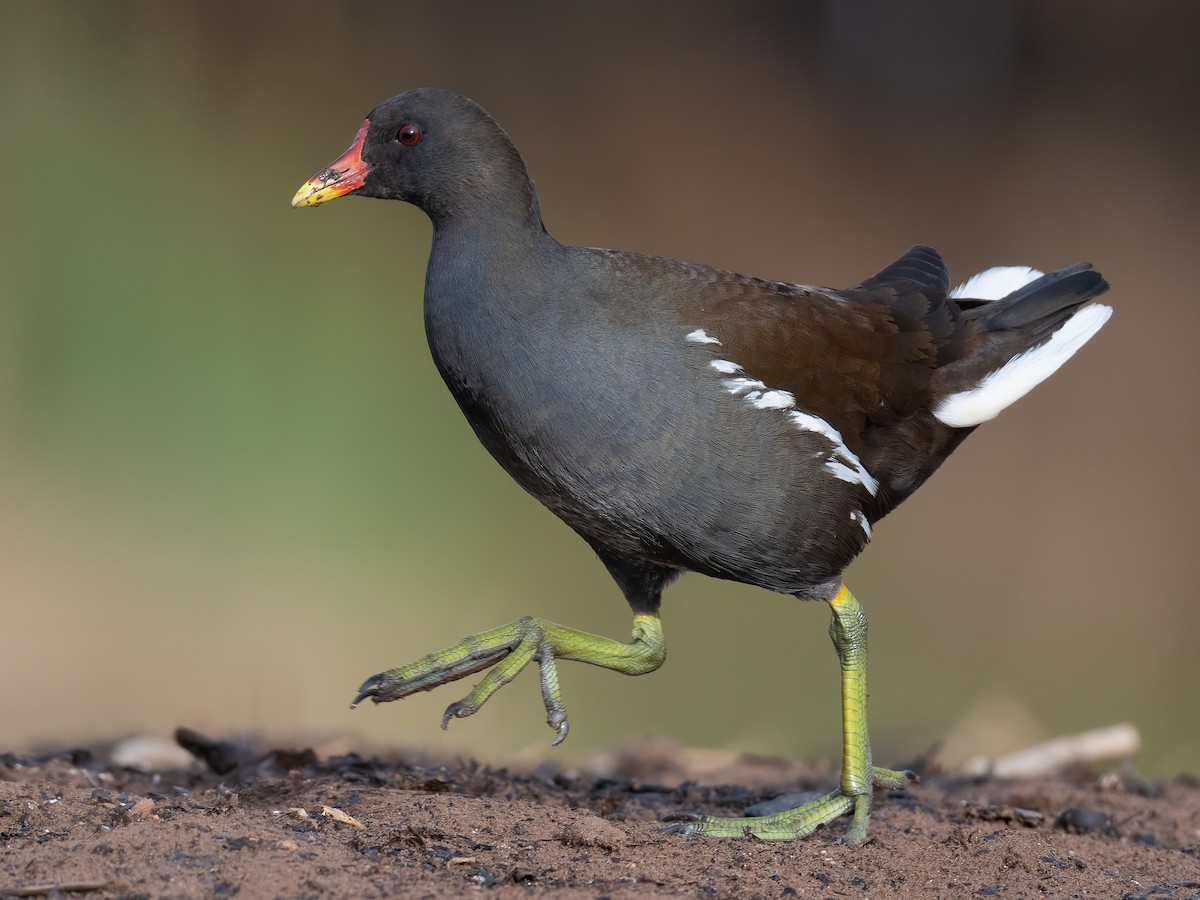
The Common Moorhen, often referred to as the 'Gallinella d'acqua' in Italian, is a medium-sized water bird belonging to the rail family. It is easily recognized by its dark plumage, red frontal shield, and red-and-yellow bill. It is a common and widespread species found in various wetland habitats across much of the world.
Dimensioni e longevità
- Lunghezza
- 30-38 cm
- Apertura alare
- 50-55 cm
- Peso
- 192-500 g
- Longevità
- Up to 10 years in the wild, typically 3-5 years
- Dieta
- Omnivore, feeding on a wide variety of plant material, small invertebrates, and occasionally small fish or carrion.
Caratteristiche fisiche
- Piumaggio
- Adults have dark sooty-grey to black plumage over most of the body, with a brownish back and wings. The flanks show distinctive white streaks, and the undertail coverts are white with a central black stripe. The flight feathers are dark brown.
- Forma del becco
- Conical, bright red with a yellow tip. A prominent red frontal shield extends from the base of the bill onto the forehead.
- Colore degli occhi
- Dark red to reddish-brown.
- Colore delle zampe
- Yellowish-green, with a distinctive red garter-like band at the top of the tibia (above the tarsus). Long toes are not webbed but have broad lobes for walking on soft ground and swimming.
- Caratteristiche distintive
- The most striking features are the bright red frontal shield and bill with a yellow tip, and the white undertail coverts with a central black stripe. The white flank stripe is also a key identifier.
- Aspetto giovanile
- Juveniles are duller and browner overall, lacking the bright red frontal shield and bill. Their bill is dull greenish-brown, and the frontal shield is small and dusky. The white flank stripe is less distinct, and the undertail coverts are buffy-white without the prominent black stripe. They gradually acquire adult plumage over their first year.
- Cambiamenti stagionali
- No significant seasonal plumage changes. The brightness of the frontal shield and bill may intensify slightly during the breeding season.
- Dimorfismo sessuale
- Males and females are generally similar in plumage, though males tend to be slightly larger and heavier. The frontal shield may appear slightly larger and brighter in males during the breeding season.
Come identificare
- 1
Bill and Frontal Shield
Look for the bright red bill with a yellow tip and the prominent red frontal shield extending onto the forehead. This is the most distinctive feature of an adult.
- 2
Plumage Coloration
Observe the dark sooty-grey to black body plumage, contrasting with a brownish back and wings.
- 3
Flank and Undertail Markings
Note the distinct white stripe along the flanks and the white undertail coverts with a central black stripe. These are key field marks, especially when the bird is walking or swimming.
- 4
Legs
Identify the yellowish-green legs with a red 'garter' band just above the knee (tibia). The long, unwebbed toes are also characteristic.
- 5
Behavior
Watch for its characteristic jerky head-bobbing while swimming or walking, and its tendency to flick its tail, revealing the white undertail pattern.
- 6
Vocalizations
Listen for its sharp, explosive 'krrruk' or 'kittick' calls, which are often heard before the bird is seen.
Habitat e areale
- Biomi
- Freshwater wetlands, marshes, ponds, lakes, slow-moving rivers, canals, ditches, and even urban parks with suitable water bodies.
- Areale geografico
- Nearly cosmopolitan, found across Europe, Asia, Africa, and North and South America. Absent from Australia and polar regions. In Europe, it is widespread, particularly in temperate and Mediterranean zones.
- Fascia altitudinale
- Typically found from sea level up to around 2,000 meters, though less common at higher altitudes.
- Ambienti preferiti
- Prefers still or slow-moving freshwater with dense emergent vegetation (reeds, rushes, sedges) along the edges for cover, nesting, and foraging. Also utilizes open water for swimming and feeding.
Comportamento
- Periodo di attività
- Diurnal, most active during dawn and dusk, but can be seen throughout the day.
- Abitudini alimentari
- Forages both in water and on land. It pecks at vegetation, gleans insects from leaves, dabbles in shallow water, and occasionally dives for submerged food. Diet includes aquatic plants, seeds, berries, insects, snails, worms, small fish, and tadpoles.
- Comportamento sociale
- Typically solitary or found in pairs during the breeding season. Outside of breeding, they may form small, loose flocks, especially in winter or at communal roosts.
- Tipo di volo
- Reluctant to fly, preferring to walk or swim. When it does fly, it has a rather weak, flapping flight with legs dangling, often for short distances between patches of cover. In longer flights, legs are trailed behind the body.
- Migrazione
- Resident in much of its range, particularly in milder climates. Northern populations are migratory, moving south to warmer regions for winter. Migratory movements are often nocturnal.
- Territorialità
- Highly territorial during the breeding season, with pairs defending their nesting area aggressively against other moorhens and sometimes other water birds.
Canto e richiami
- Canto
- Not a true songbird. Its vocalizations are primarily calls.
- Richiamo
- A variety of sharp, explosive, and often metallic calls. Common calls include a sharp 'krrruk' or 'krruk-krruk', a high-pitched 'kittick', and a more drawn-out 'kewk'. Alarm calls are typically sharper and more insistent. They also produce softer clucking sounds.
- Quando vocalizza
- Vocalizes throughout the day, especially when alarmed, communicating with a mate, or defending territory. More vocal during the breeding season.
Riproduzione
- Stagione riproduttiva
- Typically March to August in temperate regions, but can vary geographically and may have multiple broods.
- Abitudini di nidificazione
- Nests are usually well-concealed platforms of reeds, rushes, and other aquatic vegetation, built close to water level or sometimes floating, anchored to emergent plants. Both sexes participate in nest building.
- Dimensione della covata
- Usually 5-8 eggs, but can range from 3 to 10. Can lay up to 2-3 clutches per season.
- Descrizione dell'uovo
- 3-10 (typically 5-8) eggs per clutch. Eggs are smooth, oval, pale buff to olive-brown, with reddish-brown or purplish-grey spots and blotches, often concentrated at the broader end.
- Periodo di incubazione
- 19-22 days, incubated by both parents.
- Periodo di involo
- Chicks are precocial, leaving the nest within a few days of hatching. They are able to feed themselves but are cared for by parents for 40-50 days until they can fly. They become independent around 6-8 weeks.
- Cure parentali
- Both parents share incubation duties and care for the young. Older chicks from an earlier brood may sometimes assist in feeding younger siblings.
Dove trovarlo
Freshwater Ponds and Lakes
Look along the vegetated edges of ponds, lakes, and reservoirs, especially those with emergent vegetation like reeds and sedges.
Slow-moving Rivers and Canals
Check areas with dense bankside vegetation, where they can find cover and forage.
Marshes and Wetlands
Ideal habitats with abundant aquatic plants and shallow water.
Urban Parks and Gardens
Surprisingly common in urban environments with suitable water features, often becoming quite tame.
Consigli sul campo
- Look for movement in dense vegetation. Moorhens are often secretive and prefer to stay hidden. Watch for rustling in reeds or sedges, or sudden appearances from cover.
- Listen for calls. Their distinctive calls are often the first indication of their presence. Learn to recognize their 'krrruk' and 'kittick' sounds.
- Observe at dawn and dusk. They are often more active and visible during these times, venturing out from dense cover to feed.
- Scan open water near cover. While they prefer cover, they will often swim out into open water to forage, especially if there are floating plants or insects.
- Be patient and quiet. Moorhens are easily spooked. Approach quietly and use binoculars to observe them from a distance.
Specie simili
Eurasian Coot
Fulica atra
Coots are entirely black with a prominent white frontal shield and bill. They lack the red on the bill and frontal shield, and the white flank stripe of the Moorhen. Coots also have lobed feet but are generally more aquatic and less secretive than Moorhens.
Purple Swamphen
Porphyrio porphyrio
Purple Swamphens are much larger, with iridescent purple-blue plumage, a massive red bill, and red frontal shield. Their legs are red, and they lack the white flank stripe and the distinctive white undertail pattern of the Moorhen.
Little Crake
Porzana parva
Little Crakes are much smaller and more secretive. Males have a grey face and underparts, while females are browner. They lack the red bill and frontal shield, and the prominent white flank and undertail markings of the Moorhen.
Fatti rapidi
- Status:
- Common and widespread
- Habitat:
- Freshwater wetlands with dense vegetation
- Diet:
- Omnivorous (plants, insects, small invertebrates)
- Key ID Feature:
- Red frontal shield and bill with yellow tip, white flank stripe, white undertail with black stripe
- Vocalization:
- Sharp 'krrruk' or 'kittick' calls
Curiosità
- Despite being a water bird, the Common Moorhen is not a strong swimmer compared to ducks, and its feet are not fully webbed. Its long toes help it walk on floating vegetation.
- Moorhen chicks are born with a small, brightly colored frontal shield and bill, which helps parents identify them and stimulate feeding.
- They are known to be quite aggressive during the breeding season, defending their territory fiercely against rivals.
- The Common Moorhen is sometimes called a 'water hen' or 'marsh hen' due to its chicken-like appearance and behavior.
- In some parts of its range, particularly in urban areas, Moorhens can become quite accustomed to human presence and may even feed from people's hands.
Classificazione scientifica
- Regno
- Animalia
- Phylum
- Chordata
- Classe
- Aves
- Ordine
- Gruiformes
- Famiglia
- Rallidae
- Genere
- Gallinula
- Specie
- chloropus
Esplora Common Moorhen
Identifica uccelli ovunque
Gratis su iOS, Android e Web. Identificazione per foto e suono, database completo e la tua lista personale.