
Visto un uccello? Identificalo all'istante con l'app Birdby
Apri l'appInformazioni
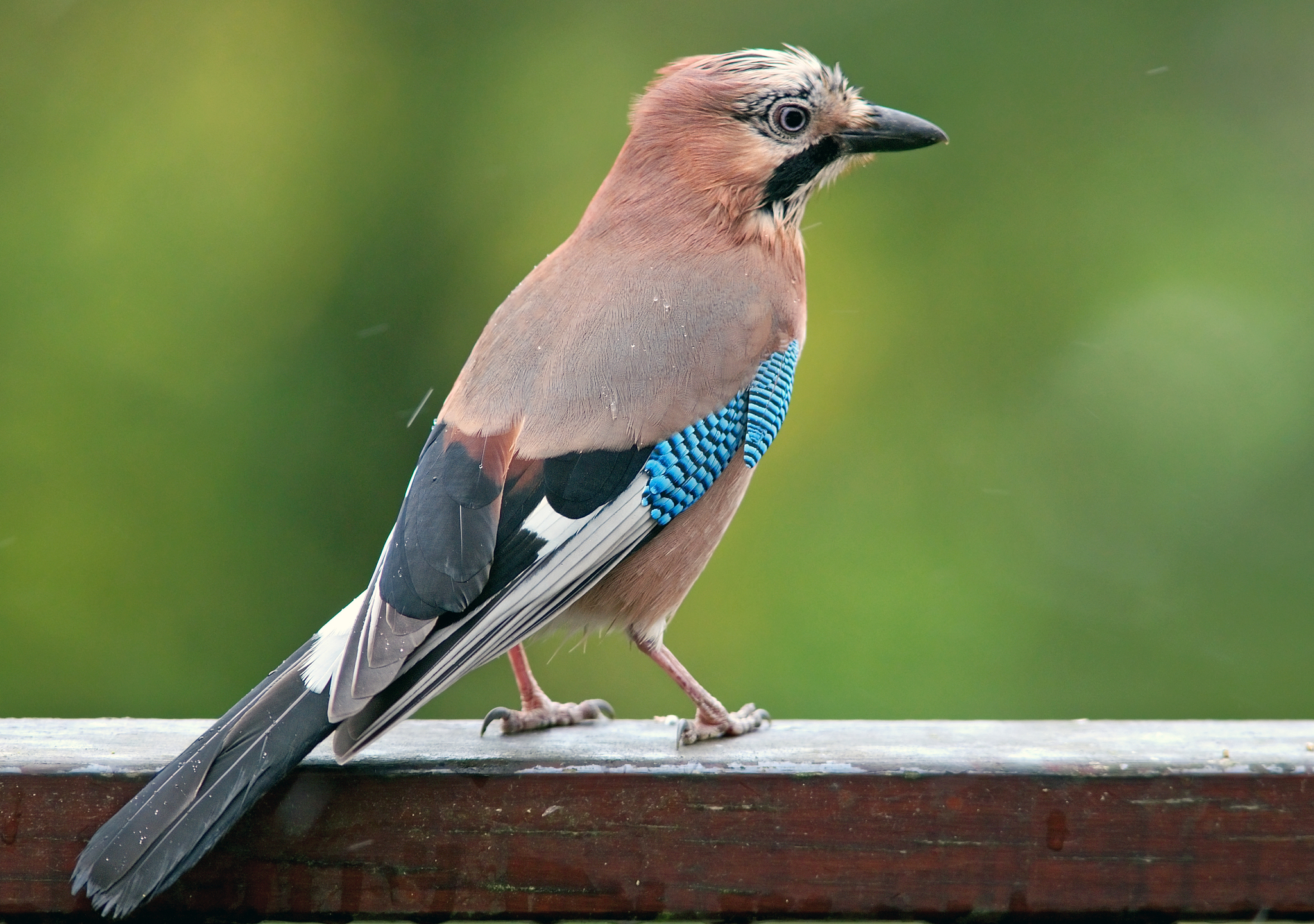
The Eurasian Jay, commonly known as Ghiandaia in Italian, is a colorful member of the crow family, renowned for its striking blue wing patches and its habit of burying acorns. It is a highly intelligent and adaptable bird, found across a vast range from Western Europe and Northwest Africa to the Indian subcontinent and Southeast Asia. Its distinctive calls and secretive nature often make it more heard than seen, despite its vibrant plumage.
Dimensioni e longevità
- Lunghezza
- 32-37 cm
- Apertura alare
- 52-58 cm
- Peso
- 150-190 g
- Longevità
- Up to 16 years in the wild, typically 5-8 years
- Dieta
- Omnivore
Caratteristiche fisiche
- Piumaggio
- The body plumage is predominantly pinkish-brown to reddish-brown. The crown is streaked black and white, often appearing greyish. The most distinctive feature is the bright blue, black-barred patch on the wing coverts. The primary flight feathers are black, and the secondary flight feathers are black with a white patch. The rump is white, contrasting sharply with the black tail. A prominent black moustachial stripe extends from the base of the beak.
- Forma del becco
- Strong, conical, and pointed beak, typically dark grey to black.
- Colore degli occhi
- Pale blue to whitish iris, contrasting with the dark pupil.
- Colore delle zampe
- Dark grey to black.
- Caratteristiche distintive
- Bright blue, black-barred wing patches; white rump; black moustachial stripe; streaked crown.
- Aspetto giovanile
- Juveniles resemble adults but have a duller plumage, less distinct streaking on the crown, and often a slightly browner iris. The blue wing patch may be less vibrant.
- Cambiamenti stagionali
- No significant seasonal plumage changes. Plumage may appear slightly duller when worn before molting.
- Dimorfismo sessuale
- None. Males and females are identical in plumage and size.
Come identificare
- 1
Plumage Coloration
Look for the overall pinkish-brown body, contrasting with the bright blue, black-barred wing patches. The white rump and black tail are also key.
- 2
Head Markings
Note the streaked black and white crown and the distinct black moustachial stripe.
- 3
Vocalizations
Listen for its characteristic harsh 'skaaak' call. This is often the first indication of its presence, even if hidden in foliage.
- 4
Behavior
Observe its flight pattern – often heavy and undulating. Look for it foraging on the ground under oak trees, especially in autumn, or caching acorns.
Habitat e areale
- Biomi
- Temperate forests, mixed woodlands, coniferous forests, deciduous forests, parks, large gardens, orchards.
- Areale geografico
- Widespread across Europe, Northwest Africa, and Asia, extending eastwards to Japan and Southeast Asia. In Europe, it is found from the British Isles and Scandinavia south to the Mediterranean basin.
- Fascia altitudinale
- Sea level up to 2,000 meters, occasionally higher in mountainous regions.
- Ambienti preferiti
- Prefers mature woodlands with a good supply of oak trees due to its reliance on acorns. Also thrives in suburban parks and gardens where suitable trees and food sources are available.
Comportamento
- Periodo di attività
- Diurnal.
- Abitudini alimentari
- Highly opportunistic omnivore. Diet primarily consists of acorns, beechmast, and other nuts and seeds, especially in autumn and winter. Also consumes insects (beetles, caterpillars), small mammals (mice, voles), eggs and nestlings of other birds, amphibians, reptiles, and fruits. Known for caching thousands of acorns and other seeds for later consumption, playing a crucial role in forest regeneration.
- Comportamento sociale
- Typically seen singly or in pairs during the breeding season. Outside of breeding, they may form small family groups or loose flocks, especially when foraging for acorns. Can be quite secretive and shy, but also bold when visiting bird feeders.
- Tipo di volo
- Undulating and rather heavy flight, often appearing somewhat clumsy. When disturbed, it flies with rapid wing beats, often just above the canopy, before diving into cover. Can be surprisingly agile when navigating dense woodland.
- Migrazione
- Mostly resident throughout its range, but northern and eastern populations may undertake irruptive movements or short-distance migrations in years of poor acorn crops. Juveniles may disperse more widely.
- Territorialità
- Territorial during the breeding season, defending nesting sites and foraging areas. Outside of breeding, territoriality is less pronounced.
Canto e richiami
- Canto
- The Eurasian Jay does not have a true song. Its vocalizations are primarily a series of harsh calls.
- Richiamo
- Most characteristic call is a loud, harsh, grating 'skaaak-skaaak' or 'kraaak-kraaak', often repeated. Also produces a variety of other calls, including a softer, more melodious 'kwee-kwee' or 'kew' call, and a distinctive 'rattle' call. Jays are excellent mimics and can imitate the calls of other birds (e.g., buzzards, owls) and even human sounds.
- Quando vocalizza
- Vocalizes throughout the year, but calls are particularly frequent during the breeding season and when disturbed or alarmed.
Riproduzione
- Stagione riproduttiva
- April to June, with peak activity in May.
- Abitudini di nidificazione
- Nests are typically built in trees or large shrubs, often close to the trunk or in a fork, usually 2-10 meters above the ground. The nest is a bulky, cup-shaped structure made of twigs, roots, moss, and lined with finer materials like hair, feathers, and grass.
- Dimensione della covata
- 4-6 eggs, rarely 3 or 7.
- Descrizione dell'uovo
- Typically 4-6 eggs, pale greenish-blue or buffish with fine brown speckles, sometimes forming a cap at the broader end. Average size is about 31 x 23 mm.
- Periodo di incubazione
- 16-19 days, primarily by the female.
- Periodo di involo
- 19-23 days after hatching. Young leave the nest but are still fed by parents for several weeks.
- Cure parentali
- Both parents participate in feeding the young. The female primarily incubates, while the male brings food to her and later to the chicks. Both parents defend the nest vigorously.
Dove trovarlo
Oak Woodlands
The best places to find Eurasian Jays are in mature oak forests, especially during autumn when they are actively collecting and burying acorns.
Mixed Forests
They are also common in mixed deciduous and coniferous woodlands, particularly those with an understory of shrubs.
Parks and Gardens
In suburban and rural areas, large parks, gardens, and orchards with mature trees can host Eurasian Jays, especially if there are oak or beech trees nearby.
Consigli sul campo
- Listen for calls. Eurasian Jays are often heard before they are seen. Their loud, harsh 'skaaak' call is unmistakable and can alert you to their presence, even if they are hidden in dense foliage.
- Look for movement. Despite their bright colors, they can be surprisingly secretive. Scan tree canopies and undergrowth for movement, especially near oak trees.
- Observe caching behavior. In autumn, watch for jays carrying acorns in their beaks and burying them in the ground or under leaf litter. This behavior is a strong indicator of their presence.
- Visit early morning or late afternoon. Like many birds, jays are often most active during the cooler parts of the day, making these times ideal for observation.
Specie simili
Siberian Jay
Perisoreus infaustus
The Siberian Jay is smaller, lacks the prominent blue wing patches, and has a more uniform grey-brown plumage with rufous patches on the wings and tail. Its range is restricted to northern Eurasia.
Azure-winged Magpie
Cyanopica cyanus
While also having blue wings, the Azure-winged Magpie has a much longer tail, a black cap, and a greyish body. Its distribution is more restricted to parts of Iberia and East Asia, not overlapping significantly with the Eurasian Jay across most of its range.
Fatti rapidi
- Primary Food Source:
- Acorns
- Key Identification Mark:
- Blue wing patch
- Ecological Role:
- Forest regenerator (seed dispersal)
- Vocalization:
- Harsh 'skaaak' call, mimicry
- Social Structure:
- Pairs or small family groups
Curiosità
- A single Eurasian Jay can cache thousands of acorns in a season, remembering the location of many of them. This behavior is vital for the spread and regeneration of oak forests.
- They are known for their remarkable ability to mimic the calls of other birds, including raptors, which they may use to scare away rivals from food sources.
- The scientific name 'Garrulus' means 'chattering' or 'noisy', referring to its characteristic loud calls, while 'glandarius' refers to 'acorn', highlighting its strong association with oak trees.
- Eurasian Jays have been observed using tools, such as small sticks, to extract insects from crevices.
Classificazione scientifica
- Regno
- Animalia
- Phylum
- Chordata
- Classe
- Aves
- Ordine
- Passeriformes
- Famiglia
- Corvidae
- Genere
- Garrulus
- Specie
- Garrulus glandarius
Esplora Eurasian Jay
Identifica uccelli ovunque
Gratis su iOS, Android e Web. Identificazione per foto e suono, database completo e la tua lista personale.